




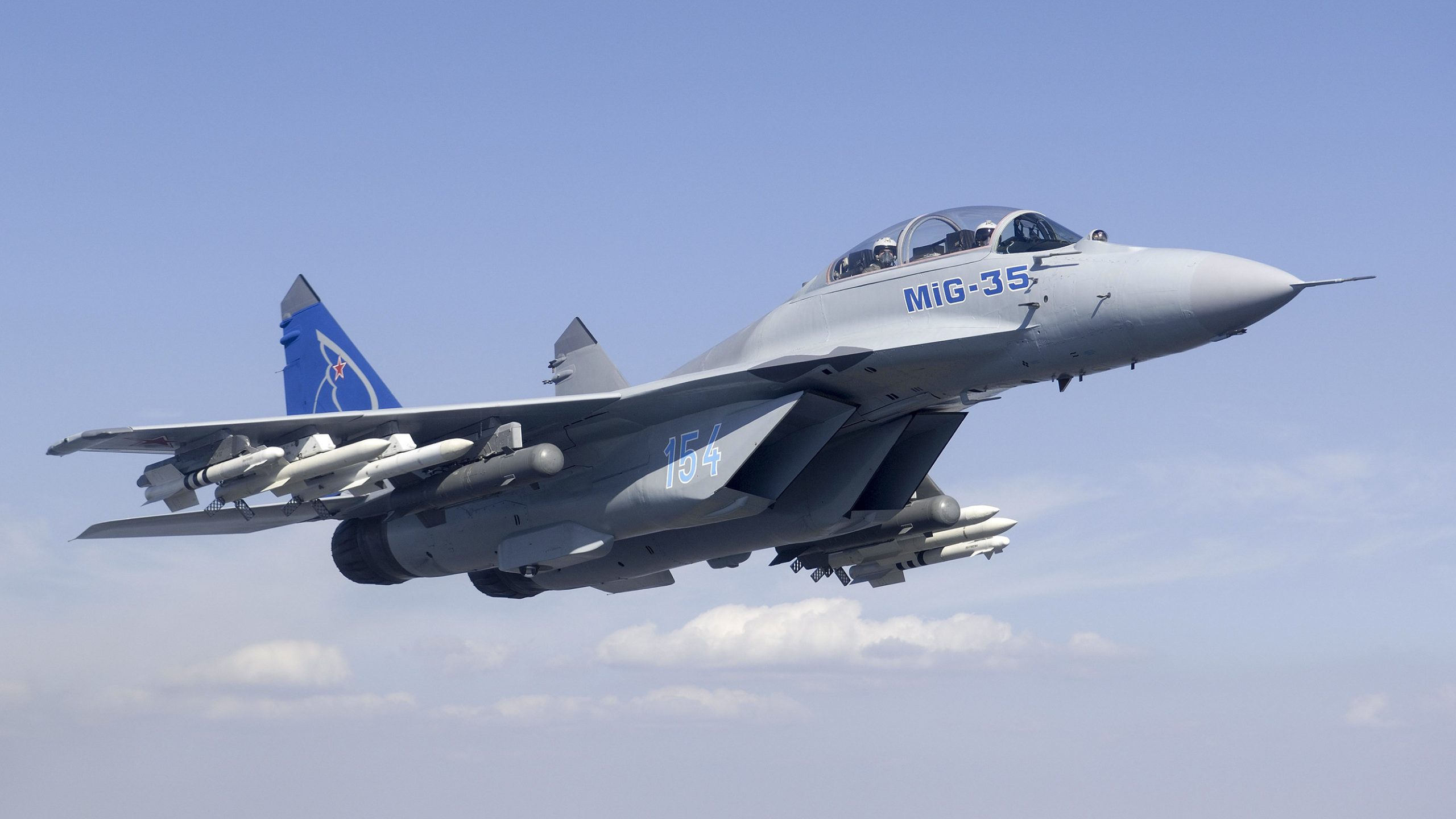
Russia’s MiG-35 fighter jet represents a shift from the allure of fifth-generation stealth fighters towards a more practical and versatile multirole platform. Evolving from the MiG-29 lineage, this aircraft captures decades of Soviet and Russian design experience, aiming to fulfill the demands of modern air combat while remaining cost-effective.
At its core, the MiG-35 is a 4++ generation fighter designed for air superiority, reconnaissance, and strike missions. Officially unveiled in 2007 and entering limited service in the late 2010s, it showcases an updated airframe tailored for high-threat environments, prioritizing survivability and flexibility. Powered by two Klimov RD-33MK turbofan engines, the MiG-35 can reach speeds of Mach 2.25 and boasts a combat range of 1,000 kilometers without refueling and up to 3,100 kilometers with external fuel tanks.
The MiG-35’s advanced sensor suite includes the Zhuk-AE radar, which can track up to 30 airborne targets simultaneously within a 160-kilometer range and engage six at once. Complementing this is a sophisticated optical targeting system that improves the aircraft’s capability to engage threats day and night. This configuration allows the MiG-35 to switch between air-to-air and air-to-ground missions seamlessly, enhancing its operational versatility.
Design features include thrust-vectoring nozzles that enhance maneuverability, ensuring high agility in close-range combat scenarios. The MiG-35’s operational efficiency is further supported by a robust avionics suite, enabling improved situational awareness and faster engagement decisions on the battlefield.
Despite its capabilities, the MiG-35 has limitations. It lacks the low-observability features characteristic of stealth fighters, which may hinder its performance in highly contested environments congested with radar systems. Moreover, its production scale has been constrained, limiting the operational footprint and integration potential across Russia’s broader air force. The market for international sales remains modest amid geopolitical pressures, affecting its global reach.
Competing primarily with platforms such as the F-16 Fighting Falcon and China’s JF-17, the MiG-35 offers a blend of advanced sensor capabilities and multirole versatility. However, it does not match the stealth features or networked performance offered by more advanced fifth-generation fighters.
Looking ahead, the future of the MiG-35 is uncertain, yet it remains relevant. Air forces are increasingly balancing costs against capabilities, suggesting a continued demand for sophisticated, non-stealth aircraft. The MiG-35 may serve as a transitional platform, highlighting the reality that not every air force requires the most advanced fighter; rather, the focus should be on fighters that are suitably adapted to their unique operational needs.


