




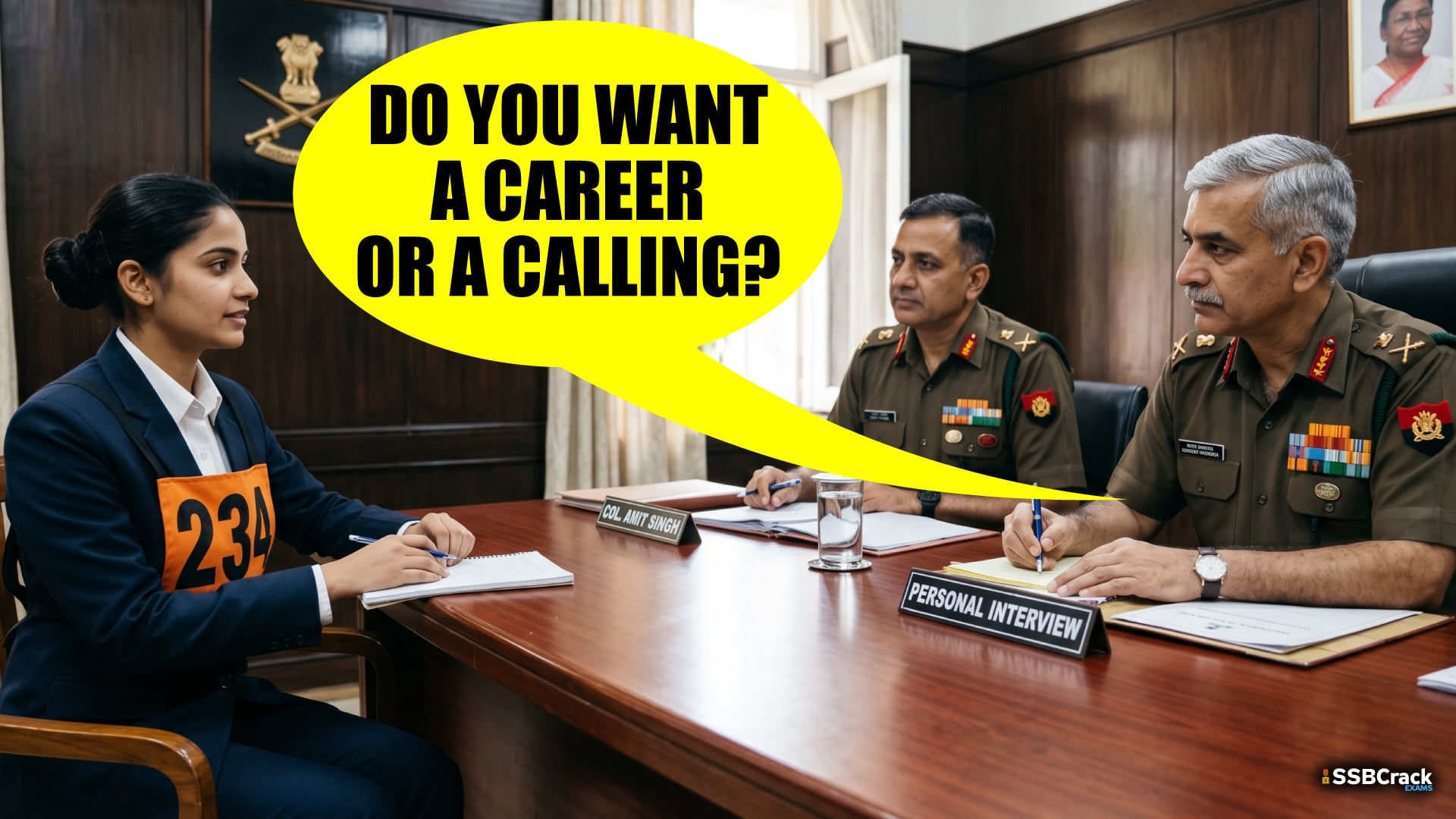
The Short Service Commission Technical Entry, popularly known as SSC Tech, is one of the most sought-after officer entries for engineering graduates in the Indian Army. It provides a unique opportunity to combine technical expertise with military leadership and national service.
Many SSC Tech aspirants believe that because it is a technical entry, the SSB Interview will focus primarily on engineering subjects. While technical awareness is important, the SSB is fundamentally a personality assessment. The assessors are looking for future Army officers who possess leadership potential, responsibility, social adaptability, initiative, emotional stability, and Officer Like Qualities.
In this article, we will discuss 20 important interview questions frequently asked to SSC Tech candidates, understand why they are asked, learn how to answer them effectively, and review sample responses that reflect the qualities expected in future technical officers of the Indian Army.
1. Tell me about yourself.
Why it is asked
To assess communication skills, confidence, self-awareness, and personality.
How to answer
Include:
- Family background
- Engineering education
- Achievements
- Hobbies
- Responsibilities
Sample Answer
“I am an Electronics Engineering graduate from XYZ University. Along with academics, I have participated in technical projects, sports activities, and event management. These experiences helped me develop teamwork, leadership, and organizational skills.”
2. Why do you want to join the Army through SSC Tech?
Why it is asked
To assess motivation and career clarity.
How to answer
Focus on service, leadership, and technical opportunities.
Sample Answer
“SSC Tech allows me to apply my engineering knowledge while serving the nation as an Army officer. The opportunity to lead people, solve technical challenges, and contribute to national security motivates me strongly.”
3. Why Army and not a corporate engineering career?
Why it is asked
To assess commitment and career preference.
How to answer
Respect both careers while explaining your choice.
Sample Answer
“Corporate careers offer technical growth, but the Army offers something more comprehensive—leadership responsibility, service to the nation, teamwork, and the opportunity to operate in challenging environments.”
4. What do you know about SSC Tech Entry?
Why it is asked
To assess preparation and seriousness.
How to answer
Know the basic structure of the entry.
Sample Answer
“SSC Tech is a Short Service Commission entry for engineering graduates. Selected candidates undergo military training before being commissioned as officers in various technical arms and services of the Indian Army.”
5. Why should we select you?
Why it is asked
To assess self-confidence and suitability.
How to answer
Connect your qualities with officer requirements.
Sample Answer
“I possess technical competence, adaptability, responsibility, teamwork, and a willingness to learn. I enjoy taking initiative and performing effectively under challenging circumstances.”
6. What are your strengths?
Why it is asked
To assess self-awareness.
How to answer
Support strengths with examples.
Sample Answer
“My strengths are analytical thinking, discipline, and teamwork. Engineering projects and academic activities have helped me develop these qualities consistently.”
7. What are your weaknesses?
Why it is asked
To assess honesty and improvement orientation.
How to answer
Mention a manageable weakness.
Sample Answer
“I sometimes spend additional time evaluating alternatives before making decisions. I am actively working on improving decision-making speed while maintaining accuracy.”
8. Tell me about your engineering project.
Why it is asked
To assess technical understanding and involvement.
How to answer
Explain:
- Objective
- Role
- Challenges
- Outcome
Sample Answer
“My final-year project focused on designing an automated monitoring system. I was responsible for system integration and testing. The project improved my technical skills and teamwork abilities.”
9. Which engineering subject do you enjoy most?
Why it is asked
To assess technical interest.
How to answer
Explain practical relevance.
Sample Answer
“I enjoy Digital Electronics because it forms the foundation of modern computing and communication systems, making it highly relevant in today’s technological environment.”
10. Which engineering subject do you find difficult?
Why it is asked
To assess honesty and learning attitude.
How to answer
Show improvement efforts.
Sample Answer
“Initially, I found Control Systems challenging because of its mathematical concepts. Through consistent practice and practical applications, I improved my understanding significantly.”
11. Describe a leadership experience.
Why it is asked
To assess leadership potential.
How to answer
Use a real-life example.
Sample Answer
“During a technical competition, I led a team of five members. I coordinated tasks, resolved conflicts, and ensured timely completion of our project, which earned appreciation from the judges.”
12. What responsibilities do you have at home?
Why it is asked
To assess maturity and responsibility.
How to answer
Mention genuine responsibilities.
Sample Answer
“I assist with family decision-making, documentation work, financial planning discussions, and household responsibilities whenever required.”
13. What are your hobbies?
Why it is asked
To assess personality beyond academics.
How to answer
Mention genuine hobbies.
Sample Answer
“I enjoy fitness training, badminton, reading defence-related articles, and following technological developments.”
14. What is your biggest achievement?
Why it is asked
To assess effort, commitment, and goal orientation.
How to answer
Choose a meaningful achievement.
Sample Answer
“My biggest achievement was successfully leading a college technical project that solved a practical problem and received recognition at a university-level competition.”
15. Tell me about a failure and what you learned.
Why it is asked
To assess resilience and learning ability.
How to answer
Focus on lessons learned.
Sample Answer
“I once underestimated the preparation required for a technical competition and failed to perform as expected. The experience taught me the importance of preparation and contingency planning.”
16. What qualities should an Army officer possess?
Why it is asked
To assess understanding of military leadership.
How to answer
Mention practical OLQs.
Sample Answer
“An Army officer should possess integrity, courage, responsibility, initiative, teamwork, emotional stability, effective intelligence, and the ability to inspire confidence in others.”
17. How do you handle pressure and deadlines?
Why it is asked
To assess emotional stability.
How to answer
Mention practical strategies.
Sample Answer
“I prioritize tasks, create action plans, focus on critical objectives first, and maintain a calm and organized approach under pressure.”
18. What would you do if your team disagreed with your decision?
Why it is asked
To assess teamwork and flexibility.
How to answer
Show openness and objectivity.
Sample Answer
“I would listen carefully to their opinions, evaluate all alternatives objectively, and support the decision that best serves the team’s objective.”
19. If not selected this time, what will you do?
Why it is asked
To assess resilience and determination.
How to answer
Remain positive and practical.
Sample Answer
“I will continue developing professionally, improve my shortcomings, and prepare for future opportunities because my aspiration to serve in the Armed Forces remains strong.”
20. What does becoming an Army officer mean to you?
Why it is asked
To assess understanding of military responsibility.
How to answer
Focus on leadership and service.
Sample Answer
“Becoming an Army officer means accepting responsibility for people and missions, leading by example, making decisions under pressure, and serving the nation with integrity and dedication.”
Technical Questions Commonly Asked to SSC Tech Candidates
Depending on your branch, interviewers may ask:
Computer Science
- What is Object-Oriented Programming?
- What is Cloud Computing?
- Difference between Compiler and Interpreter?
Electronics
- What is a Microcontroller?
- Difference between Analog and Digital Signals?
- What is Modulation?
Mechanical Engineering
- Explain Thermodynamics.
- What is Heat Transfer?
- Difference between Turbine and Pump?
Electrical Engineering
- What is Power Factor?
- Explain Transformer Working.
- Difference between AC and DC.
Civil Engineering
- Types of Foundations.
- What is Reinforced Concrete?
- Purpose of Soil Testing.
Tip
The interviewer generally assesses conceptual understanding, confidence, and communication ability rather than expecting textbook-perfect definitions.
What Assessors Look for in SSC Tech Candidates
Officer Like Qualities (OLQs)
- Effective Intelligence
- Initiative
- Responsibility
- Self-Confidence
- Organizing Ability
- Cooperation
- Social Adaptability
- Determination
- Courage
- Emotional Stability
Technical Competence
Sound understanding of engineering fundamentals.
Leadership Potential
Ability to guide, motivate, and coordinate teams.
Communication Skills
Ability to explain technical concepts clearly.
Learning Ability
Willingness to acquire new knowledge and skills.
Common Mistakes SSC Tech Candidates Make
- Focusing only on technical preparation.
- Ignoring personality development.
- Giving memorized responses.
- Exaggerating project contributions.
- Becoming defensive when unable to answer technical questions.
- Claiming leadership without evidence.
- Treating the SSB interview like a corporate placement interview.
Interview Answer Formula
For experience-based questions:
Situation → Action → Result → Learning
Example:
“Our project faced delays due to technical issues. I coordinated with team members, revised the work schedule, and ensured timely completion. The project succeeded, and I learned the importance of planning and adaptability.”
Final Advice for SSC Tech Aspirants
Remember that SSC Tech is a technical entry, but the Indian Army is selecting future officers first and engineers second. Technical knowledge may help you qualify, but your recommendation depends largely on your leadership potential, responsibility, teamwork, emotional stability, communication skills, and Officer Like Qualities.
Work on developing both your technical competence and your personality.
Closing Lines
The Army needs technical officers who can not only understand machines, systems, and technology but also lead people, make decisions under pressure, and inspire confidence in those they command.
The most successful SSC Tech candidates are those who combine engineering knowledge with leadership, responsibility, integrity, and a genuine commitment to serving the nation. Focus on building these qualities in your daily life, and they will naturally reflect during the SSB assessment process.


