




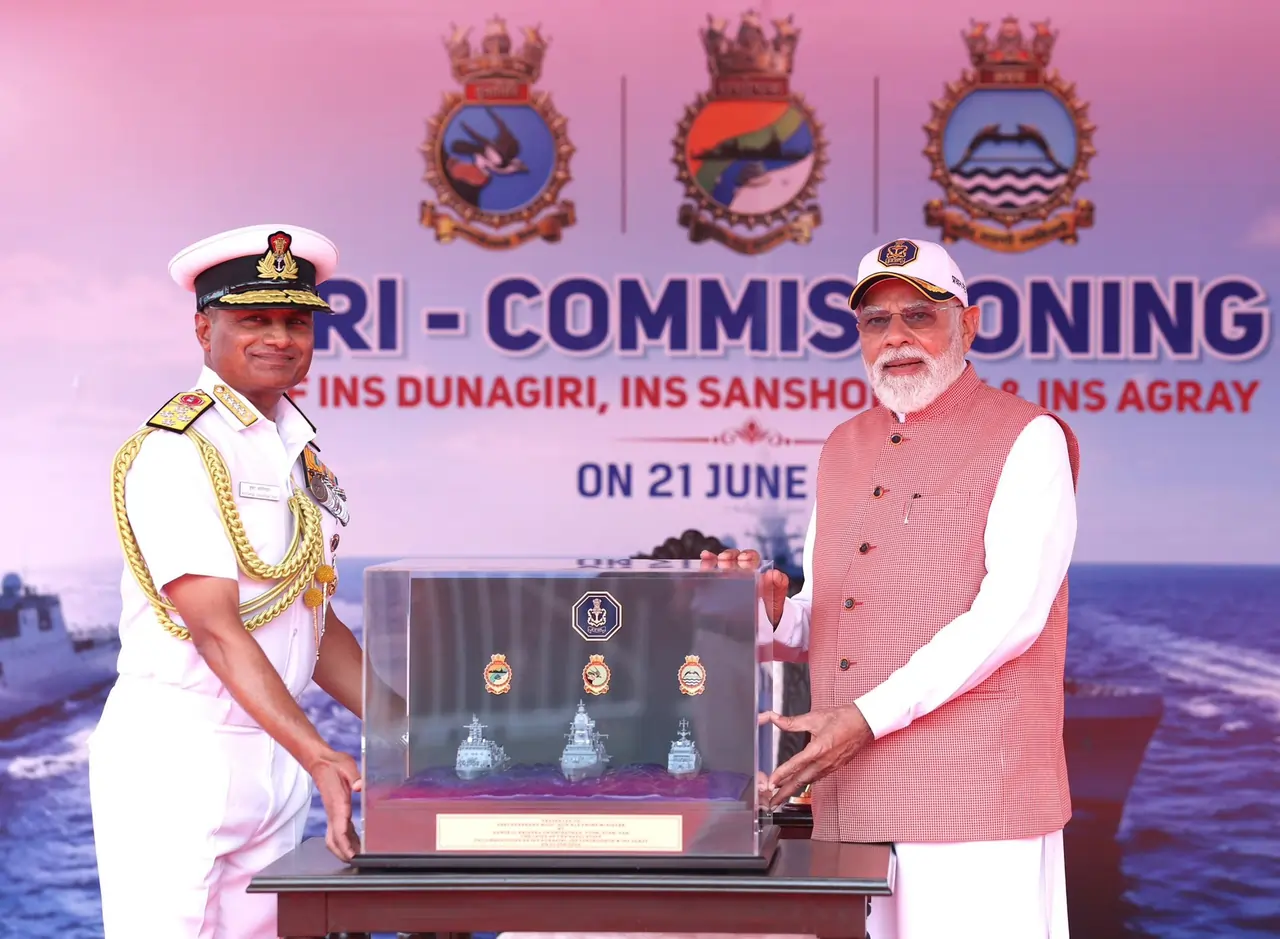
Prime Minister Narendra Modi recently inaugurated three advanced naval platforms—INS Dunagiri, INS Sanshodhak, and INS Agray—into the Indian Navy during a ceremony held in Kolkata. This significant event represents a major leap in India’s ongoing maritime modernization efforts and its commitment to indigenous defense manufacturing.
The newly commissioned vessels include an advanced stealth frigate, a sophisticated survey vessel, and a shallow water craft designed for anti-submarine warfare. Together, these additions are expected to greatly enhance the Navy’s operational capabilities, bolster maritime domain awareness, and improve the nation’s ability to confront emerging security challenges in the Indian Ocean Region.
During the ceremony, the Prime Minister emphasized the importance of maritime strength, linking it directly to a nation’s economic and strategic prosperity. He remarked, "The country whose maritime strength is robust, its economic and strategic influence will be equally robust. India is preparing itself for this reality," underscoring the strategic significance of these naval advancements.
Modi also highlighted India’s growing self-reliance in defense manufacturing, pointing to the journey from the commissioning of INS Vikrant to the addition of the new vessels as a reflection of the country’s capabilities in indigenous design and innovation. He noted that all three naval platforms were designed and built in India, showcasing the skills of local engineers, scientists, shipbuilders, and industry partners. Additionally, over 200 Micro, Small, and Medium Enterprises (MSMEs) contributed to the construction, generating employment and reinforcing the domestic defense ecosystem.
The Prime Minister outlined the government’s strong focus on shipbuilding, maintenance, and repair capabilities as part of a broader national initiative. He discussed recent policy measures and investments aimed at positioning India as a leading maritime and shipbuilding hub.
Following the Prime Minister, Raksha Mantri Rajnath Singh characterized the tri-commissioning of these vessels as a pivotal moment in the enhancement of India’s maritime capabilities. He stated that these platforms signify India’s robust defense manufacturing ecosystem and its unwavering commitment to self-reliance.
INS Dunagiri, the fifth Nilgiri-class stealth frigate under Project 17A, stands as a prime example of this commitment. Built by Garden Reach Shipbuilders & Engineers, INS Dunagiri is outfitted with cutting-edge surface-to-surface missiles, modern air defense systems, and anti-submarine warfare technologies, notably advancing the Navy’s blue-water combat effectiveness. Its capacity to operate various helicopter types further enhances its operational flexibility.
INS Sanshodhak, the fourth vessel in the Survey Vessel (Large) class, is equipped with advanced hydrographic and oceanographic systems intended to facilitate comprehensive hydrographic surveys and coastal mapping. The vessel is designed to support India’s Maritime Vision 2030 and advance Blue Economy initiatives through accurate hydrographic data collection. Its dual-role capability also allows it to function as a hospital ship during humanitarian efforts.
INS Agray, the fifth Anti-Submarine Warfare Shallow Water Craft, significantly bolsters the Navy’s capacity to detect and neutralize underwater threats in coastal waters. The vessel features advanced sonar systems, torpedoes, and a modern combat management system, granting it superior maneuverability and rapid response capabilities in shallow-water environments.
Chief of Naval Staff Admiral Krishna Swaminathan described the tri-commissioning as yet another milestone in India’s naval shipbuilding journey and praised the rapid advancements in indigenous warship construction and technological innovation. The fact that these vessels boast over 75 percent indigenous content further cements India’s dedication to developing a modern, networked naval force primed to safeguard national interests and uphold stability in the Indo-Pacific region.
As these new platforms enter service, they are anticipated to play critical roles in maritime security, anti-submarine operations, hydrographic missions, and humanitarian assistance, further solidifying India’s standing as a formidable maritime power in the region.


