




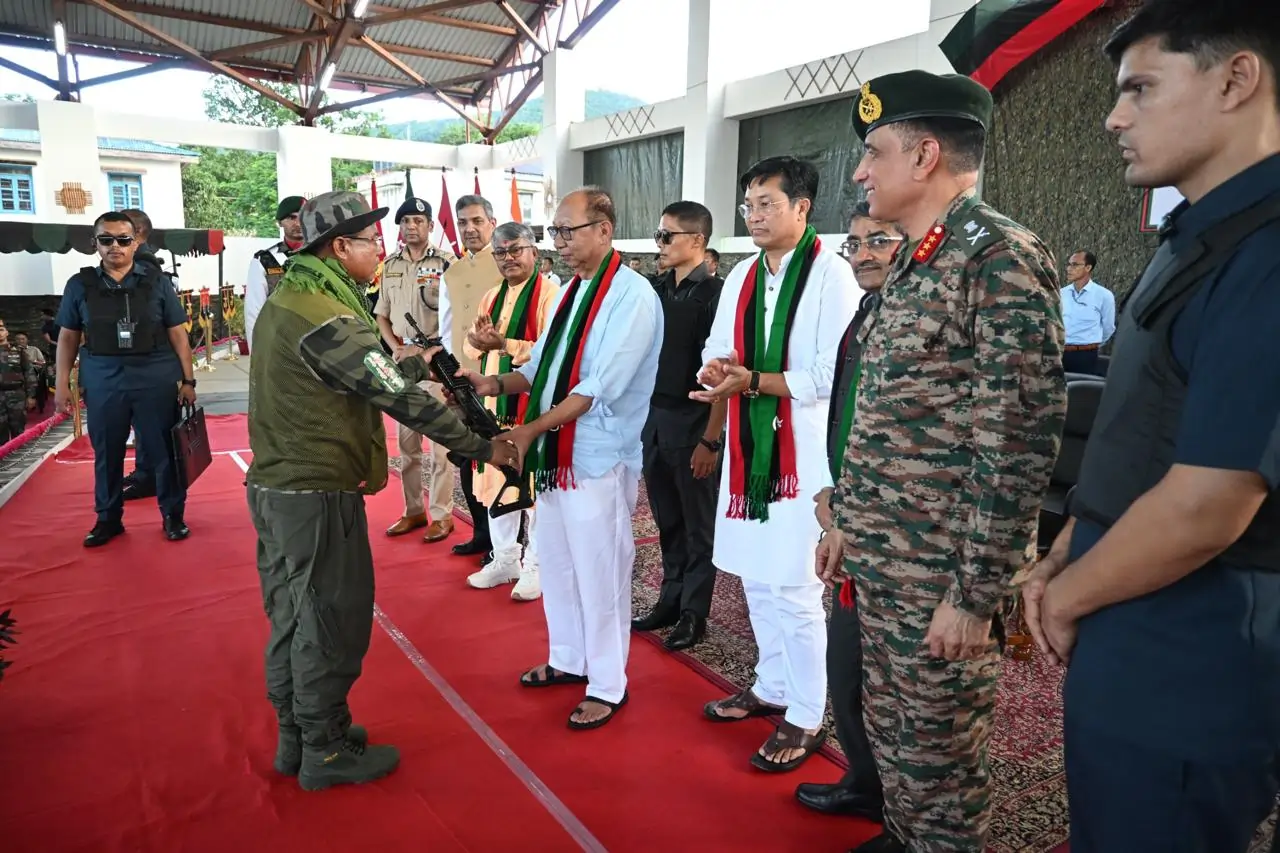
In a significant advancement for peace efforts in Manipur, 46 members of the banned Kangleipak Communist Party (KCP) voluntarily surrendered to the state’s Chief Minister, Shri Y. Khemchand Singh, at the Mantripukhri Garrison in Imphal East. This mass surrender is seen as a notable achievement in the ongoing initiative to encourage insurgents to abandon violence and reintegrate into civil society.
The event was attended by numerous high-ranking officials from civil, military, and police sectors, illustrating the collaborative approach taken by both the government and security forces. Among those present were the General Officer Commanding (GOC) of the Spear Corps, the Director General of Police (DGP) of Manipur, the Inspector General of Assam Rifles (South), the General Officer Commanding of the Red Shield Division, and the Deputy Inspector General (DIG) of the Central Reserve Police Force (CRPF).
Official reports indicate that this surrender was the result of extensive outreach efforts, confidence-building measures, and persistent engagement by the Indian Army and the Assam Rifles, which operate under the Spear Corps and Eastern Command. These efforts were conducted in close coordination with the Manipur Police and various Central Security Agencies, marking a comprehensive civil-security partnership aimed at restoring peace in the region.
Security officials noted that this initiative succeeded due to the open communication maintained by the Assam Rifles, which persisted despite numerous challenges. Through ongoing dialogue and confidence-building initiatives, the security forces were able to encourage the KCP cadres to renounce their militant activities and embrace a more peaceful future.
The surrendered militants have pledged to renounce violence and their affiliation with the KCP, opting to return to civilian life. Their choice is anticipated to facilitate their rehabilitation under existing government policies designed to support the reintegration of former insurgents into society.
This development is being celebrated as a crucial milestone in the larger effort to restore normalcy in Manipur, a region that has grappled with security issues stemming from decades of insurgency. Security officials believe that such voluntary surrenders not only dismantle militant organizations but also deliver a strong message to other disillusioned youth, encouraging them to pursue dialogue over armed conflict.
The Indian Army reaffirmed its commitment to peace initiatives in the area, stating that its formations, along with the Assam Rifles and local police, will persist in creating an environment favorable for reconciliation, stability, and sustainable development.
This surrender also serves to highlight the effectiveness of a strategy blending strong security operations with humanitarian outreach and rehabilitation programs. Rather than solely relying on military action, the security establishment has increasingly sought to engage militants in dialogue and build trust to encourage their return to the democratic mainstream.
As Manipur continues on its path toward lasting peace, the voluntary surrender of the 46 KCP cadres marks a pivotal step in reducing insurgent violence and enhancing public confidence in the ongoing peace process. The synergistic efforts of the Indian Army, Assam Rifles, state police, and civil administration are vital in promoting stability and fostering a secure and prosperous future for the people of Manipur.


