




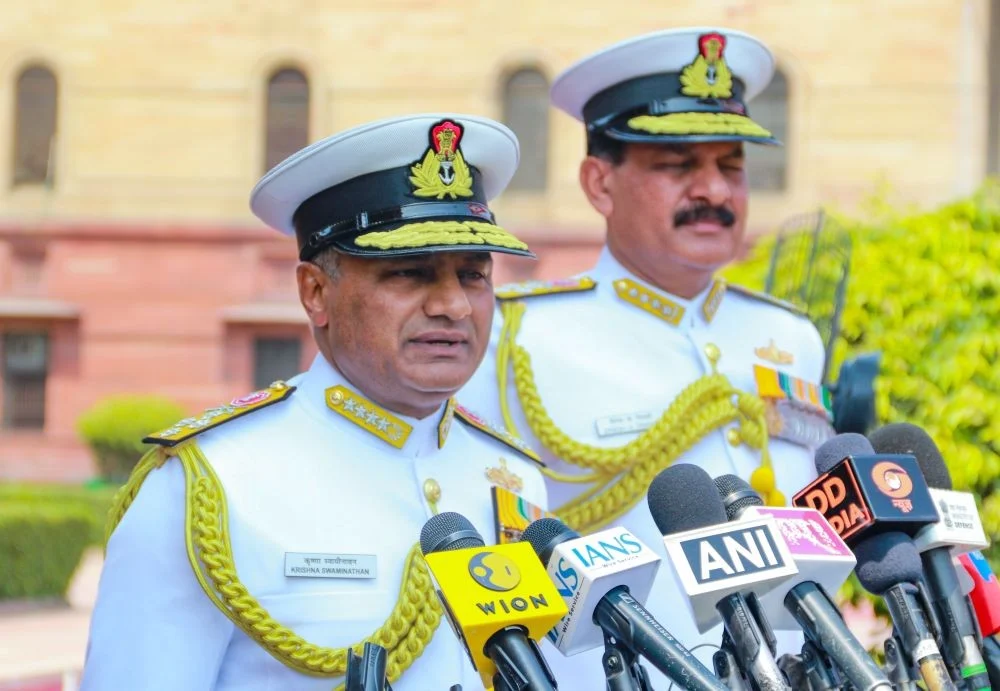
The Indian Navy is ramping up efforts to expand its fleet to over 200 vessels by 2035, responding to escalating maritime challenges in the Indian Ocean Region. This push is primarily focused on mitigating the increasing naval presence of China and addressing Pakistan’s acquisition of advanced submarines sourced from China. The ambitious expansion aligns with India’s broader goal of self-reliance under the Atmanirbhar Bharat initiative.
Chief of the Naval Staff Admiral has emphasized the Navy’s trajectory towards a 200-plus ship fleet by 2035, with a long-term vision for a fully self-reliant naval force by 2047. Currently, the Indian Navy operates around 140 to 150 ships, including approximately 135 frontline combatants like destroyers, frigates, corvettes, and submarines. There are nearly 50 warships and submarines under construction across Indian shipyards, alongside approved projects that encompass about 65 surface vessels and additional submarines, collectively worth over ₹2.35 lakh crore.
Induction rates have markedly increased, with an indigenous warship or submarine being added every 40 days on average. In 2025, the Navy commissioned around 12 warships and one submarine, with plans to add 15 to 19 additional vessels in 2026. Recent milestones bolster this momentum; for instance, in July 2026, the Navy unveiled two major platforms in quick succession.
INS Mahendragiri, the sixth Nilgiri-class stealth frigate, was commissioned at Visakhapatnam. This vessel, constructed by Mazagon Dock Shipbuilders Limited, boasts over 75% indigenous content and was designed by the Navy’s Warship Design Bureau. At Karwar, the Navy also commissioned INS Malvan, the second Mahe-class Anti-Submarine Warfare Shallow Water Craft, built by Cochin Shipyard Limited with over 80% indigenous content. This 78-meter, 1,100-tonne vessel is designed for coastal anti-submarine operations, mine-laying, and other low-intensity maritime tasks.
Moreover, the seventh and final Project 17A frigate, INS Vindhyagiri, is anticipated, with plans already underway for a follow-on batch under Project 17B.
The strategic backdrop of this expansion includes the growing naval presence of China, whose People’s Liberation Army Navy currently holds over 370 ships and submarines. China’s expansion in the Indian Ocean has been marked by port access agreements and an increased number of research vessels and submarine deployments. Concurrently, Pakistan is enhancing its underwater capabilities, having recently commissioned the first of eight Chinese-built Hangor-class attack submarines. This further bolsters Pakistan’s operational strength in the Arabian Sea and northern Indian Ocean.
In light of these developments, Indian Navy planners underscore the necessity of a larger, more modern fleet to maintain control of critical sea lines of communication, deter multi-front maritime threats, and secure strategic interests.
A significant aspect of this expansion is the commitment to complete self-reliance in shipbuilding. The Navy’s last major foreign-origin warship, INS Tamal, was delivered in July 2025, with future vessels expected to be constructed in Indian yards. This ideological shift extends to component levels, aiming to reduce reliance on imported materials such as specialized steel and advanced sensors.
Key projects include the Project 75(I) submarines featuring air-independent propulsion, new ASW shallow-water craft, next-generation frigates, and destroyers—all part of a concerted effort toward indigenous development.
The focus is not solely on quantity but also on enhancing qualitative capabilities. The Navy plans to incorporate stealth features, advanced anti-submarine warfare systems, long-range land-attack missiles, and improved network-centric operations. Additionally, the expansion of the aviation sector and undersea capabilities aims to establish a balanced three-dimensional force capable of sustained operations.
Officials assert that reaching the 200-ship goal by 2035 is not merely a numbers game against China; rather, it is about developing a technologically advanced, combat-ready, and strategically autonomous fleet capable of safeguarding India’s interests across the Indian Ocean and beyond. With its steady induction rate, robust domestic shipbuilding initiatives, and clear strategic objectives, the Indian Navy is well-positioned for a significant leap in capabilities over the next decade.


