




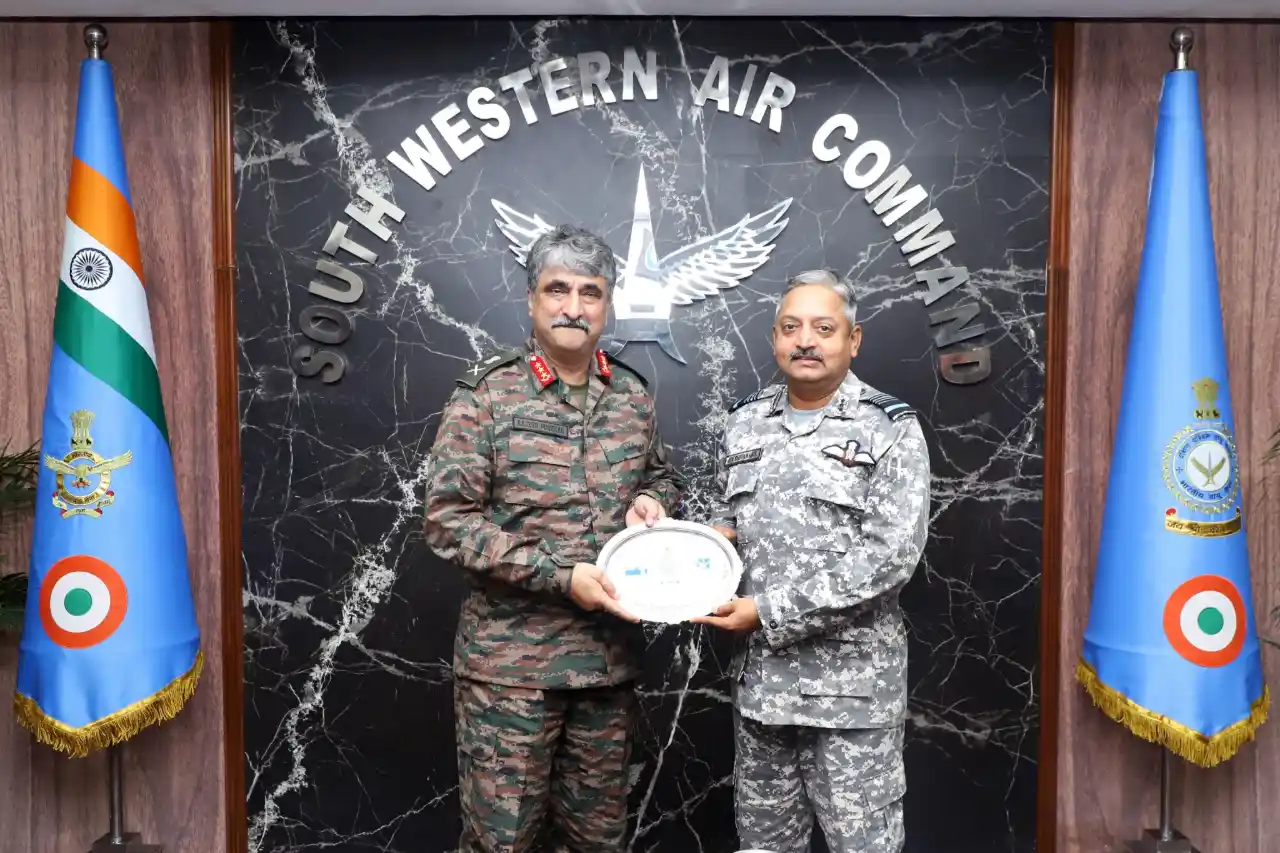
Lieutenant General Rajesh Pushkar, AVSM, VSM, the General Officer Commanding-in-Chief of the Indian Army’s Southern Command, embarked on a significant visit to the Headquarters of the South Western Air Command (SWAC). This initiative aimed to enhance inter-service coordination and engage with senior Indian Air Force leadership about critical operational issues. During the visit, General Pushkar engaged directly with Air Marshal PV Shivanand, AVSM, VM, the Air Officer Commanding-in-Chief of SWAC, along with other key officers stationed at the command headquarters.
The high-level dialogue highlighted the Indian Armed Forces’ ongoing efforts to strengthen jointness and promote integrated planning among the three services as part of the nation’s broader military transformation. The visit served as a platform for discussing a wide array of strategic operational issues that are increasingly relevant given the current security landscape.
The discussions centered on fortifying cooperation between the Indian Army and the Indian Air Force, ensuring seamless integration during joint military operations across diverse domains. This need for close coordination is underscored by the modern warfare paradigm, which intertwines land, air, cyber, space, and information domains. As such, effective collaboration among the Armed Forces is pivotal to achieving operational success.
General Pushkar and Air Marshal Shivanand examined existing cooperation mechanisms and assessed ways to bolster interoperability between formations under Southern Command and the South Western Air Command. They placed particular emphasis on joint operational planning, synchronized mission execution, and refining decision-making processes through integrated command structures.
The senior commanders further discussed initiatives aimed at enhancing operational synergy through consistent joint training, realistic military exercises, and coordinated operational planning. These cooperative efforts are designed to cultivate a shared understanding of operational concepts, thereby improving interoperability and overall readiness for a spectrum of operational contingencies.
In recent years, integrated planning has emerged as a fundamental component of India’s defense reforms, aligning with the government’s vision of enhancing theatre-level coordination and joint operational capabilities. The discussions between Army and Air Force leadership reflect these broader objectives to develop a more integrated and agile military that can respond effectively to evolving threats.
Additionally, the commanders acknowledged the importance of leveraging the complementary strengths of both services in future operations. The effective integration of air power with ground operations significantly improves battlefield awareness, precision engagement, mobility, logistics support, and mission efficacy.
Both General Pushkar and Air Marshal Shivanand reaffirmed their mutual commitment to advancing inter-service cooperation by encouraging regular professional exchanges, joint operational reviews, and collaborative planning methods. Such engagements are deemed essential for ensuring military formations remain well-prepared for coordinated operations across various conflict spectrums.
The visit also underscored the increasing institutional collaboration between the operational commands of the Indian Army and the Indian Air Force. Through ongoing leadership-level dialogue, both services continue to refine their operational approaches and enhance their readiness to address emerging security challenges swiftly.
The enhanced scope of joint training and integrated planning underscores the Indian Armed Forces’ commitment to transform towards greater theatre-level synergy. The engagement between Southern Command and South Western Air Command plays a crucial role in reinforcing this vision by facilitating strategic dialogue and operational alignment.
In conclusion, Lieutenant General Rajesh Pushkar’s visit provided a vital opportunity to review ongoing initiatives focused on readiness, interoperability, and fostering a culture of jointmanship across the Armed Forces. The discussions culminated in a shared commitment to deepen inter-service synergy, bolster operational preparedness, and develop an integrated force capable of tackling the multifaceted security challenges that lie ahead. This interaction reaffirmed the Indian Armed Forces’ dedication to ensuring that both the Army and the Air Force are prepared to execute coordinated operations in defense of the nation’s strategic interests.


