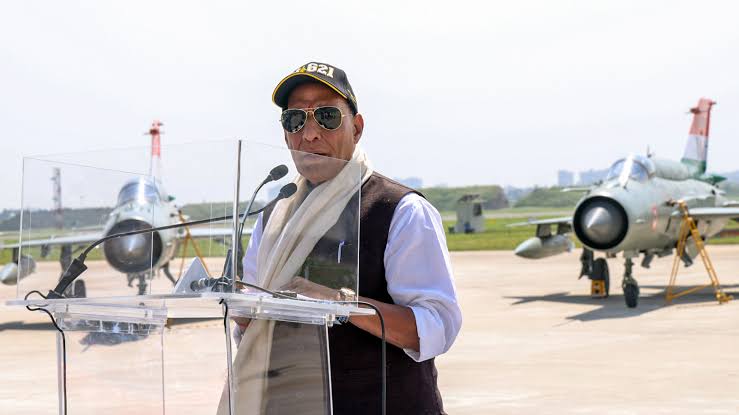
Defence Minister Rajnath Singh has announced that India aims to achieve defence production worth ₹3 lakh crore and defence exports worth ₹50,000 crore by 2029. The targets reflect the government’s commitment to strengthening domestic defence manufacturing, promoting self-reliance and reducing dependence on foreign suppliers.
Bharat Targets ₹3 Lakh Crore Defence Production and ₹50000 Crore Defence Exports By 2029
Consultative Committee Meeting in Jaisalmer
On 3 November 2026, Rajnath Singh chaired a meeting of the Consultative Committee of the Ministry of Defence in Jaisalmer, Rajasthan. The meeting focused on the modernisation of the Indian Armed Forces and the need to develop a technologically advanced, future-ready and operationally agile military.
The discussions covered emerging security challenges, changing patterns of warfare, technological developments and the induction of next-generation military platforms and weapon systems.
Growth in Defence Production and Exports
Highlighting India’s progress towards self-reliance in defence manufacturing, the Defence Minister stated that domestic defence production had increased significantly over the years.
- Defence production in 2014–15: ₹46,429 crore.
- Defence production in 2025–26: ₹1.78 lakh crore (record level).
- Defence exports in 2014: Less than ₹2,000 crore.
- Defence exports currently: Approximately ₹40,000 crore.
- Target by 2029: ₹3 lakh crore in defence production and ₹50,000 crore in defence exports.
The government is encouraging domestic industries, including Micro, Small and Medium Enterprises (MSMEs) and large corporations, to participate more actively in the defence manufacturing ecosystem.
Defence Budget and Military Modernisation
Rajnath Singh highlighted the increased allocation for defence in the Union Budget 2026–27.
- Total Defence Budget: ₹7.85 lakh crore.
- Capital Outlay: ₹2.19 lakh crore.
The capital allocation is intended to support military modernisation and capital procurement. The Defence Minister emphasised that adequate financial resources, their effective utilisation and prioritisation of the critical requirements of the three Services are essential for strengthening India’s military capabilities.
Focus on Technology and Tri-Service Integration
The meeting highlighted the importance of accelerating the induction of next-generation platforms, weapons and technologies. Strengthening coordination among the Army, Navy and Air Force, joint operational planning and the integrated use of military capabilities were identified as important priorities.
The discussions also underlined the growing importance of technology in modern warfare, including:
- Artificial Intelligence (AI)
- Autonomous systems and unmanned platforms
- Cyber and space capabilities
- Electronic warfare
- Advanced communication systems
The Defence Research and Development Organisation (DRDO) is also contributing through the development of advanced weapons, missiles and military systems.
Importance of Human Capital and New Army Formations
The Defence Minister stressed that military strength depends not only on advanced technology and financial resources but also on the skills, preparedness and capabilities of military personnel.
He highlighted the Indian Army’s new formations, including:
- Asani Platoons
- Bhairav Platoons
- Shaktiban Platoons
These formations were described as effective in meeting contemporary operational requirements and adapting to changing battlefield conditions.
Significance
India’s defence production and export targets are part of its broader effort to achieve strategic autonomy and strengthen indigenous technological capabilities. The government is following a whole-of-the-nation approach by encouraging greater participation from domestic industries and focusing on continuous military modernisation.
The ultimate objective is to develop armed forces capable of responding effectively to conventional, sub-conventional and multi-domain security challenges.