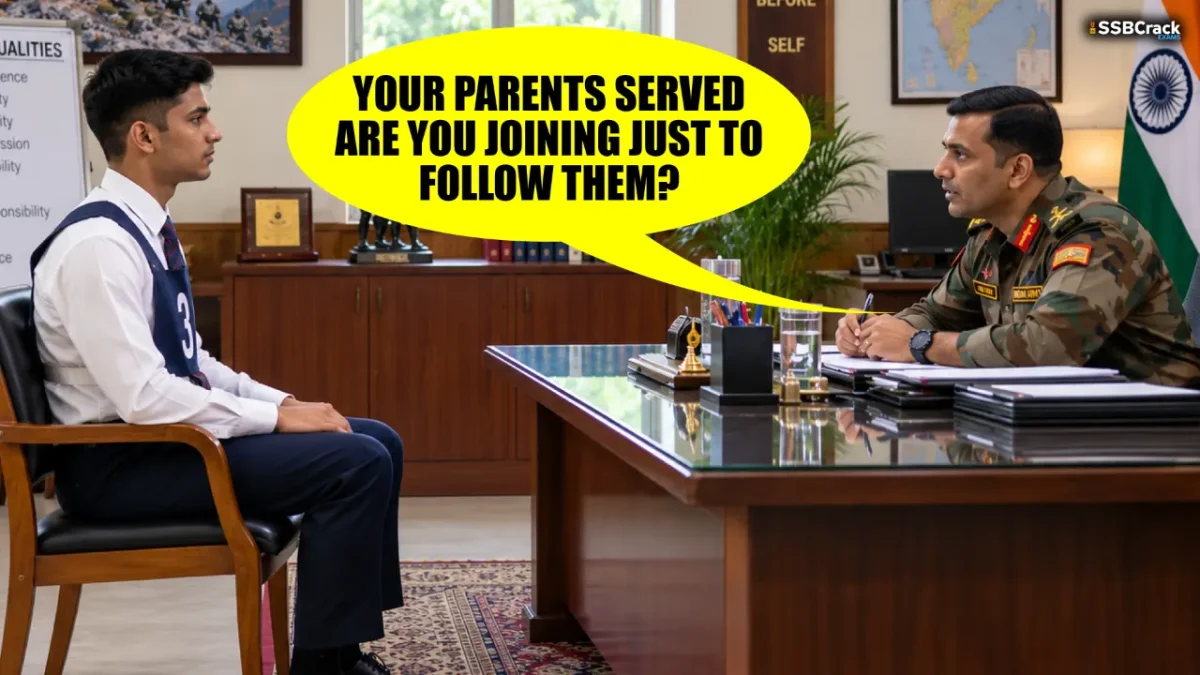
If you are preparing for the SSB Interview and you come from a defence family, then this video is especially for you.
If your parent, sibling or another close family member has served or is currently serving in the Armed Forces, you may already have some exposure to military life.
You may have seen postings, transfers, military stations, uniforms, discipline, social life, family responsibilities and the challenges that come with a defence career.
Because of this background, the Interviewing Officer may ask you some very specific questions.
The officer may want to know whether your decision to join the Armed Forces is genuinely your own or simply influenced by your family. You may also be asked about your parent’s service, the impact of postings on your family, what you have learned from military life, and whether you understand the realities of being an Armed Forces officer.
So, in today’s article, we will discuss 20 important SSB Interview questions for candidates from defence families, along with why each question is asked, how you should answer it, and a sample answer.
Remember, don’t memorise these sample answers. Use them only as references and prepare answers based on your own family experiences.
1. What does your parent or family member do in the Armed Forces?
Why is this question asked?
The officer wants to understand your family’s defence background and how familiar you are with the profession.
How should you answer?
Know the person’s service, rank, branch, appointment or broad responsibilities, posting history and other relevant details. Don’t give information you are not actually familiar with.
Sample Answer
“Sir/Ma’am, my father is serving in the Indian Army as a ________. His main responsibilities involve ________. He has served at ________ and has been posted to different locations during his career. I have had some opportunity to understand his professional life through our family experiences.”
2. What have you learned about military life from your family?
Why is this question asked?
The officer wants to know whether your defence background has given you a realistic understanding of military life.
How should you answer?
Mention actual observations rather than simply saying “discipline and patriotism.”
Sample Answer
“Sir/Ma’am, I have learned that military life involves much more than wearing a uniform or following discipline. I have seen how postings require families to adjust to new places and how service personnel have to remain responsible even when circumstances are difficult. I have also observed the importance of teamwork, punctuality and commitment to duty.”
3. Did your family influence your decision to join the Armed Forces?
Why is this question asked?
This is one of the most important questions for candidates from defence families. The officer wants to know whether your motivation is independent.
How should you answer?
Acknowledge the influence of your environment, but clearly explain your own reasons.
Sample Answer
“Yes, Sir/Ma’am, my family environment certainly gave me early exposure to the Armed Forces. It helped me understand the profession better. However, my decision to join is also based on my own interest in leadership, responsibility, teamwork and challenging situations. I have thought about the career independently and want to pursue it for my own reasons.”
4. If your parent had not been in the Armed Forces, would you still want to join?
Why is this question asked?
The officer is testing whether your career choice is genuinely yours.
How should you answer?
Don’t say that your parent had no influence at all if that is untrue. Explain what you personally find attractive about the profession.
Sample Answer
“Yes, Sir/Ma’am. My parent’s service introduced me to the profession, so it definitely influenced my awareness of it. However, I believe I would still be interested in the Armed Forces because I am personally attracted to the responsibilities, leadership opportunities, teamwork and challenges involved in the profession.”
5. What is the best thing about your parent’s military career?
Why is this question asked?
The officer wants to understand what aspects of military service you genuinely appreciate.
How should you answer?
Choose something you have actually observed rather than giving a stereotypical answer.
Sample Answer
“Sir/Ma’am, what I appreciate most is the sense of responsibility associated with the profession. I have seen that even when my parent is tired or facing difficult circumstances, professional responsibilities still have to be completed properly. That consistency has influenced the way I think about commitment.”
6. What is the most difficult aspect of military life for your family?
Why is this question asked?
The officer wants to know whether you understand the challenges of military life rather than only its positive aspects.
How should you answer?
You can discuss frequent transfers, separation, uncertainty, adjustment to new places or other genuine family experiences.
Sample Answer
“Sir/Ma’am, frequent transfers have probably been one of the more challenging aspects for our family. Every transfer requires adjusting to a new place, school or social environment. At the same time, it taught me and my family to adapt quickly and become comfortable with change.”
7. How many times have you changed schools because of your parent’s postings?
Why is this question asked?
This question can help the officer assess your adaptability and your experience of changing environments.
How should you answer?
Know the actual number and be prepared to discuss the changes.
Sample Answer
“Sir/Ma’am, I changed schools ________ times because of my parent’s postings. Each change required me to adjust to new teachers, classmates and routines. Initially, it was difficult to leave friends behind, but over time I became more comfortable meeting new people and adapting to unfamiliar environments.”
8. Which posting of your parent did you like the most and why?
Why is this question asked?
The officer wants to see whether you can recall experiences clearly and explain your preferences.
How should you answer?
Mention a genuine posting and explain what you liked about the location or experience.
Sample Answer
“Sir/Ma’am, I particularly liked our posting at ________. I enjoyed the environment there because ________. I also had good opportunities to participate in ________. The experience is memorable because I developed close friendships and explored a new environment.”
9. Which posting did you find most difficult?
Why is this question asked?
The officer may be assessing your adaptability and ability to deal with difficult environments.
How should you answer?
Don’t complain excessively. Explain the challenge and how you adapted.
Sample Answer
“Sir/Ma’am, I found our posting at ________ relatively difficult because I had to adjust to ________. Initially, I found the environment unfamiliar, but gradually I became comfortable by interacting with people and participating in activities. It taught me not to judge a new place too quickly.”
10. What did you learn from your parent’s professional discipline?
Why is this question asked?
The officer wants to know whether you have observed and absorbed positive habits from your family environment.
How should you answer?
Give a specific habit rather than making a general statement.
Sample Answer
“Sir/Ma’am, I have particularly noticed the importance my parent gives to punctuality and preparation. Before important tasks, he or she usually plans things in advance rather than waiting until the last moment. I have tried to adopt the same habit in my studies and other responsibilities.”
11. Have you ever visited your parent’s unit or workplace?
Why is this question asked?
The officer wants to know how directly you have experienced the military environment.
How should you answer?
If you have visited, describe what you observed. If not, say so honestly.
Sample Answer
“Yes, Sir/Ma’am, I have visited my parent’s unit. I observed the organised working environment and saw how different people had specific responsibilities. What interested me most was the coordination between different members of the team. It gave me a better understanding of how teamwork operates in a professional environment.”
12. What is the difference between your parent’s experience and your own idea of joining the Armed Forces?
Why is this question asked?
The officer wants to know whether you are simply following your parent’s career path or have developed your own understanding.
How should you answer?
Recognise that your parent’s experience is different from what you may eventually experience.
Sample Answer
“Sir/Ma’am, my parent’s experience has given me an idea of military life, but I understand that my career would be my own journey. The responsibilities, posting and professional environment may be different from what I have seen at home. I have therefore tried to understand the profession independently rather than assuming that my experience as a family member is the same as being an officer.”
13. Does your family expect you to join the Armed Forces?
Why is this question asked?
The officer is checking whether family expectations are influencing your career choice.
How should you answer?
Be honest. If your family encourages you, say so, but make clear that the final decision is yours.
Sample Answer
“Sir/Ma’am, my family would certainly be happy if I joined the Armed Forces, especially because they understand the profession. However, they have not forced me to choose it. They have encouraged me to make an informed decision, and I have chosen this career because I personally want to pursue it.”
14. What if your family does not want you to join the Armed Forces?
Why is this question asked?
The officer wants to assess your independence, maturity and ability to handle disagreement.
How should you answer?
Show respect for your family’s concerns while demonstrating that you can make an informed career decision.
Sample Answer
“Sir/Ma’am, I would first understand why they were opposed to my decision. Since they have military experience, their concerns would be important to me. I would discuss the issue with them and explain my own reasons. Ultimately, I would want to make a responsible career decision after considering both their concerns and my own goals.”
15. What is one thing about military life that you do not like?
Why is this question asked?
The officer wants to see whether you can evaluate the profession objectively rather than idealising it.
How should you answer?
Give a genuine difficulty without criticising the Armed Forces.
Sample Answer
“Sir/Ma’am, frequent separation from family is something I find difficult about military life. I have seen how postings and duties can sometimes keep family members apart. However, I understand that such situations are part of the profession and that responsibilities cannot always be adjusted according to personal convenience.”
16. Have you ever compared your life with that of your civilian friends?
Why is this question asked?
The officer may be assessing your attitude towards military and civilian lifestyles.
How should you answer?
Give a balanced comparison without suggesting that one lifestyle is inherently superior.
Sample Answer
“Yes, Sir/Ma’am, I have noticed differences between our family life and that of some of my civilian friends. My family has had to move more frequently, while some of my friends have lived in the same place for many years. At the same time, military life has given me opportunities to experience different places and meet people from diverse backgrounds.”
17. What have you learned from being a defence-family child?
Why is this question asked?
The officer wants to understand how your family environment has influenced your personality.
How should you answer?
Mention specific experiences such as adaptability, independence, making new friends or dealing with change.
Sample Answer
“Sir/Ma’am, I think the biggest lesson has been adaptability. Because of postings, I had to adjust to new schools and new groups of people. I also learned not to become too dependent on one environment because circumstances can change. These experiences made me more comfortable meeting new people and adjusting to change.”
18. Do you think being from a defence family gives you an advantage at SSB?
Why is this question asked?
The officer wants to see whether you have a realistic view of your background.
How should you answer?
Acknowledge the exposure you have received but don’t assume it guarantees success.
Sample Answer
“Sir/Ma’am, I may have some familiarity with military life because of my family background. I may also understand certain aspects of postings and military culture better than someone without that exposure. However, I don’t think it guarantees an advantage at SSB. I still have to demonstrate my own personality, reasoning, communication, teamwork and decision-making abilities.”
19. If you become an officer, what will you do differently from your parent?
Why is this question asked?
The officer wants to assess independent thinking. They are not asking you to criticise your parent.
How should you answer?
Mention something you would like to develop or approach differently while respecting your parent’s experience.
Sample Answer
“Sir/Ma’am, I would not say that I would necessarily do things better than my parent because every officer works in different circumstances. However, I would like to develop my own leadership style. I would try to learn from my parent’s experiences while also adapting my approach according to my own responsibilities and the people I work with.”
20. What has your defence-family background taught you about becoming an Armed Forces officer?
Why is this question asked?
This is a comprehensive question that allows the officer to understand what you have genuinely learned from your upbringing and whether you have developed your own motivation.
How should you answer?
Connect your family experiences with your understanding of responsibility, adaptability, teamwork and military life.
Sample Answer
“Sir/Ma’am, my defence-family background has given me an early understanding that military service involves responsibility and sacrifice, not just the uniform or status associated with it. Frequent postings taught me adaptability, while observing my parent’s professional life taught me the importance of punctuality, commitment and teamwork. At the same time, I understand that I cannot depend on my family background to become a good officer. I will have to develop my own abilities and earn that responsibility through my performance.”
Important Tips for Candidates From Defence Families
- Know your parent’s service details. Be familiar with the service, rank, branch, broad responsibilities, postings and career path of the family member you mention.
- Know your family’s posting history. The officer may ask where you lived, where you studied and how you adapted to different locations.
- Don’t say you want to join only because your parent is serving. Explain your own motivation clearly.
- Be prepared for the “If your parent were not in the Armed Forces…” question. This is a common way to examine independent motivation.
- Understand military life realistically. Don’t present it as a glamorous lifestyle. Be aware of transfers, separation from family, demanding training and professional responsibility.
- Don’t pretend to know everything about military life. Being a defence-family member gives you exposure, but it does not make you an expert on every aspect of the profession.
- Know your parent’s experiences. The officer may ask about memorable postings, challenges, achievements or lessons you learned from them.
- Don’t criticise your parent’s service. If asked about difficulties, discuss them objectively and respectfully.
- Be ready to discuss family expectations. Know whether your parents encourage your career choice or have other expectations.
- Don’t assume that a defence background guarantees an SSB advantage. Your family background is only one part of your overall personality.
- Develop your own identity. Explain what you have achieved, what you have learned and what motivates you independently.
- Be prepared to compare your experiences with civilian friends. Give a balanced answer without looking down on civilian life.
- Know what you personally learned from military life. Don’t simply repeat what your parent says about the Armed Forces.
- Be ready to discuss the difficult aspects. A candidate who understands only the glamorous side may appear unrealistic.
- Don’t memorise these sample answers. The Interviewing Officer may ask detailed follow-up questions based on your family history, so speak from your actual experiences.
Closing Lines
So, these were 20 important SSB Interview questions for candidates from defence families.
Remember, coming from a defence family can give you valuable exposure to military life, but it does not automatically make you suitable for the Armed Forces.
The Interviewing Officer may actually examine your motivation more closely because you have grown up around the profession.
The key question is:
“Are you choosing the Armed Forces because you genuinely want this career, or simply because it is familiar to you?”
There is nothing wrong with saying that your family influenced your interest. In fact, it is natural. What matters is that you can explain how that initial influence developed into your own informed career decision.
Don’t try to prove that you know everything about military life just because your parent serves. At the same time, don’t underestimate the valuable experiences you have gained from living in a defence environment.
Talk about your real experiences—transfers, schools, postings, family adjustments, friendships, responsibilities and the things you have observed.
And remember, your parent’s rank, achievements or service history cannot become your achievement. At SSB, you are being assessed as an individual.
So, be confident about your background, but let your own personality and abilities speak for you.
Keep preparing, stay confident, and remember—your family background may shape your journey, but your own actions define you as a candidate.
All the best for your SSB journey!