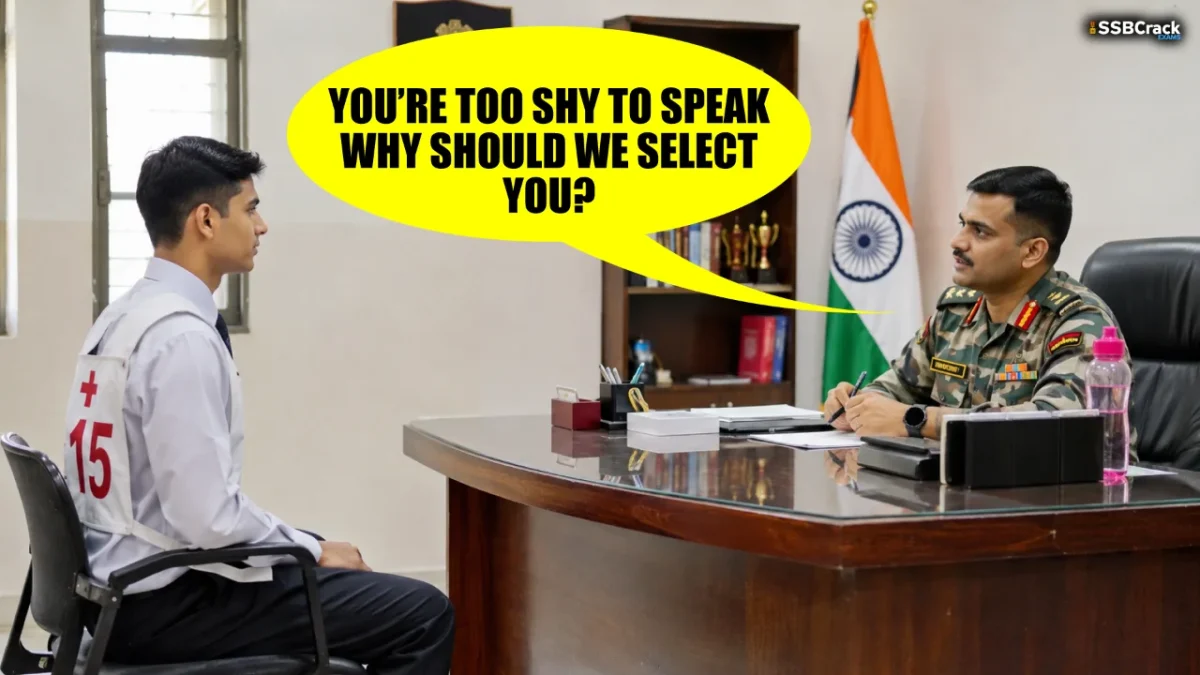
If you are preparing for the SSB Interview and you are naturally shy, hesitant or uncomfortable while talking to new people, then today’s article is especially for you.
Many candidates believe that being shy automatically means they cannot become an officer. They worry that they will not be able to speak confidently in the interview, participate in group discussions or interact with unfamiliar people.
But remember—being shy and lacking ability are not the same thing.
You may take some time to become comfortable with people. You may hesitate before speaking. You may prefer listening rather than immediately joining a conversation. But what matters at SSB is whether you can overcome that hesitation when the situation requires you to communicate, take responsibility, cooperate with others and express your opinion.
The Interviewing Officer may therefore ask you questions about your confidence, friendships, communication, public speaking, group participation, leadership and how you deal with unfamiliar people.
So, in today’s article, we will discuss 20 important SSB Interview questions for shy candidates, along with why each question is asked, how you should answer it, and a sample answer.
Remember, don’t try to suddenly behave like an extremely outgoing person during the SSB. Be natural, but work on communicating clearly and confidently.
1. Would you describe yourself as a shy person?
Why is this question asked?
The officer wants to understand whether you are aware of your own personality and whether you can honestly identify your strengths and weaknesses.
How should you answer?
Be honest, but don’t present shyness as a permanent limitation. Explain how you manage it.
Sample Answer
“Sir/Ma’am, yes, I would describe myself as somewhat shy, especially when I meet people for the first time. I usually take some time to become comfortable. However, once I become familiar with the situation, I communicate normally. I have also been consciously working on becoming more comfortable in unfamiliar social situations.”
2. Why do you think you are shy?
Why is this question asked?
The officer wants to see whether you understand the reason behind your behaviour.
How should you answer?
Don’t invent a complicated explanation. If you are naturally reserved or need time to become comfortable, say so.
Sample Answer
“Sir/Ma’am, I think I am naturally a little reserved. I usually observe people and situations before becoming comfortable. I don’t think there is one particular reason for it. Over time, I have realised that I become much more confident when I have some familiarity with the people or situation.”
3. Do you lack confidence?
Why is this question asked?
The officer wants to distinguish between shyness and lack of confidence.
How should you answer?
Explain that hesitation in social situations does not necessarily mean you lack confidence in your abilities.
Sample Answer
“No, Sir/Ma’am, I don’t think I lack confidence in my abilities. I may hesitate when I have to interact with unfamiliar people, but when I know what I am doing or when a responsibility is given to me, I can work confidently. I am trying to improve the communication aspect of my personality.”
4. Do you find it difficult to talk to strangers?
Why is this question asked?
An officer may want to assess your social adaptability.
How should you answer?
Don’t say that you completely avoid strangers. Explain that you may need some time to initiate a conversation.
Sample Answer
“Sir/Ma’am, I find it slightly difficult to initiate a conversation with a complete stranger, especially without a common topic. However, if there is a reason to interact, such as a task, class or activity, I can start communicating. Once the conversation begins, I generally become more comfortable.”
5. How many close friends do you have?
Why is this question asked?
The officer wants to understand whether your shyness prevents you from forming relationships.
How should you answer?
Don’t worry about giving a large number. Talk about genuine friendships.
Sample Answer
“Sir/Ma’am, I have a few close friends. I don’t have a very large circle, but I have good relationships with the people I am close to. I value trust and mutual understanding, and I usually take some time before becoming very comfortable with someone.”
6. Who is your best friend?
Why is this question asked?
The officer may want to understand your social relationships, what qualities you value and how well you know your friends.
How should you answer?
Mention a genuine friend and explain why you value the friendship.
Sample Answer
“Sir/Ma’am, my best friend is ________. We have known each other for ________ years. I value this friendship because we can discuss our problems openly and support each other. My friend is particularly good at ________, and I have learned ________ from him/her.”
7. How do you make new friends if you are shy?
Why is this question asked?
The officer wants to know whether you can overcome your initial hesitation and build relationships.
How should you answer?
Explain your natural process rather than pretending that making friends is effortless.
Sample Answer
“Sir/Ma’am, I usually make friends through regular interaction. It may take me some time to initiate a conversation, but common activities such as classes, sports or group projects make it easier. Once I start interacting regularly with someone, I gradually become comfortable and develop a friendship.”
8. Have you ever avoided an opportunity because you were shy?
Why is this question asked?
This question tests self-awareness and whether shyness has significantly restricted your actions.
How should you answer?
If it has happened, admit it and explain what you learned.
Sample Answer
“Yes, Sir/Ma’am, earlier I have avoided speaking opportunities because I was nervous about making mistakes in front of others. I realised that avoiding such opportunities was not helping me. Since then, I have tried to participate even when I feel uncomfortable, especially in presentations and group activities.”
9. How do you behave in a group discussion?
Why is this question asked?
Group interaction is important at SSB, so the officer wants to know whether you can contribute despite being shy.
How should you answer?
Don’t say that you remain silent. Explain how you listen and contribute.
Sample Answer
“Sir/Ma’am, I generally listen carefully at the beginning so that I understand the topic and different viewpoints. Earlier, I used to hesitate before speaking, but now I make a conscious effort to contribute when I have a relevant point. I may not speak the most, but I try to make my contribution meaningful.”
10. What do you do when you have an opinion but are afraid to express it?
Why is this question asked?
The officer is testing your assertiveness and ability to express independent views.
How should you answer?
Show that you are learning to overcome hesitation.
Sample Answer
“Sir/Ma’am, I may initially hesitate, but if the opinion is relevant to the situation, I make an effort to express it. I remind myself that disagreement or an imperfect answer is better than remaining silent when my contribution could help. I also try to express my point respectfully rather than worrying too much about how others will react.”
11. Are you comfortable speaking in front of a large group?
Why is this question asked?
An officer needs to communicate instructions and ideas clearly, so public speaking ability is relevant.
How should you answer?
Be realistic about your current ability and mention how you are improving.
Sample Answer
“Sir/Ma’am, it was not very comfortable for me initially. I used to become nervous when many people were listening to me. However, through presentations and classroom activities, I have improved. I still feel some nervousness before speaking to a large group, but I can manage it and communicate my points.”
12. What do you do when someone asks you a question unexpectedly?
Why is this question asked?
The officer wants to assess your ability to handle pressure and communicate without excessive hesitation.
How should you answer?
Show that you don’t panic and that you are comfortable taking a moment to think.
Sample Answer
“Sir/Ma’am, I first listen carefully to the question and take a moment to understand it. If I know the answer, I respond directly. If I don’t know something, I prefer to say that honestly rather than invent an answer. I am also trying to become more comfortable with spontaneous conversations.”
13. Have you ever been teased for being shy?
Why is this question asked?
The officer may be checking your emotional maturity and how you handle criticism or teasing.
How should you answer?
Don’t become defensive. Explain how you dealt with it.
Sample Answer
“Yes, Sir/Ma’am, some friends have occasionally joked that I am quiet or take time to open up. I generally take it positively because they know my nature. If the situation becomes uncomfortable, I tell them politely. I don’t allow such comments to affect my relationships or confidence.”
14. How do you react when someone criticises you?
Why is this question asked?
The officer wants to assess your emotional stability and willingness to accept feedback.
How should you answer?
Explain that you separate useful criticism from unnecessary comments.
Sample Answer
“Sir/Ma’am, I try to understand whether the criticism is genuine and useful. If I have made a mistake, I accept it and try to correct it. I may initially think about the criticism because I tend to reflect on things, but I don’t want it to stop me from improving.”
15. Would you be able to lead a group despite being shy?
Why is this question asked?
The officer wants to know whether shyness prevents you from taking responsibility.
How should you answer?
Show that leadership requires action and communication, not necessarily an outgoing personality.
Sample Answer
“Yes, Sir/Ma’am. I believe I can. Being shy may make me less likely to start casual conversations, but leadership is about taking responsibility, making decisions, communicating the plan and supporting the team. If I am given responsibility, I would focus on the task and communicate clearly with the team.”
16. What would you do if your team members were not listening to you?
Why is this question asked?
The officer is testing your assertiveness, communication and leadership.
How should you answer?
Don’t say that you would simply remain silent because you are shy. Explain how you would address the situation.
Sample Answer
“Sir/Ma’am, I would first check whether I have communicated the task clearly. If there is confusion, I would explain it again. If someone disagrees, I would listen to their reason. But if a decision is required, I would communicate it firmly and respectfully rather than avoiding the situation because I am uncomfortable.”
17. Do you prefer working alone because you are shy?
Why is this question asked?
The officer wants to know whether your shyness affects your ability to function as a team member.
How should you answer?
Give a balanced answer.
Sample Answer
“Sir/Ma’am, I am comfortable working independently when a task requires concentration, but I don’t avoid teamwork because I am shy. I understand that many tasks require cooperation and communication. In fact, working with others has helped me become more comfortable expressing my ideas.”
18. What are you doing to overcome your shyness?
Why is this question asked?
The officer wants to assess whether you take initiative to improve yourself.
How should you answer?
Mention actual steps rather than saying, “I am trying to be confident.”
Sample Answer
“Sir/Ma’am, I am trying to put myself in situations where I have to communicate with others. I participate in presentations, group discussions and activities that require interaction. I also make an effort to initiate conversations rather than always waiting for someone else to approach me. These small steps have helped me become more comfortable.”
19. What is one advantage of being shy or reserved?
Why is this question asked?
The officer wants to see whether you understand your own personality and can identify positive aspects without romanticising shyness.
How should you answer?
Mention a genuine strength, such as careful observation or thoughtful communication.
Sample Answer
“Sir/Ma’am, one advantage is that I usually observe and listen carefully before responding. I don’t immediately react to every situation. This sometimes helps me understand people and situations better before making a decision. However, I also understand that I should not let this habit turn into unnecessary hesitation.”
20. Why should the Armed Forces select a candidate who is shy?
Why is this question asked?
This question directly tests your confidence, self-awareness and understanding of officer responsibilities.
How should you answer?
Don’t become defensive about your shyness. Explain that you are working on it and that your other qualities can support your development as an officer.
Sample Answer
“Sir/Ma’am, I understand that I am naturally somewhat shy, especially in unfamiliar situations. However, I don’t believe that shyness prevents me from taking responsibility or working with others. I listen carefully, think before acting and can communicate when required. I am also actively working on becoming more confident in unfamiliar social situations. I believe an officer needs to be adaptable, responsible and willing to improve, and I am working towards developing those qualities.”
Important Tips for Shy Candidates
- Don’t hide your shyness. If you are naturally shy, there is no need to pretend otherwise.
- Don’t call yourself incapable of communication. Shyness can affect communication initially, but it does not mean you cannot communicate.
- Speak clearly and audibly during the interview. Even if you are nervous, make sure the officer can comfortably hear your answers.
- Maintain natural eye contact. You don’t need to stare at the officer, but continuously looking down can make you appear uncomfortable.
- Don’t give one-word answers. Answer the question properly and explain your thoughts.
- Don’t rush your answers. It is perfectly acceptable to take a few seconds to think before responding.
- Don’t memorise sample answers. Use them as guidance and answer from your own experiences.
- Prepare examples from your life. Think about situations where you spoke to strangers, led a task, handled disagreement, made friends or overcame hesitation.
- Practise speaking without becoming artificial. Talk with friends, family members or classmates about everyday topics.
- Participate in group activities. Sports, presentations, discussions and team projects can gradually improve social confidence.
- Don’t avoid leadership opportunities. If you are given responsibility, take it rather than assuming that shy people cannot lead.
- Don’t confuse shyness with introversion. A person may be introverted, shy, both, or neither. Understand your own behaviour.
- Don’t say that you have no weaknesses. Honest self-awareness is more convincing than a perfect personality.
- Don’t blame your personality for everything. If shyness has caused a problem, explain what you are doing to improve.
- Learn to express disagreement respectfully. Being shy should not mean agreeing with everyone.
- Work on spontaneous communication. Practise answering simple questions without preparing every word beforehand.
- Don’t compare yourself with extremely outgoing candidates. Your goal is effective communication, not maximum talking.
- Be socially adaptable. You may take time to open up, but you should still be willing to interact with new people.
- Show initiative. Taking the first step occasionally can help demonstrate that hesitation does not control your behaviour.
- Remember that SSB is assessing your overall personality. You don’t need to eliminate every trace of shyness. You need to show that you can function confidently and responsibly despite it.
Closing Lines
So, these were 20 important SSB Interview questions for shy candidates.
If you are naturally shy, remember one very important thing:
You don’t have to stop being shy overnight. You simply have to learn not to let shyness control your actions.
You can be quiet and still be confident.
You can take time to open up and still work effectively in a team.
You can feel nervous and still take responsibility.
And you can be shy and still develop into a strong leader.
At SSB, don’t try to become the most talkative person in the room just to prove that you are confident.
Instead, focus on speaking clearly, expressing your opinions, listening to others, participating in group activities and taking initiative when the situation demands it.
If you hesitate to speak, practise.
If you feel uncomfortable with strangers, interact with more people.
If public speaking makes you nervous, start with small groups and gradually challenge yourself.
And most importantly, don’t use shyness as an excuse to avoid opportunities.
The objective is not to completely change your personality. The objective is to become confident enough to use your abilities even when you feel uncomfortable.
Keep preparing, stay confident, take small steps every day, and remember—being quiet is not a weakness; allowing fear to stop you from acting is what you must learn to overcome.
All the best for your SSB journey!