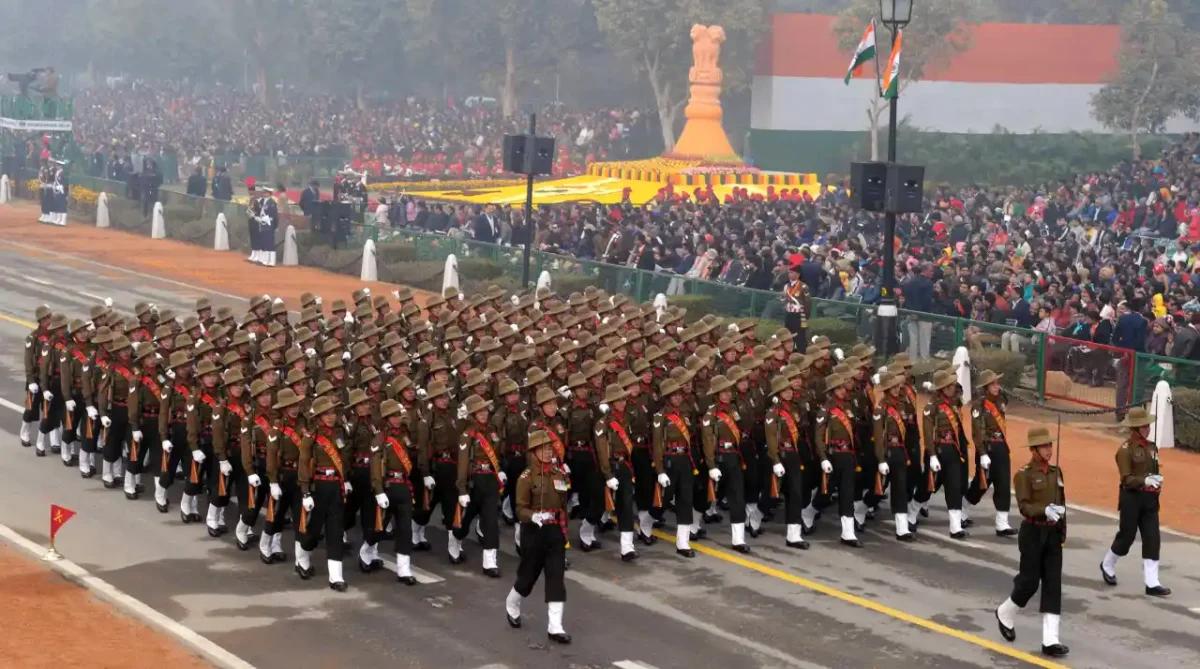
The Indian Army is organised around a proud regimental system. Each infantry and mechanised regiment has its own history, recruiting tradition, motto, war cry and battle honours. For NDA, CDS and SSB aspirants, this is more than general knowledge. Questions about famous regiments, Param Vir Chakra awardees and landmark battles often come up in interviews, group discussions and current affairs.
The Army does not officially rank its infantry regiments as “most elite.” Every regiment has a distinguished record of service. The ten formations below are highlighted because of a specialised combat role, a highly decorated history, or a distinctive place in India’s military tradition. They are among the units that defence aspirants are most often expected to know.
1. Parachute Regiment
Raised: Formally constituted on 1 March 1945; re-raised on 15 April 1952
Regimental Centre: Bengaluru, Karnataka
Motto: Shatrujeet (Conqueror of Enemies)
War Cry: Balidan Param Dharma (Sacrifice is the Supreme Duty)
The Parachute Regiment is the Indian Army’s airborne and special forces regiment, widely recognised by the maroon beret. It was officially formed on 1 March 1945, later disbanded in the post-war reorganisation, and re-raised on 15 April 1952 by absorbing three existing parachute battalions drawn from the Punjab Regiment, the Maratha Light Infantry and the Kumaon Regiment. The centre later moved to Bengaluru.
The regiment includes airborne battalions and PARA Special Forces (PARA SF) battalions, whose personnel are selected through a demanding probation. Units have taken part in the 1947–48 Jammu and Kashmir operations, the 1965 and 1971 wars, Operation Pawan in Sri Lanka, Operation Cactus in the Maldives in 1988, and the Kargil conflict of 1999. Battle honours include Shelatang, Naushera, Poonch, Hajipir, Poongli Bridge and Chachro.
2. Brigade of the Guards
Raised: 1949
Regimental Centre: Kamptee, Maharashtra
Motto: Pahla Hamesha Pahla (First Always First)
War Cry: Garud Ka Hun Bol Pyare (I am the son of Garuda, say O my friend)
The Brigade of the Guards was the brainchild of Field Marshal K. M. Cariappa, the first Indian Commander-in-Chief of the Army. Raised in 1949 as the first all-India, all-class infantry regiment after Independence, it brought together soldiers from every region and community. Cariappa described it as “The Guards, The Elite.” The President of India is the Honorary Colonel-in-Chief, and the Chief of the Army Staff is the Colonel-in-Chief. Its earliest battalions were converted from senior units of the Punjab Regiment, The Grenadiers, the Rajputana Rifles and the Rajput Regiment.
In later decades the Guards were converted to the mechanised infantry role and now form part of the Army’s mechanised forces, with the centre at Kamptee near Nagpur. Lance Naik Albert Ekka of 14 Guards was awarded the Param Vir Chakra for his gallantry at Gangasagar in the 1971 war. Battle honours include Akhaura, Burki, Hilli, Naushera, Sylhet and Ganga Sagar.
3. Gorkha Rifles
Raised: From 1815, after the Anglo-Nepalese War
Regimental Centres: Sabathu, Varanasi, Shillong and Lucknow
Common War Cry: Jai Mahakali, Ayo Gorkhali (Hail Goddess Kali, the Gorkhas are here)
The Gorkha Rifles are a family of seven rifle regiments: the 1st, 3rd, 4th, 5th, 8th, 9th and 11th Gorkha Rifles. Their origins lie in the early nineteenth century, after the Anglo-Nepalese War of 1814–16. After 1947, four Gurkha regiments went to Britain and India retained six. The 11th Gorkha Rifles was re-raised on 1 January 1948 from soldiers of the 7th and 10th Gurkha Rifles who opted to serve in India.
Mottos differ by regiment. The 1st Gorkha Rifles, the Malaun Regiment, uses “Kayar hunu bhanda marnu ramro” (Better to die than live like a coward). The 5th Gorkha Rifles (Frontier Force) uses “Shaurya evam nishtha,” and the 11th Gorkha Rifles uses “Yatraham vijayastatra.” Captain Gurbachan Singh Salaria of 3/1 Gorkha Rifles was awarded the Param Vir Chakra posthumously for his action during the United Nations operation in the Congo in 1961.
4. Sikh Regiment
Raised: 1 August 1846
Regimental Centre: Ramgarh Cantonment, Jharkhand
Motto: Nischay Kar Apni Jeet Karon (With determination, I will be triumphant)
War Cry: Bole So Nihal, Sat Sri Akal
The Sikh Regiment is widely regarded as the most decorated infantry regiment of the Indian Army. Its first battalions were raised on 1 August 1846, after the First Anglo-Sikh War, as the Ferozepore and Ludhiana Sikh regiments. The motto is taken from the vow of Guru Gobind Singh. The centre is at Ramgarh Cantonment, Jharkhand.
The regiment’s most famous pre-Independence action is the Battle of Saragarhi, fought on 12 September 1897, when 21 soldiers of the 36th Sikhs, now 4 Sikh, under Havildar Ishar Singh, defended a signalling post on the Samana Ridge against a much larger force, fighting to the last man. After Independence, 1 Sikh was the first unit airlifted to Srinagar on 27 October 1947, an event commemorated as Infantry Day. The regiment has two Param Vir Chakra awardees: Lance Naik Karam Singh (1947–48) and Subedar Joginder Singh (1962).
5. Rajputana Rifles
Raised: 10 January 1775
Regimental Centre: Delhi Cantonment
Motto: Veer Bhogya Vasundhara (The brave shall inherit the earth)
War Cry: Raja Ramchandra Ki Jai
The Rajputana Rifles is the oldest rifle regiment of the Indian Army. Its senior lineage is traced to 10 January 1775, when the East India Company raised the 5th Battalion, Bombay Sepoys. After successive redesignations it became a rifle corps, and in 1921–22 several distinguished battalions were grouped as the 6th Rajputana Rifles; the numeral was later dropped. The centre is at Delhi Cantonment. The regiment is popularly known as Raj Rif.
Company Havildar Major Piru Singh of the 6th Battalion was awarded the Param Vir Chakra posthumously for his action at Tithwal on 18 July 1948. In the Kargil War of 1999, the 2nd Battalion took part in the recapture of Tololing, a turning point of the campaign. Battle honours include Poonch, Hajipir, Charwa, Basantar, Myanamati, Tololing and Drass.
6. The Grenadiers
Raised: 1778
Regimental Centre: Jabalpur, Madhya Pradesh
Motto: Naam, Namak, Nishan (Name, loyalty and the colours)
War Cry: Sarvada Shaktishali (Always strong)
The Grenadiers is one of the oldest infantry regiments of the Indian Army, with origins in 1778 in the Bombay Army. Grenadier companies were originally picked soldiers trained to throw grenades and lead assaults; the title later came to denote an elite infantry tradition. The motto “Naam, Namak, Nishan” expresses the soldier’s duty to personal honour, loyalty to the nation, and the protection of the colours. The centre is at Jabalpur.
Company Quartermaster Havildar Abdul Hamid of 4 Grenadiers was awarded the Param Vir Chakra posthumously for destroying enemy tanks at the Battle of Asal Uttar in 1965. Major Hoshiar Singh of 3 Grenadiers received the Param Vir Chakra for his leadership in the Battle of Basantar in 1971. The first battalion of the old regiment was later converted as a battalion of the Brigade of the Guards.
7. Kumaon Regiment
Raised: 1813
Regimental Centre: Ranikhet, Uttarakhand
Motto: Parakramo Vijayate (Valour triumphs)
War Cry: Kalika Mata Ki Jai, Bajrang Bali Ki Jai, and Dada Kishan Ki Jai
The Kumaon Regiment traces its origins to 1813 and has its centre at Ranikhet in Uttarakhand. It is affiliated with the Naga Regiment, which shares the same centre. The motto “Parakramo Vijayate” and the war cries invoking local and widely revered deities reflect the regiment’s hill identity.
Major Somnath Sharma of 4 Kumaon was awarded the first Param Vir Chakra of independent India, posthumously, for his action at Badgam on 3 November 1947, which helped protect the approaches to Srinagar airfield. On 18 November 1962, Major Shaitan Singh of 13 Kumaon was awarded the Param Vir Chakra posthumously for the defence of Rezang La, where C Company fought a last-stand battle in Ladakh against a much larger Chinese assault.
8. Maratha Light Infantry
Raised: 1768
Regimental Centre: Belagavi (Belgaum), Karnataka
Motto: Duty, Honour, Courage
War Cry: Bola Shri Chhatrapati Shivaji Maharaj Ki Jai
The Maratha Light Infantry is the senior-most light infantry regiment of the Indian Army. Its first battalion, later nicknamed the Jangi Paltan, was raised in August 1768 as the 2nd Battalion, Bombay Sepoys. The centre has been at Belagavi, formerly Belgaum, since 1922. The war cry reflects the military tradition of Chhatrapati Shivaji Maharaj.
Early battalions fought at Seedaseer and Seringapatam. In the First World War, Maratha units distinguished themselves in Mesopotamia and Palestine. In the Second World War, the regiment fought in North Africa, Italy, East Africa and Burma; Naik Yeshwant Ghadge and Sepoy Namdeo Jadhav were awarded the Victoria Cross in Italy. Post-Independence battle honours include Naushera, Jhangar, Burki, Hussainiwala, Jamalpur, Burj and Suadih. Two former battalions now serve as 2 PARA (SF) and 21 PARA (SF). General J. J. Singh, a former Chief of the Army Staff, belongs to this regiment.
9. Punjab Regiment
Raised: 1761 (senior British-raised battalions)
Regimental Centre: Ramgarh Cantonment, Jharkhand
Motto: Sthal Wa Jal (By land and sea)
War Cry: Bole So Nihal, Sat Sri Akal; and Bol Jawala Ma Ki Jai
The Punjab Regiment is the second-oldest regiment still in service in the Indian Army and the most senior regional infantry regiment. Its earliest British-raised battalions were raised during the Carnatic campaigns between 1761 and 1776, originally as Coast Sepoys. After Partition, the 2nd Punjab Regiment remained in India, with the present centre at Ramgarh Cantonment, Jharkhand. The motto is also rendered as “Khushki wa Tari.” The insignia is a naval galley, unusual for an infantry regiment, awarded for a historic readiness to serve overseas.
The regiment’s best-known post-Independence battle is Longewala, fought on the night of 5 December 1971 in the Rajasthan desert. A reinforced company of 23 Punjab, commanded by Major (later Brigadier) Kuldip Singh Chandpuri, held the post against a much larger Pakistani assault until air support could be brought to bear at first light. Chandpuri was awarded the Maha Vir Chakra. Other battle honours include Zoji La, Ichhogil, Dograi, Burki and Garibpur.
10. Ladakh Scouts
Raised: 1 June 1963; established as a full infantry regiment on 1 June 2000
Regimental Centre: Leh, Ladakh
Nickname: Snow Warriors / Snow Leopards
War Cry: Ki Ki So So Lhargyalo (Victory to God)
The Ladakh Scouts were raised on 1 June 1963, after the 1962 Sino-Indian War, by grouping the 7th and 14th Battalions of the Jammu and Kashmir Militia under Colonel S. P. Salunke. The unit was created for high-altitude border operations in Ladakh and was converted into a regular infantry regiment on 1 June 2000. It recruits mainly from the Ladakhi and Tibetan communities. The centre is at Leh.
In the 1971 war, the Scouts earned the battle honour Turtuk. Elements of the regiment were later associated with early operations on the Siachen Glacier under Operation Meghdoot in 1984. In the Kargil conflict of 1999, particularly in the Batalik sector, Major Sonam Wangchuk was awarded the Maha Vir Chakra. On 21 August 2017, President Ram Nath Kovind presented the President’s Colours to the regiment at Leh.
Conclusion
These ten regiments represent different strands of the Indian Army’s history: airborne and special forces, mixed-class Guards, hill and high-altitude infantry, and some of the oldest and most decorated line and rifle regiments. “Elite” is not an official ladder of seniority. The Madras Regiment, raised in 1758, is the oldest infantry regiment of the Army. Officers commissioned through NDA, IMA, OTA and other entries are allotted regiments on the basis of vacancies, merit and choice, and every regiment offers a complete career of service. For NDA, CDS and SSB preparation, the most useful approach is to know the raising year, centre, motto, war cry and one or two landmark battles of each major regiment, and to speak of them with accuracy and respect.
Frequently Asked Questions
1. Which is the most elite regiment of the Indian Army?
The Indian Army does not officially declare any one infantry regiment as the most elite. The Parachute Regiment, especially its PARA Special Forces battalions, is widely regarded as the Army’s premier special operations force because of its selection and training. Line and rifle regiments such as the Sikh Regiment, Gorkha Rifles, Rajputana Rifles and The Grenadiers are often cited for their decorations and battle honours.
2. Which is the oldest regiment of the Indian Army?
The Madras Regiment, raised in 1758, is the oldest infantry regiment of the Indian Army. Among the regiments covered here, the Rajputana Rifles (1775) is the oldest rifle regiment, and the Maratha Light Infantry (1768) is the senior light infantry regiment.
3. What is the difference between PARA and PARA SF?
Both belong to the Parachute Regiment. Airborne (PARA) battalions are parachute-qualified infantry trained for rapid airborne insertion. PARA SF battalions are Special Forces units. Soldiers volunteer for a rigorous probation; only those who complete it serve in PARA SF and wear the Balidaan Badge. All PARA SF personnel are paratroopers, but not every paratrooper is a Special Forces operator.
4. Can an NDA or CDS candidate choose a regiment?
Newly commissioned officers submit preferences, but final allotment depends on vacancies, merit and the Army’s requirements. There is no guarantee of a particular regiment. Knowledge of regimental history is useful at the SSB, but it does not decide allotment.
5. Which of these regiments have won the Param Vir Chakra?
Several have Param Vir Chakra awardees, including Karam Singh and Joginder Singh (Sikh Regiment), Piru Singh (Rajputana Rifles), Abdul Hamid and Hoshiar Singh (The Grenadiers), Somnath Sharma and Shaitan Singh (Kumaon Regiment), Gurbachan Singh Salaria (Gorkha Rifles), and Albert Ekka (Brigade of the Guards). This is not a complete list of all PVC awardees in the Army.
6. Are the Ladakh Scouts a full regiment of the Indian Army?
Yes. They were raised as a specialised high-altitude unit in 1963 and converted into a regular infantry regiment on 1 June 2000, with the centre at Leh.