Questions on defence equipment appear regularly in the NDA, CDS, AFCAT and CAPF written examinations, and an Interviewing Officer at the Services Selection Board (SSB) may well ask a candidate who wants to join the Army what tanks, guns or missiles the Army uses.
The Indian Army uses a wide range of weapons, from the rifle carried by an infantry soldier to supersonic cruise missiles that can strike targets hundreds of kilometres away. A growing share is designed in India by the Defence Research and Development Organisation (DRDO).
This article covers 15 weapons in Indian Army service: tanks, an infantry combat vehicle, artillery guns, a rocket system, missiles and small arms. The numbering is for easy reading and is not a ranking. Figures such as range are approximate, because they depend on ammunition and conditions.
1. Arjun Main Battle Tank
Type: Main battle tank
Origin/Maker: India; designed by DRDO’s Combat Vehicles Research and Development Establishment (CVRDE), built at the Heavy Vehicles Factory (HVF), Avadi
Main gun: 120 mm rifled gun
Inducted: From 2004
The Arjun is India’s indigenously designed main battle tank. The programme was sanctioned in 1974. The Army has 124 Arjun Mk1 tanks, which equip two armoured regiments and serve mainly in the western desert sector.
In September 2021 the Ministry of Defence ordered 118 improved Arjun Mk1A tanks from HVF Avadi. Deliveries have been delayed, mainly because the German-made engine is no longer in production. As of late 2026 no Mk1A had been delivered, and work on an alternative powerpack, including DRDO’s indigenous DATRAN engine, is continuing.
2. T-90S Bhishma
Type: Main battle tank
Origin/Maker: Russia; licence-built in India at HVF Avadi
Main gun: 125 mm smoothbore gun, able to fire the Invar anti-tank guided missile
Inducted: First ordered in 2001
The T-90S, named Bhishma in Indian service, is the most modern tank in the Army’s large armoured fleet. India first bought it from Russia in 2001. Licence production later began at HVF Avadi.
The Bhishma has a three-man crew and an automatic loader. It equips many armoured regiments, and in 2020 T-90 regiments were among the forces deployed to eastern Ladakh during the stand-off with China.
3. T-72 Ajeya
Type: Main battle tank
Origin/Maker: Soviet Union; licence-built in India at HVF Avadi
Main gun: 125 mm smoothbore gun
Inducted: Late 1970s
The T-72, known in India as the Ajeya, has been the workhorse of the Armoured Corps for more than four decades. It remains the Army’s most numerous tank type.
Many Ajeya tanks have been upgraded with better fire-control and night-vision equipment, and in 2025 a contract was signed with Russia for more powerful 1,000 hp engines for the fleet. In the long term the Army plans to replace it with a Future Ready Combat Vehicle (FRCV).
4. BMP-2 Sarath Infantry Combat Vehicle
Type: Tracked infantry combat vehicle (ICV)
Origin/Maker: Soviet design; licence-built by Ordnance Factory Medak, Telangana
Armament: 30 mm automatic cannon, 7.62 mm machine gun and Konkurs anti-tank missile launcher
Inducted: Indian production from 1987
The BMP-2, called Sarath in India, is the main vehicle of the Mechanised Infantry Regiment. It carries a crew of three and a section of infantry soldiers, who can fight from the vehicle or dismount.
Ordnance Factory Medak rolled out the first Indian-built Sarath in 1987 and has since built the vehicle in large numbers.
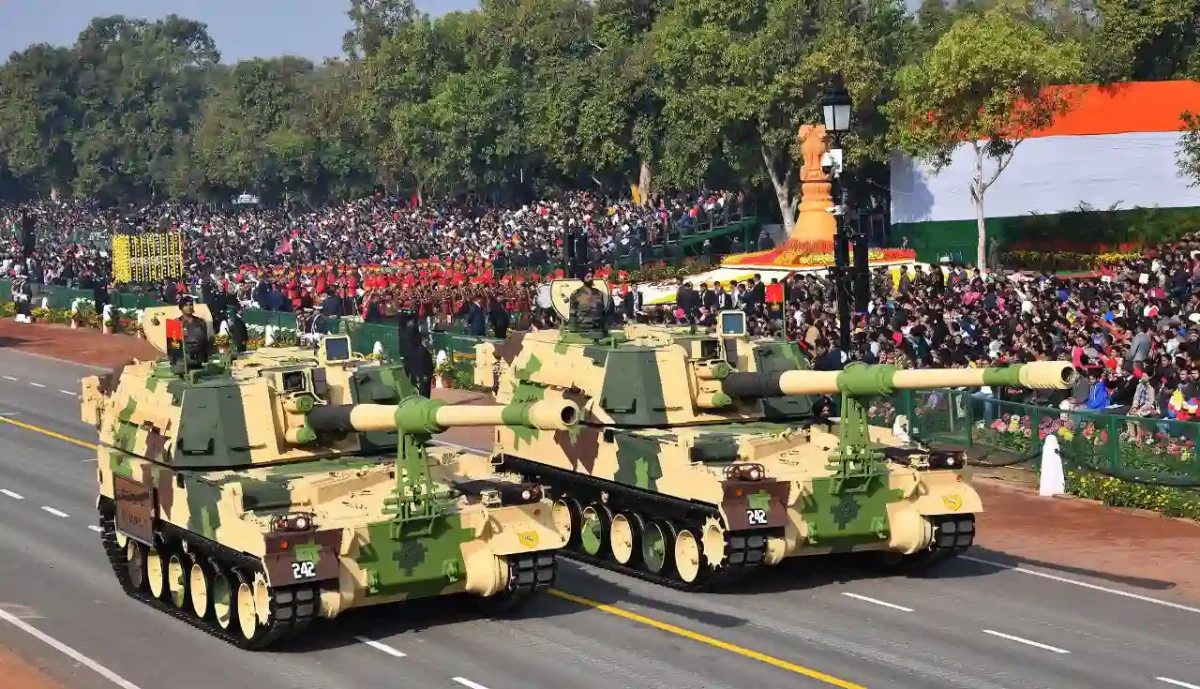
5. K9 Vajra-T Self-Propelled Howitzer
Type: 155 mm/52-calibre tracked self-propelled gun
Origin/Maker: South Korean K9 Thunder design; built in India by Larsen & Toubro (L&T) at Hazira, Gujarat, with Hanwha
Range: About 28–38 km, depending on ammunition
Inducted: From 2018; first 100 guns delivered by February 2021
The K9 Vajra-T is a self-propelled gun: the 155 mm gun is mounted on a tracked, armoured chassis, so it can move with tank formations, fire, and quickly move away before the enemy can respond. The Ministry of Defence signed the first contract for 100 guns with L&T in May 2017, and all were delivered by February 2021.
The gun was originally bought for the deserts of Rajasthan. After the 2020 stand-off with China, some K9s were given winter kits and moved to eastern Ladakh. On 20 December 2024 the Ministry signed a ₹7,628.70 crore contract with L&T for 100 more K9 Vajra-T guns, which are to be able to operate in high-altitude, sub-zero conditions.
6. Dhanush Towed Howitzer
Type: 155 mm/45-calibre towed howitzer
Origin/Maker: India; developed by the Ordnance Factory Board, now built by Advanced Weapons and Equipment India Ltd (AWEIL), Jabalpur
Range: About 36 km, up to about 38 km with special ammunition
Inducted: 8 April 2019
The Dhanush is often called the ‘desi Bofors’. It was developed from the technology documents that came with the Bofors deal of the 1980s and was upgraded from 39 to 45 calibre (a longer barrel), with electronic sighting and laying systems added. It is India’s first indigenous long-range artillery gun to enter service.
The first Dhanush guns were handed over to the Army in April 2019, against an initial order for 114 guns.
7. M777 Ultra-Light Howitzer
Type: 155 mm/39-calibre towed ultra-light howitzer
Origin/Maker: BAE Systems (United States/United Kingdom); most of India’s guns assembled in India with Mahindra Defence
Range: About 24–30 km depending on ammunition
Inducted: Contract signed in 2016
The M777 is made largely of titanium. It weighs only about 4.2 tonnes, roughly half as much as a conventional 155 mm towed gun. That low weight means it can be carried slung under a CH-47 Chinook helicopter to mountain positions that guns cannot reach by road.
India signed for 145 M777 guns with the United States in November 2016. Twenty-five came ready-built and the rest were assembled in India. The guns are deployed mainly in mountainous sectors, including Arunachal Pradesh and Ladakh.
8. Bofors FH-77B Howitzer
Type: 155 mm/39-calibre towed howitzer
Origin/Maker: AB Bofors, Sweden
Range: About 27–30 km depending on ammunition
Inducted: Contract for 410 guns signed in 1986
The Bofors gun is one of the best-known weapons in Indian military history. India ordered 410 FH-77B howitzers from Sweden in 1986. The deal became a political controversy, but the gun earned a strong reputation.
During the Kargil War in 1999, Bofors guns fired in the direct-fire role at enemy positions on the high ridges. They played a major part in recapturing peaks such as Tololing and Tiger Hill. Many are still in service.
9. Pinaka Multi-Barrel Rocket Launcher
Type: Multi-barrel rocket launch system (MBRL)
Origin/Maker: India; developed by DRDO’s Armament Research and Development Establishment (ARDE), Pune; launchers and rockets built by Indian public and private firms
Calibre/Range: 214 mm rockets; about 37–45 km depending on rocket type
Inducted: Early 2000s
Pinaka is named after the bow of Lord Shiva. Each launcher carries 12 rockets that can be fired in under a minute. The system was first used in combat during the Kargil War.
Pinaka is now one of DRDO’s most successful products. On 6 February 2025 the Ministry of Defence signed contracts worth ₹10,147 crore for Area Denial Munition (ADM) Type-1 and High Explosive Pre-Fragmented (HEPF) Mk-1 (Enhanced) rockets, and for upgrades to the system. These orders support the Army’s plan to operate around ten Pinaka regiments.
10. BrahMos Supersonic Cruise Missile
Type: Supersonic cruise missile (land-attack version)
Origin/Maker: BrahMos Aerospace, an India–Russia joint venture between DRDO and Russia’s NPO Mashinostroyeniya
Range: Originally about 290 km; extended-range versions about 450 km
Inducted: First Army regiment raised in 2007
The name BrahMos combines the Brahmaputra and Moskva rivers. The missile flies at nearly three times the speed of sound (about Mach 2.8), which makes it very hard to intercept. Versions exist for the Army, Navy and Air Force. In the Army, it is fired from mobile launchers on heavy trucks.
The Army raised its first BrahMos regiment in 2007 and now has several. The original range was limited to about 290 km, partly because of the Missile Technology Control Regime (MTCR). After India joined the MTCR in 2016, extended-range versions of about 450 km were tested.
11. Akash Surface-to-Air Missile
Type: Short-to-medium range surface-to-air missile system
Origin/Maker: India; developed by DRDO, missiles produced by Bharat Dynamics Limited (BDL)
Range: About 25 km
Inducted: Army Akash regiments from the 2010s; Akash Prime being added
Akash is an indigenous air defence missile system. It protects important areas and moving formations against aircraft, helicopters, drones and cruise missiles. It came out of the Integrated Guided Missile Development Programme (IGMDP) and is used by both the Army and the IAF.
The Army operates Akash regiments and is raising regiments of Akash Prime, an improved version with an indigenous seeker designed for high-altitude operation. In July 2025 the Army tested Akash Prime at about 15,000 feet in Ladakh. Official sources say Akash performed well against drones during Operation Sindoor in May 2025.
12. Nag Anti-Tank Guided Missile (NAMIS)
Type: Third-generation fire-and-forget anti-tank guided missile
Origin/Maker: India; developed by DRDO’s Defence Research and Development Laboratory (DRDL), Hyderabad; missiles by BDL; tracked carrier by Armoured Vehicles Nigam Limited (AVNL)
Platform: Nag Missile Carrier (NAMICA) on a BMP-2 chassis
Inducted: Contract for the tracked system signed on 27 March 2025
Nag was also part of the IGMDP. It is a ‘fire-and-forget’ missile: once the target is locked and the missile is launched, the crew does not need to guide it and can take cover or engage another target.
On 27 March 2025 the Ministry of Defence signed a ₹1,801.34 crore contract with AVNL for the Nag Missile System (Tracked), or NAMIS (Tr), for the Mechanised Infantry. In October 2025 the Defence Acquisition Council approved the improved NAMIS (Tracked) Mk-II. The Nag Mk-2 missile completed field trials at Pokhran in January 2025.
13. INSAS Rifle
Type: Assault rifle and light machine gun family
Origin/Maker: India; developed by ARDE and manufactured by the Ordnance Factories
Calibre: 5.56 × 45 mm
Inducted: Late 1990s
The Indian National Small Arms System (INSAS) was India’s first standard indigenous rifle family after Independence. It replaced the older 7.62 mm self-loading rifle and was used widely in the Kargil War and in counter-insurgency operations.
Over time, troops reported problems with reliability and the 5.56 mm round, especially in harsh conditions. The Army is replacing INSAS in frontline units with the SIG 716 and AK-203, but large numbers remain in service with the Army, other forces and training establishments.
14. AK-203 Assault Rifle
Type: Assault rifle
Origin/Maker: Russian Kalashnikov design; made in India by Indo-Russian Rifles Private Limited (IRRPL), Korwa, Amethi (Uttar Pradesh)
Calibre: 7.62 × 39 mm
Inducted: Contract for over six lakh rifles signed in December 2021
The AK-203 is a modern member of the Kalashnikov family. It is planned to become the standard rifle of most Indian Army soldiers. It is produced by IRRPL, a joint venture formed in 2019 between Indian and Russian partners, at the Korwa ordnance factory complex in Amethi.
The first rifles were assembled at Korwa in 2023 with low indigenous content. In 2026 IRRPL test-fired a fully indigenous rifle named ‘Sher’, with deliveries of fully indigenous rifles expected from 2027. The full order of over six lakh rifles is targeted for completion by December 2030.
15. SIG 716 Assault Rifle
Type: Battle/assault rifle
Origin/Maker: SIG Sauer, United States
Calibre: 7.62 × 51 mm
Inducted: First 72,400 ordered in February 2019; repeat order for 73,000 in 2024
The SIG 716 was bought to give frontline infantry, especially troops on the Line of Control and in counter-terrorism roles, a rifle that fires the larger 7.62 × 51 mm round. India first bought 72,400 rifles in February 2019 under fast-track procurement.
The rifle performed well and was liked by troops, so the Ministry of Defence signed a repeat order for 73,000 more in 2024. That will bring the total in Indian service to about 1.45 lakh. With the SIG 716 for frontline units and the AK-203 for the bulk of the force, the Army is moving towards a two-rifle system to replace INSAS.
Conclusion
Together, these 15 weapons show how the Indian Army fights. They also show a clear trend: older imported systems such as the T-72, Bofors and BMP-2 are being joined or replaced by Indian-designed or India-made equipment such as Dhanush, Pinaka, Akash, Nag and the AK-203 made in Amethi.
For NDA, CDS, AFCAT and SSB aspirants, the aim is not to memorise every number. Know what each weapon does, where it comes from and why it matters.
Frequently Asked Questions
1. Which is the main battle tank of the Indian Army?
The Army operates three main battle tanks: the T-72 Ajeya, the T-90S Bhishma and the indigenous Arjun. The T-72 is the most numerous; the T-90 is the most modern in large-scale service.
2. Which rifle is replacing INSAS in the Indian Army?
Two rifles are replacing INSAS: the AK-203, made in Amethi by Indo-Russian Rifles Private Limited, for most soldiers, and the US-made SIG 716 for frontline units.
3. What is the range of the BrahMos missile used by the Army?
The original land-attack BrahMos had a range of about 290 km. Extended-range versions of about 450 km have been tested since India joined the MTCR in 2016.
4. Which Indian Army artillery gun is called the ‘desi Bofors’?
The Dhanush 155 mm/45-calibre towed howitzer, built by AWEIL, is called the ‘desi Bofors’ because it was developed from Bofors technology. It was inducted on 8 April 2019.
5. Why are defence equipment questions important for SSB?
Interviewing Officers and GTOs value candidates who know about the service they want to join. Basic knowledge of the Army’s major weapons shows genuine interest and helps in lecturettes, group discussions and the personal interview.