If you are preparing for the NDA, CDS, INET or AFCAT examinations, or you hope to wear the white uniform of the Indian Navy one day, you should know the ships that make up its fighting strength. Questions on aircraft carriers, destroyers, frigates and submarines appear regularly in general knowledge papers, and at the Services Selection Board (SSB) a Navy candidate may well be asked to name a few frontline warships and explain what they do.
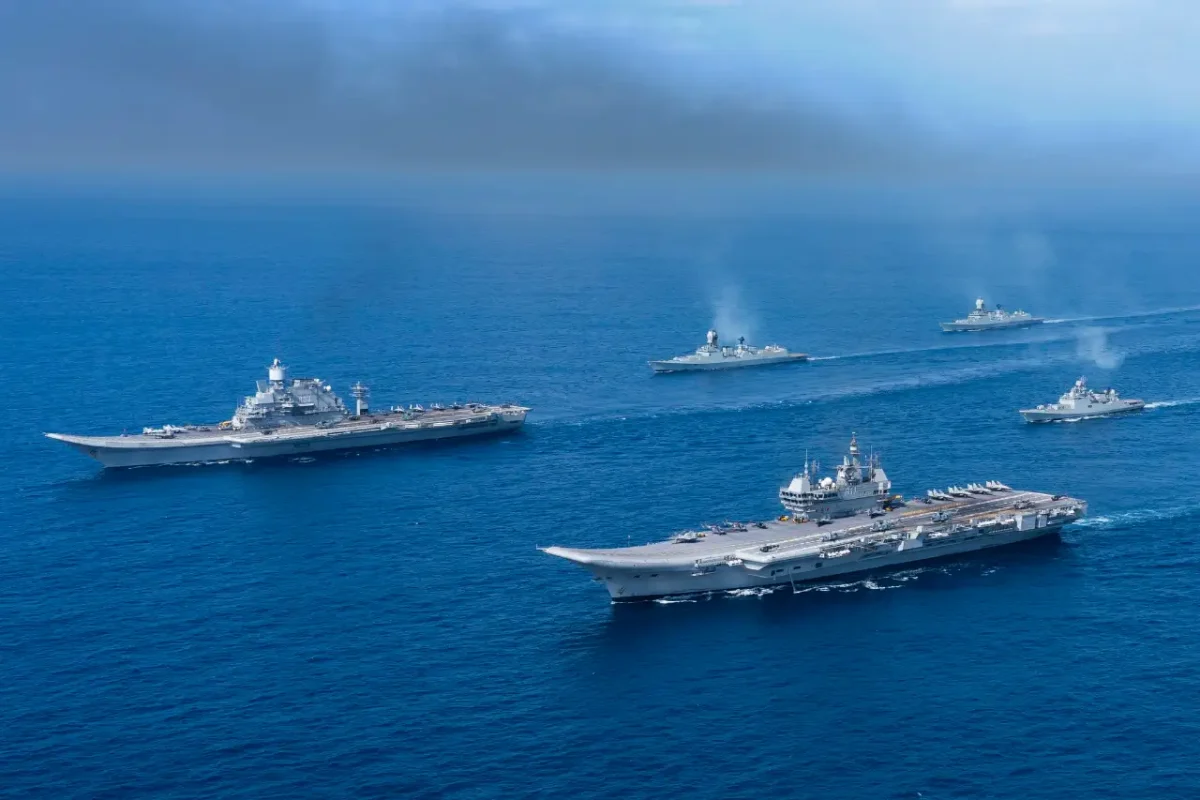
The Indian Navy has changed a great deal in the last few years. India now operates two aircraft carriers, has commissioned its third nuclear-powered ballistic missile submarine, and has inducted six new Nilgiri-class stealth frigates in about a year and a half. Almost every major warship now joining the fleet is designed and built in India.
This article covers 10 of the most powerful warships and warship classes of the Indian Navy as of November 2026. The numbering is for easy reading and is not an official ranking. Where official figures differ between sources, we have used approximate values or left them out.
1. INS Vikrant (R11)
Class/Type: Indigenous Aircraft Carrier (IAC-1)
Commissioned: 2 September 2022
Displacement: About 43,000 tonnes (full load)
Length: About 262 metres
Builder: Cochin Shipyard Limited, Kochi; designed by the Navy’s Warship Design Bureau
Air wing: Up to about 30 aircraft, including MiG-29K fighters and helicopters
INS Vikrant is India’s first indigenously designed and built aircraft carrier and the largest warship ever built in the country. Prime Minister Narendra Modi commissioned her at Kochi on 2 September 2022. She carries the name of India’s first carrier, the old INS Vikrant, which served from 1961 to 1997 and played an important role in the 1971 war, when her aircraft attacked targets in what was then East Pakistan.
Vikrant uses the STOBAR method (Short Take-Off But Arrested Recovery). Fighters take off with the help of a ski-jump ramp at the bow and land by catching arrester wires with a hook. Her current fighters are MiG-29Ks, and India signed a deal in April 2025 for 26 Rafale Marine fighters that are planned to operate from the Navy’s carriers. Helicopters on board can carry out anti-submarine warfare, early warning, search and rescue and transport tasks.
For aspirants, the key point is self-reliance: Vikrant made India one of only a few nations able to design and build a carrier of this size. A carrier is the centre of a carrier battle group, protected by destroyers, frigates and submarines, and it lets the Navy take air power far out into the Indian Ocean.
2. INS Vikramaditya (R33)
Class/Type: Modified Kiev-class aircraft carrier
Commissioned: 16 November 2013, at Severodvinsk, Russia
Displacement: About 45,000 tonnes (full load)
Length: About 284 metres
Origin: Former Soviet/Russian carrier Admiral Gorshkov, rebuilt by Sevmash shipyard, Russia
Air wing: MiG-29K fighters, Kamov-31 early-warning and Kamov-28 anti-submarine helicopters
Motto: Strike Far, Strike Sure
INS Vikramaditya was the Indian Navy’s flagship for several years before Vikrant joined the fleet. She began life as the Soviet carrier Admiral Gorshkov. India bought the ship in 2004, and she was extensively rebuilt in Russia, gaining a full flight deck, a ski-jump and arrester gear so that she could operate MiG-29K fighters. She was commissioned in November 2013.
Like Vikrant, she is a STOBAR carrier. Her short refit and dry docking was carried out at Cochin Shipyard from December 2024, and she returned to the fleet in 2025. In June 2023 the Navy showed its twin-carrier capability when Vikramaditya and Vikrant operated together in the Arabian Sea with their escorts, an important milestone for a navy that wants at least two carriers available at all times.
3. Arihant-class SSBNs (INS Arihant, INS Arighaat, INS Aridhaman)
Type: Nuclear-powered ballistic missile submarine (SSBN)
Commissioned: Arihant 2016; Arighaat 29 August 2024; Aridhaman 3 April 2026
Displacement: About 6,000 tonnes for the first two boats; Aridhaman is larger (reported at about 7,000 tonnes)
Builder: Ship Building Centre, Visakhapatnam, under the Advanced Technology Vessel (ATV) programme
Key weapons: K-15 (Sagarika) and K-4 submarine-launched ballistic missiles
Control: Strategic Forces Command
The Arihant-class submarines are the most powerful vessels in the Indian Navy in one important sense: they carry India’s sea-based nuclear deterrent. Because a submarine hidden deep in the ocean is very hard to find and destroy, it guarantees that India could respond to a nuclear attack. This is the basis of India’s ‘No First Use’ nuclear doctrine and of its nuclear triad, which means the ability to deliver nuclear weapons from land, air and sea.
INS Arihant was commissioned in 2016 and completed her first deterrence patrol in 2018, which completed India’s nuclear triad. INS Arighaat followed in August 2024. The third boat, INS Aridhaman, was commissioned at Visakhapatnam on 3 April 2026 in a low-key ceremony attended by Defence Minister Rajnath Singh. Aridhaman is longer than the first two and is reported to have eight missile tubes instead of four, allowing her to carry more K-4 missiles, which have a range of about 3,500 km.
4. Visakhapatnam-class Destroyers (Project 15B)
Ships: INS Visakhapatnam (D66), INS Mormugao (D67), INS Imphal (D68), INS Surat (D69)
Commissioned: November 2021 to January 2025
Displacement: About 7,400 tonnes
Length: About 164 metres
Builder: Mazagon Dock Shipbuilders Limited (MDL), Mumbai; designed by the Warship Design Bureau
Key weapons: 16 BrahMos supersonic cruise missiles, 32 Barak-8/MRSAM surface-to-air missiles, torpedoes and anti-submarine rockets
The four Visakhapatnam-class stealth guided-missile destroyers are among the most heavily armed surface warships in the Indian Navy. They are an improved version of the Kolkata class, with better stealth, more automation and upgraded systems. The class was completed when INS Surat was commissioned at Mumbai on 15 January 2025, on the same day as the frigate INS Nilgiri and the submarine INS Vaghsheer.
Each ship carries 16 BrahMos missiles for striking ships and land targets, and 32 medium-range surface-to-air missiles for defending the fleet against aircraft and missiles. Their Israeli-origin MF-STAR active electronically scanned array (AESA) radar can track many targets at once. They also carry torpedoes, anti-submarine rockets and up to two helicopters.
5. Kolkata-class Destroyers (Project 15A)
Ships: INS Kolkata (D63), INS Kochi (D64), INS Chennai (D65)
Commissioned: 2014, 2015 and 2016
Displacement: About 7,500 tonnes (as commonly quoted)
Length: About 163 metres
Builder: Mazagon Dock Shipbuilders Limited, Mumbai
Key weapons: 16 BrahMos missiles, 32 Barak-8/MRSAM surface-to-air missiles, torpedoes and anti-submarine rockets
When INS Kolkata was commissioned in August 2014, she was the largest destroyer built in India up to that time. The three Kolkata-class ships brought a big jump in capability over earlier destroyers, introducing vertically launched BrahMos missiles, the MF-STAR AESA radar and long-range surface-to-air missiles to the Indian fleet.
These destroyers were designed for anti-air, anti-surface and anti-submarine warfare, and they can carry two helicopters. Their design became the base for the later Visakhapatnam class, which looks similar but has a different bridge and improved systems. Together, the seven Kolkata and Visakhapatnam-class destroyers form the heart of the Navy’s destroyer force.
6. Nilgiri-class Stealth Frigates (Project 17A)
Ships commissioned: INS Nilgiri, INS Udaygiri, INS Himgiri, INS Taragiri, INS Dunagiri, INS Mahendragiri; INS Vindhyagiri under construction
Commissioned: January 2025 to July 2026
Displacement: About 6,670 tonnes
Speed: Up to about 28 knots
Builders: Mazagon Dock Shipbuilders (four ships) and Garden Reach Shipbuilders and Engineers, Kolkata (three ships)
Key weapons: 8 BrahMos missiles, 32 MRSAM surface-to-air missiles, torpedoes, anti-submarine rockets and a multi-role helicopter
The Nilgiri class is the newest class of frontline warship in the Indian Navy, and its pace of induction has been remarkable. INS Nilgiri was commissioned in January 2025. INS Udaygiri and INS Himgiri followed together in August 2025, INS Taragiri in April 2026, INS Dunagiri at Kolkata in June 2026 and INS Mahendragiri at Visakhapatnam on 11 July 2026, making six ships in about a year and a half. The seventh and last ship, Vindhyagiri, is still being built.
These frigates follow on from the Shivalik class but are much stealthier, with a cleaner hull and superstructure designed to reduce their radar, infrared and acoustic signatures. They are designed for the full range of naval tasks, from fleet air defence and anti-ship strikes to submarine hunting, surveillance and disaster relief. Each ship has more than 75% indigenous content.
7. Talwar-class and Tushil-class Frigates (Project 1135.6)
Ships: Six Talwar/Teg-class frigates (2003–2013), INS Tushil (F70) and INS Tamal (F71), plus two ships built in India by Goa Shipyard
Tushil commissioned: 9 December 2024, Kaliningrad, Russia
Tamal commissioned: 1 July 2025, Kaliningrad, Russia
Displacement: About 3,900 tonnes (Tamal)
Length: About 125 metres
Key weapons: BrahMos missiles, Shtil vertically launched surface-to-air missiles, 100 mm gun, close-in weapon systems, torpedoes and anti-submarine rockets
The Project 1135.6 frigates are smaller than the destroyers on this list, but they pack a heavy punch for their size. The first six ships were built in Russia and joined the Navy between 2003 and 2013. Two improved follow-on ships, INS Tushil and INS Tamal, were commissioned at the Yantar Shipyard in Kaliningrad in December 2024 and July 2025.
INS Tamal has a special place in naval history because it is the last major warship the Indian Navy will induct from a foreign shipyard. Even so, the Navy says about 26% of her equipment is Indian, including the BrahMos missile and the HUMSA-NG sonar. Two more ships of the class have been built in India by Goa Shipyard Limited, starting with Triput.
8. Shivalik-class Stealth Frigates (Project 17)
Ships: INS Shivalik (F47), INS Satpura (F48), INS Sahyadri (F49)
Commissioned: 2010, 2011 and 2012
Displacement: About 6,200 tonnes (full load)
Builder: Mazagon Dock Shipbuilders Limited, Mumbai
Key weapons: Klub anti-ship missiles, Shtil and Barak surface-to-air missiles, 76 mm gun, torpedoes and anti-submarine rockets
The Shivalik class holds an important record: these were the first stealth frigates designed and built in India. INS Shivalik was commissioned in April 2010, followed by INS Satpura in 2011 and INS Sahyadri in 2012. Their sloping sides and cleaner upper decks were designed to make them harder to detect on radar than older warships.
The ships combine Russian, Israeli, Western and Indian weapons and sensors, and they can carry two helicopters. They have travelled widely, taking part in exercises with friendly navies across the Pacific and Indian Oceans. Their experience fed directly into the design of the newer Nilgiri class.
9. Delhi-class Destroyers (Project 15)
Ships: INS Delhi (D61), INS Mysore (D60), INS Mumbai (D62)
Commissioned: 1997, 1999 and 2001
Displacement: About 6,200 tonnes or more (full load; figures vary by source)
Builder: Mazagon Dock Shipbuilders Limited, Mumbai
Original weapons: Kh-35 Uran anti-ship missiles, Shtil surface-to-air missiles, 100 mm gun, torpedoes and anti-submarine rockets
The Delhi class was the first class of large guided-missile destroyers designed and built in India. When INS Delhi was commissioned in November 1997, it was a big step forward for Indian shipbuilding. The three ships started the Project 15 series, which led on to the Kolkata (P-15A) and Visakhapatnam (P-15B) classes.
These destroyers have served for more than two decades, and they have been modernised through mid-life upgrades of their sensors and weapons. They can carry two helicopters, and they have taken part in many operations, including evacuation of Indian citizens from conflict zones, anti-piracy patrols and humanitarian missions.
10. Kalvari-class Submarines (Project 75)
Ships: INS Kalvari, INS Khanderi, INS Karanj, INS Vela, INS Vagir, INS Vaghsheer
Commissioned: December 2017 to January 2025
Type: Diesel-electric attack submarine (Scorpene design)
Builder: Mazagon Dock Shipbuilders Limited, Mumbai, with technology transfer from Naval Group of France
Key weapons: Heavyweight torpedoes and anti-ship missiles; can also lay mines
Submarines are the hidden hunters of a navy, and the six Kalvari-class boats are the Indian Navy’s most modern conventional submarines. INS Kalvari was commissioned in December 2017, and the sixth and final boat, INS Vaghsheer, joined the fleet on 15 January 2025.
These submarines are built to the French Scorpene design, which is known for being very quiet. They can attack enemy ships and submarines with torpedoes and anti-ship missiles, lay mines, gather intelligence and carry out surveillance. Their names come from the Navy’s first Kalvari-class submarines of Soviet origin, which served from the late 1960s; Kalvari means tiger shark.
Conclusion
From the aircraft carriers Vikrant and Vikramaditya to the Arihant-class nuclear submarines, the Indian Navy today has a fleet that can protect India’s interests across the Indian Ocean and beyond. The new destroyers and frigates show how far Indian shipbuilding has come, with most frontline warships now designed by the Navy’s own Warship Design Bureau and built in Indian shipyards.
For NDA, CDS and INET aspirants, knowing these ships, their classes and their roles is useful for both the written exam and the SSB interview. Do not just memorise numbers. Understand why a navy needs carriers, destroyers, frigates and submarines, and how they work together.
Frequently Asked Questions (FAQs)
1. Which is the largest warship of the Indian Navy?
INS Vikramaditya and INS Vikrant are the largest, each with a full-load displacement in the range of about 43,000 to 45,000 tonnes. INS Vikrant is the largest warship ever built in India.
2. How many aircraft carriers does India have?
India currently operates two aircraft carriers, INS Vikramaditya (commissioned 2013) and INS Vikrant (commissioned 2022).
3. How many nuclear ballistic missile submarines does India have?
As of November 2026, India has commissioned three Arihant-class SSBNs: INS Arihant (2016), INS Arighaat (2024) and INS Aridhaman (2026).
4. Which is the newest class of frigates in the Indian Navy?
The Nilgiri class (Project 17A). Six ships have been commissioned between January 2025 and July 2026, and the seventh, Vindhyagiri, is under construction.
5. Which was India’s last foreign-built warship?
INS Tamal, a Project 1135.6 frigate commissioned in Russia on 1 July 2025, is the last major warship to be inducted from a foreign shipyard.