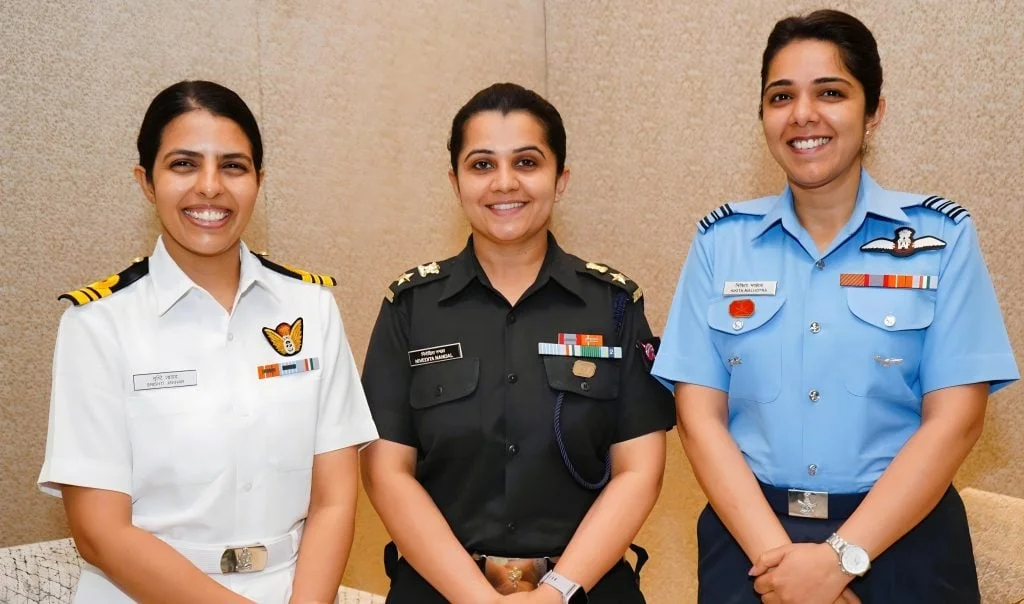
The ranks and insignia of the Indian Army, Indian Navy and Indian Air Force represent the hierarchy, authority and responsibilities of personnel serving in India’s three armed services. Each service follows its own rank structure, but corresponding ranks have broadly equivalent status across the armed forces.
For example, a Colonel in the Indian Army is equivalent to a Captain in the Indian Navy and a Group Captain in the Indian Air Force. Similarly, an Army Major is equivalent to a Lieutenant Commander in the Navy and a Squadron Leader in the Air Force.
Understanding these military ranks is important for candidates preparing for NDA, CDS, AFCAT, SSB interviews, UPSC and other defence examinations.
This guide covers the complete Indian Armed Forces rank hierarchy, officer rank equivalence, personnel below officer rank, insignia identification, five-star ranks and important defence GK questions.
Equivalent Ranks of Indian Army, Navy and Air Force
The Indian Armed Forces follow different rank nomenclatures based on their operational roles and historical traditions.
The following table compares the corresponding commissioned officer ranks in the three services, from highest to lowest.
| Indian Army | Indian Navy | Indian Air Force |
|---|---|---|
| Field Marshal | Admiral of the Fleet | Marshal of the Indian Air Force |
| General | Admiral | Air Chief Marshal |
| Lieutenant General | Vice Admiral | Air Marshal |
| Major General | Rear Admiral | Air Vice Marshal |
| Brigadier | Commodore | Air Commodore |
| Colonel | Captain | Group Captain |
| Lieutenant Colonel | Commander | Wing Commander |
| Major | Lieutenant Commander | Squadron Leader |
| Captain | Lieutenant | Flight Lieutenant |
| Lieutenant | Sub Lieutenant | Flying Officer |
Important: Field Marshal, Admiral of the Fleet and Marshal of the Indian Air Force are five-star ranks. They are not part of the normal promotion ladder for serving officers.
The highest ordinarily held ranks in the three services are General, Admiral and Air Chief Marshal, respectively.
Indian Army Ranks and Insignia in Order
The Indian Army is responsible for land warfare, territorial defence and a wide range of military operations. Its rank structure establishes the chain of command, leadership responsibilities and professional seniority.
Indian Army personnel are broadly organised into three categories:
- Commissioned Officers
- Junior Commissioned Officers (JCOs)
- Other Ranks, including Non-Commissioned Officers (NCOs)
1. Indian Army Commissioned Officer Ranks
Commissioned officers exercise military command and hold leadership appointments at different levels of the Indian Army.
The commissioned officer ranks, arranged from highest to lowest, are:
| Rank | General Description |
|---|---|
| General | Four-star rank normally held by the Chief of Army Staff |
| Lieutenant General | Three-star officer; may command an Army Command or Corps and hold senior staff appointments |
| Major General | Two-star officer; may command a division or serve in senior headquarters appointments |
| Brigadier | One-star officer; may command a brigade |
| Colonel | Senior field officer; may command a battalion or regiment |
| Lieutenant Colonel | Field officer; may command a battalion or hold senior staff appointments |
| Major | Field officer responsible for company-level leadership or staff duties |
| Captain | Junior commissioned officer rank with command and staff responsibilities |
| Lieutenant | Entry-level commissioned rank for regular Army officers |
The nature of an officer’s appointment may vary according to the service arm, operational formation, seniority and organisational requirements.
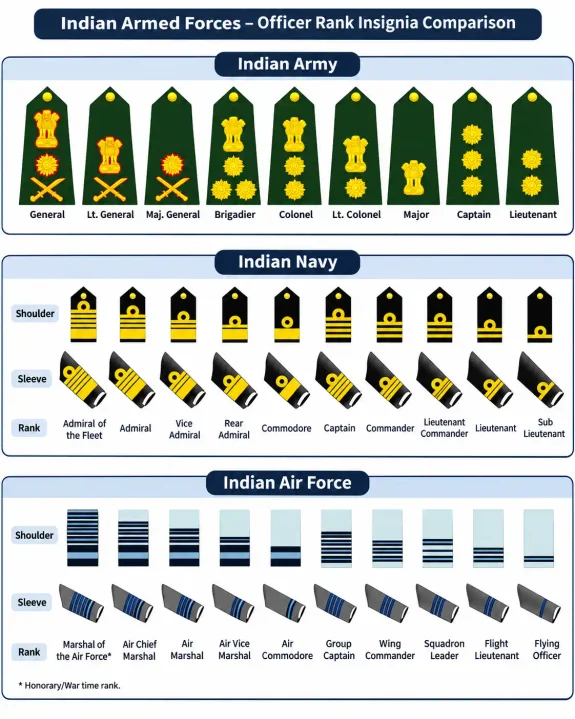
Indian Army Officer Rank Insignia
Indian Army officer insignia commonly incorporate national and military symbols, including the Ashoka emblem, five-pointed stars, crossed sword and baton, and the rank-specific shoulder or uniform insignia.
The insignia allow personnel to identify an officer’s rank and position in the military hierarchy.
For junior and field officer ranks, commonly recognised insignia include:
| Army Rank | Insignia Identification |
|---|---|
| Colonel | National emblem above two stars |
| Lieutenant Colonel | National emblem above one star |
| Major | National emblem |
| Captain | Three stars |
| Lieutenant | Two stars |
Senior officer insignia use additional combinations of national and military symbols.
Image placement: Insert the official Indian Army officer rank insignia chart here, showing Lieutenant through General, with Field Marshal displayed separately.
2. Indian Army Junior Commissioned Officer Ranks
Junior Commissioned Officers form an important leadership link between commissioned officers and other ranks.
The principal JCO ranks are:
| JCO Rank | Rank Position |
|---|---|
| Subedar Major | Highest regular JCO rank |
| Subedar | Senior JCO rank |
| Naib Subedar | Entry JCO rank |
JCOs play important roles in unit administration, personnel leadership, training, discipline and operational coordination.
In some arms, particularly cavalry and armoured regiments, traditional rank titles such as Risaldar Major, Risaldar and Naib Risaldar are used.
3. Indian Army Other Ranks
The principal Army ranks below JCO are:
| Rank | Position |
|---|---|
| Havildar | Senior NCO rank |
| Naik | NCO rank |
| Lance Naik | Junior NCO rank |
| Sepoy | Basic soldier rank |
Equivalent traditional titles may differ between infantry, cavalry, artillery and other arms of the Indian Army.
Personnel enrolled under the Agnipath scheme are designated Agniveers. Agniveer is a distinct designation and should not automatically be treated as equivalent to every regular soldier rank.
Indian Navy Ranks and Insignia in Order
The Indian Navy protects India’s maritime interests, secures sea lines of communication and conducts naval operations.
Naval rank terminology differs from Army terminology because of the Navy’s maritime traditions and command structure.
1. Indian Navy Commissioned Officer Ranks
| Rank | General Description |
|---|---|
| Admiral | Four-star rank normally held by the Chief of Naval Staff |
| Vice Admiral | Three-star flag officer |
| Rear Admiral | Two-star flag officer |
| Commodore | One-star senior officer |
| Captain | Senior naval officer; may command major warships or shore establishments |
| Commander | Field-grade equivalent naval officer |
| Lieutenant Commander | Seniority above Lieutenant |
| Lieutenant | Junior commissioned naval officer |
| Sub Lieutenant | Entry-level commissioned rank |
A naval Captain is equivalent to a Colonel in the Indian Army, not an Army Captain.
This is one of the most frequently tested rank-equivalence facts in defence examinations.
Indian Navy Rank Insignia
Indian Navy officer rank insignia are commonly identified by gold-coloured stripes worn on the appropriate uniform, with the distinctive naval executive curl appearing in officer rank lace.
Different combinations of broad, medium and narrow stripes distinguish the various officer ranks.
Image placement: Insert a high-resolution Indian Navy officer rank chart showing Sub Lieutenant to Admiral, including sleeve and shoulder insignia where applicable.
2. Indian Navy Sailor Ranks
The principal sailor rank hierarchy includes:
| Rank | Position |
|---|---|
| Master Chief Petty Officer First Class | Senior-most regular sailor rank |
| Master Chief Petty Officer Second Class | Senior sailor rank |
| Chief Petty Officer | Senior sailor rank |
| Petty Officer | Non-commissioned sailor rank |
| Leading Seaman / Leading Rate | Junior leadership rank |
| Seaman First Class | Seaman rank |
| Seaman Second Class | Basic seaman rank |
Some naval branches use additional specialist titles and technical rating designations.
The precise insignia and terminology also depend on branch and uniform category.
Agniveers serving in the Navy have a distinct service designation under the Agnipath scheme.
Indian Air Force Ranks and Insignia in Order
The Indian Air Force is responsible for defending Indian airspace, conducting air operations and supporting joint military missions.
Its rank hierarchy reflects its aviation traditions and operational requirements.
1. Indian Air Force Commissioned Officer Ranks
| Rank | General Description |
|---|---|
| Air Chief Marshal | Four-star rank normally held by the Chief of the Air Staff |
| Air Marshal | Three-star air officer |
| Air Vice Marshal | Two-star air officer |
| Air Commodore | One-star air officer |
| Group Captain | Senior officer equivalent to Army Colonel |
| Wing Commander | Officer equivalent to Army Lieutenant Colonel |
| Squadron Leader | Officer equivalent to Army Major |
| Flight Lieutenant | Officer equivalent to Army Captain |
| Flying Officer | Entry-level commissioned rank |
A Flying Officer is the first commissioned officer rank in the Indian Air Force.
Promotion to higher ranks depends on the applicable service rules, experience, selection criteria and available vacancies.
Indian Air Force Officer Rank Insignia
Indian Air Force officer insignia generally feature rank-specific blue and black braid arrangements, with the eagle appearing on relevant shoulder insignia.
The number and arrangement of stripes or braid distinguish individual officer ranks.
Image placement: Insert the official Indian Air Force rank structure chart showing Flying Officer to Air Chief Marshal.
2. Indian Air Force Airmen Ranks
The airmen rank hierarchy, from highest to lowest, is:
| Rank | Position |
|---|---|
| Master Warrant Officer | Highest regular airman rank |
| Warrant Officer | Senior airman rank |
| Junior Warrant Officer | Warrant rank |
| Sergeant | Senior NCO rank |
| Corporal | NCO rank |
| Leading Aircraftman | Airman rank |
| Aircraftman | Basic airman rank |
The Indian Air Force also has a separate category of Non-Combatants (Enrolled), identified as NCs(E).
Airmen and Agniveervayu should not be confused with commissioned officers.
Agniveervayu personnel serve under the applicable Agnipath engagement framework and have a distinct service designation.
Equivalent Ranks of JCOs, Sailors and Airmen
The ranks below commissioned officer level are not organised identically in the three services.
The Army uses Junior Commissioned Officer ranks, while the Navy has senior sailor ranks and the Air Force uses warrant officer ranks.
The following table presents broadly corresponding ranks used in official inter-service equivalence references.
| Indian Army | Indian Navy | Indian Air Force |
|---|---|---|
| Subedar Major | Master Chief Petty Officer First Class | Master Warrant Officer |
| Subedar | Master Chief Petty Officer Second Class | Warrant Officer |
| Naib Subedar | Chief Petty Officer | Junior Warrant Officer |
| Havildar | Petty Officer | Sergeant |
| Naik | Leading Seaman | Corporal |
| Sepoy | Seaman First/Second Class | Aircraftman / Leading Aircraftman |
Note: This is a simplified equivalence table. The services maintain different rank and specialist-rating structures. Certain intermediate ranks, such as Army Lance Naik, do not have an exact separate one-to-one counterpart in the official equivalence table.
Five-Star Ranks in the Indian Armed Forces
The Indian Armed Forces have three corresponding five-star ranks:
- Indian Army: Field Marshal
- Indian Navy: Admiral of the Fleet
- Indian Air Force: Marshal of the Indian Air Force
These ranks occupy the highest ceremonial position in the respective service hierarchies.
They are exceptionally rare and are not part of ordinary service promotions.
Field Marshal in the Indian Army
Only two officers have been conferred the rank of Field Marshal in India.
Field Marshal Sam Manekshaw
Sam Hormusji Framji Jamshedji Manekshaw became India’s first Field Marshal in 1973.
He is remembered for his leadership of the Indian Army during the 1971 India-Pakistan War.
Field Marshal K. M. Cariappa
Kodandera Madappa Cariappa was the first Indian Commander-in-Chief of the Indian Army.
He was conferred the rank of Field Marshal in 1986.
Marshal of the Indian Air Force
Marshal of the Indian Air Force Arjan Singh received the five-star rank in 2002.
He was the first and remains the only Indian Air Force officer to have held this rank.
Arjan Singh previously served as Chief of the Air Staff and played an important role in leading the Air Force during the 1965 India-Pakistan War.
Admiral of the Fleet in the Indian Navy
Admiral of the Fleet is the corresponding five-star rank of the Indian Navy.
However, no Indian Navy officer has been conferred this rank.
Difference Between Rank and Appointment in the Armed Forces
Rank and appointment are related but distinct concepts.
Rank indicates a service member’s formal position in the military hierarchy.
Appointment refers to the specific role, command or responsibility assigned to that person.
For example, General is a military rank, while Chief of the Army Staff is an appointment.
Similarly:
| Military Rank | Example of Appointment |
|---|---|
| General | Chief of the Army Staff |
| Admiral | Chief of the Naval Staff |
| Air Chief Marshal | Chief of the Air Staff |
| Lieutenant General | General Officer Commanding-in-Chief |
| Vice Admiral | Flag Officer Commanding-in-Chief |
| Air Marshal | Air Officer Commanding-in-Chief |
The same rank may be held by multiple officers occupying different appointments.
How to Identify Military Ranks by Insignia
Military insignia provide a visual indication of rank, although designs and placement vary by service and type of uniform.
Indian Army
Army officer insignia commonly feature stars, the national emblem and crossed sword-and-baton devices.
Junior officers are often identified through star combinations, while senior ranks use additional insignia.
Indian Navy
Naval officers are recognised by distinctive gold rank stripes and executive curls on prescribed uniforms.
The arrangement and width of stripes help distinguish ranks.
Indian Air Force
Air Force officer insignia use distinctive braid or stripe arrangements and service-specific symbols.
The insignia allow officers of different ranks to be identified on appropriate dress uniforms.
Important: Uniform insignia may differ between ceremonial, working, operational and other authorised dress combinations. Candidates should study official charts rather than assuming every uniform carries identical insignia.
Important Facts About Indian Military Ranks for NDA, CDS and SSB Interviews
| Question | Answer |
|---|---|
| Highest five-star rank in the Indian Army? | Field Marshal |
| Highest normal commissioned rank in the Indian Army? | General |
| Equivalent of Army Colonel in Navy? | Captain |
| Equivalent of Army Major in Air Force? | Squadron Leader |
| Equivalent of Army Brigadier in Navy? | Commodore |
| Equivalent of Army Lieutenant General in Air Force? | Air Marshal |
| Equivalent of Navy Commander in Army? | Lieutenant Colonel |
| Equivalent of Navy Sub Lieutenant in Air Force? | Flying Officer |
| Equivalent of Air Force Group Captain in Army? | Colonel |
| First Indian Field Marshal? | Sam Manekshaw |
| First Indian Commander-in-Chief of the Army? | K. M. Cariappa |
| Only Marshal of the Indian Air Force? | Arjan Singh |
| Has India appointed an Admiral of the Fleet? | No |
| Highest regular JCO rank in Army? | Subedar Major |
| Highest regular airman rank in IAF? | Master Warrant Officer |
Frequently Asked Questions (FAQs)
1. What are the ranks in the Indian Army in order?
The normal commissioned officer ranks, from lowest to highest, are Lieutenant, Captain, Major, Lieutenant Colonel, Colonel, Brigadier, Major General, Lieutenant General and General. Field Marshal is an exceptional five-star rank.
2. What are the ranks in the Indian Navy?
The commissioned officer ranks are Sub Lieutenant, Lieutenant, Lieutenant Commander, Commander, Captain, Commodore, Rear Admiral, Vice Admiral and Admiral. Admiral of the Fleet is the five-star rank.
3. What are the ranks in the Indian Air Force?
The commissioned officer ranks are Flying Officer, Flight Lieutenant, Squadron Leader, Wing Commander, Group Captain, Air Commodore, Air Vice Marshal, Air Marshal and Air Chief Marshal.
4. Which rank is equivalent to Major in the Indian Navy?
An Indian Army Major is equivalent to a Lieutenant Commander in the Indian Navy.
5. Which rank is equivalent to Captain in the Indian Air Force?
An Indian Army Captain is equivalent to a Flight Lieutenant in the Indian Air Force.
6. Is a Navy Captain higher than an Army Captain?
Yes. A Navy Captain is equivalent to an Army Colonel, making it substantially higher in the rank hierarchy than an Army Captain.
7. Is a Wing Commander equivalent to a Colonel?
No. An Indian Air Force Wing Commander is equivalent to an Army Lieutenant Colonel. An Air Force Group Captain is equivalent to an Army Colonel.
8. What is the equivalent of Brigadier in the Indian Navy?
An Indian Army Brigadier is equivalent to a Commodore in the Indian Navy and an Air Commodore in the Indian Air Force.
9. What is the lowest commissioned officer rank in the Army?
Lieutenant is the entry-level commissioned rank in the Indian Army.
10. What is the lowest commissioned officer rank in the Navy?
Sub Lieutenant is the entry-level commissioned officer rank in the Indian Navy.
11. What is the lowest commissioned officer rank in the Air Force?
Flying Officer is the entry-level commissioned officer rank in the Indian Air Force.
12. How many five-star military officers has India had?
India has had three five-star military officers: Field Marshal Sam Manekshaw, Field Marshal K. M. Cariappa and Marshal of the Indian Air Force Arjan Singh.
13. What is the difference between a JCO and an NCO?
A Junior Commissioned Officer holds a distinct category of junior commission in the Indian Army, while a Non-Commissioned Officer holds a non-commissioned military rank. Both contribute to leadership, discipline and unit functioning, but their service status and authority differ.
14. Are Agniveers equivalent to Sepoys?
Agniveers have a distinct designation under the Agnipath scheme. Their appointment should not automatically be equated with the regular Sepoy rank or with every other traditional enlisted rank.
15. Why should SSB candidates know military ranks?
SSB interview candidates may be asked about the rank hierarchy, equivalent ranks, current service chiefs, military uniforms and organisational structure of the armed forces.
Knowing these topics demonstrates awareness of the organisation an aspirant hopes to join.
Conclusion
The ranks and insignia of the Indian Army, Navy and Air Force reflect the organisational hierarchy, command responsibilities and traditions of India’s three armed services.
Although each service uses different terminology and visual insignia, corresponding ranks broadly share an equivalent position in the military hierarchy.
For NDA, CDS, AFCAT and SSB interview candidates, understanding military ranks is an essential part of defence general knowledge.
Candidates should particularly remember the equivalent officer ranks, the distinction between commissioned officers and personnel below officer rank, the five-star ranks and the differences between military rank and appointment.