Every AFCAT, NDA and CDS aspirant who dreams of flying with the Indian Air Force (IAF) should know where the force actually lives and fights from. An air force is only as strong as its bases. Fighters, transport aircraft, helicopters, radars and air defence missiles all depend on a network of air force stations spread from the snows of Ladakh to the islands of the Bay of Bengal.
Questions on IAF bases, commands and squadrons appear regularly in defence exams, and Interviewing Officers at the Services Selection Board (SSB) often ask candidates about the defence set-up in their home state. Knowing why a base sits where it does also helps in group discussions on national security, the China border or the Indian Ocean.
The IAF is organised into seven commands: five operational commands (Western Air Command, New Delhi; Eastern Air Command, Shillong; Central Air Command, Prayagraj; Southern Air Command, Thiruvananthapuram; and South Western Air Command, Gandhinagar) and two functional ones (Training Command, Bengaluru, and Maintenance Command, Nagpur). Here are 12 important IAF bases and the reasons they matter. The numbering is for easy reading and is not an official ranking. Units move between bases from time to time, so details reflect publicly reported information.
1. Air Force Station Ambala, Haryana
Command: Western Air Command
Origins: Airstrip built in 1919; became a permanent station headquarters in 1938
Best known for: First Rafale squadron, No. 17 Squadron ‘Golden Arrows’
Strategic role: Air defence and strike operations on the western front
Ambala is one of the oldest air bases in India. An airfield was set up here by the Royal Air Force in 1919, and in 1938 it became a permanent station when No. 1 Squadron, the oldest squadron of the IAF, moved in. After Independence it became one of the earliest stations of the Indian Air Force.
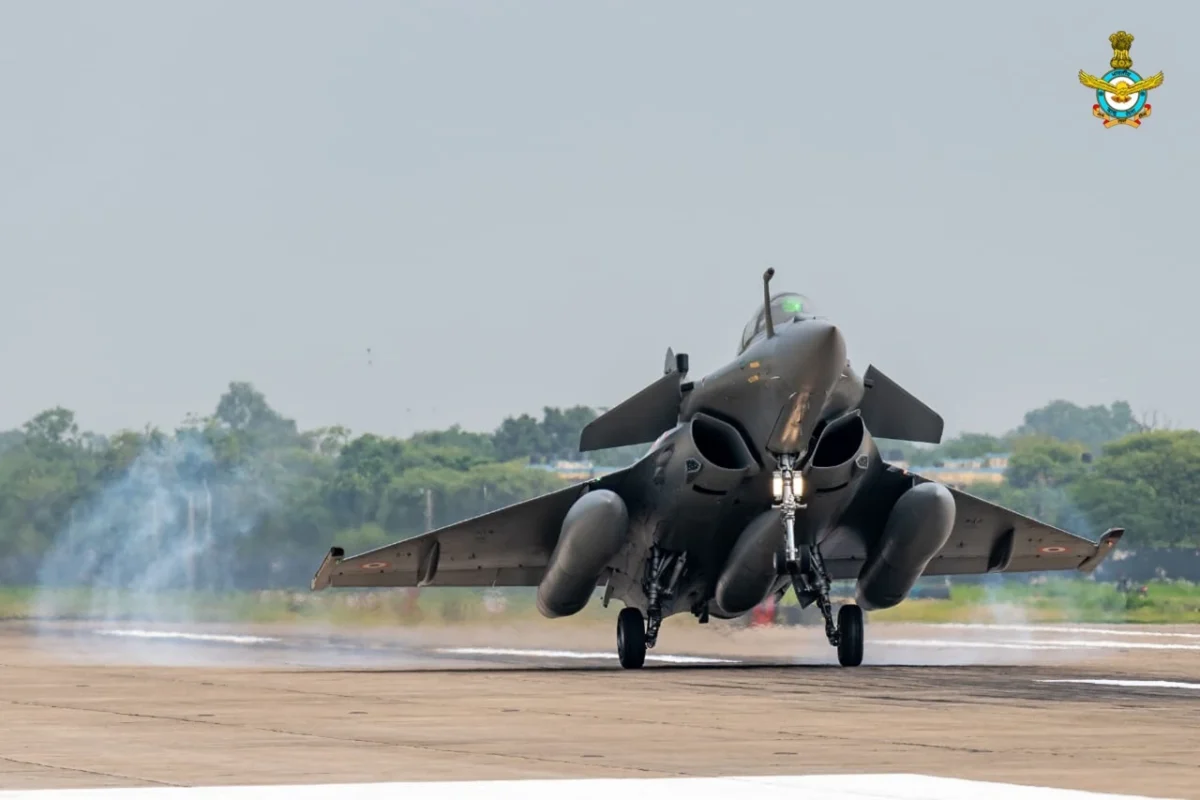
Ambala made headlines on 29 July 2020, when the first five Rafale jets landed here after flying from France. No. 17 Squadron, the ‘Golden Arrows’, was formally re-equipped with the Rafale at Ambala in September 2020, making the base the home of India’s first squadron of these 4.5-generation multirole fighters.
2. Air Force Station Hasimara, West Bengal
Command: Eastern Air Command
Activated: 7 April 1963, after the 1962 war
Best known for: Second Rafale squadron, No. 101 Squadron ‘Falcons’, inducted in July 2021
Strategic role: Guards the Siliguri Corridor and the Chumbi Valley approach
Hasimara lies in Alipurduar district, close to the India–Bhutan border. The decision to build the base was taken after the 1962 war with China, and it became active on 7 April 1963.
Its importance comes from geography. Hasimara is the closest Indian air base to the Chumbi Valley, the area around the tri-junction of Sikkim, Bhutan and Tibet. It also sits near the narrow Siliguri Corridor, the ‘Chicken’s Neck’ that links mainland India with the north-eastern states.
3. Air Force Station Hindan, Ghaziabad (Uttar Pradesh)
Command: Western Air Command
Key units: No. 81 Squadron (C-17 Globemaster III) and No. 77 Squadron (C-130J Super Hercules)
Area: About 10 sq km; often described as one of the largest air bases in Asia
Strategic role: Strategic airlift and air cover for the National Capital Region
Hindan, on the outskirts of Delhi near the Hindon river, is the hub of the IAF’s strategic airlift. The giant C-17 Globemaster III and the C-130J Super Hercules special operations aircraft both operate from here.
Aircraft from Hindan are often the first to leave India during a crisis. C-17s have flown evacuation and disaster relief missions such as Operation Ganga (bringing Indian students back from the Ukraine region in 2022) and Operation Dost (earthquake relief in Türkiye in 2023). The base also gives quick air cover to the national capital, a role whose importance was recognised in 2003 when its fighter infrastructure was revived.
4. Air Force Station Leh, Ladakh
Command: Western Air Command
Elevation: About 3,256 metres (10,682 feet)
Historic first: Air Commodore Mehar Singh landed a Dakota at Leh in May 1948
Strategic role: Air bridge and fighter operations for eastern Ladakh and the LAC
Leh, one of the highest airfields in the world, began its military story during the 1947–48 war, when Air Commodore Mehar Singh landed a Dakota at Leh in May 1948 with Major General K S Thimayya on board, on a strip with no proper runway or navigation aids. That flight helped save Ladakh, because troops and supplies could then be flown in.
Today Leh is the main air bridge for the Army in eastern Ladakh. During the standoff with China that began in 2020, the IAF flew troops, tanks, guns and supplies into Ladakh and deployed fighters and helicopters in the region. Thin air reduces engine power and lift, so flying from Leh demands special skill from pilots and engineers.
5. Mudh-Nyoma Air Force Station, Ladakh
Command: Western Air Command
Elevation: About 13,700 feet
Operationalised: 12 November 2025, when the Chief of the Air Staff landed in a C-130J
Strategic role: Fighter-capable base close to the Line of Actual Control
Nyoma, in eastern Ladakh, is the newest major base on this list. The old advanced landing ground was upgraded by the Border Roads Organisation into a full air base with a runway of about 2.7 km, hangars, an air traffic control building and hard standing for aircraft. Defence Minister Rajnath Singh laid the foundation stone in September 2023.
On 12 November 2025, Air Chief Marshal A P Singh landed at the base in a C-130J Super Hercules to mark its operationalisation. Media reports place Nyoma roughly 23 to 25 km from the Line of Actual Control, which makes it one of the IAF’s most forward bases in the region.
Nyoma is built to handle fighter jets, transport aircraft and helicopters. It strengthens a chain of Ladakh airfields that already includes Leh, Thoise and Kargil, along with advanced landing grounds such as Daulat Beg Oldi, where a C-130J landed in August 2013 at an altitude of about 16,600 feet.
6. Air Force Station Srinagar, Jammu and Kashmir
Command: Western Air Command
Historic airlift: 27 October 1947: Dakotas flew in troops of 1 Sikh to save Srinagar
Param Vir Chakra: Flying Officer Nirmal Jit Singh Sekhon, No. 18 Squadron, 14 December 1971
Strategic role: Air defence and support operations in the Kashmir Valley
Srinagar airfield has a special place in Indian military history. On 27 October 1947, IAF and civilian Dakotas landed troops of the 1st Battalion of the Sikh Regiment here to stop raiders who were advancing on the city. The airlift, flown from a poorly developed strip without landing aids, helped save Srinagar.
In the 1971 war, the base was attacked by the Pakistan Air Force. On 14 December 1971, Flying Officer Nirmal Jit Singh Sekhon of No. 18 Squadron took off in his Gnat during an enemy raid and engaged several attacking Sabres before he was killed. He was awarded the Param Vir Chakra posthumously and remains the only IAF officer to receive India’s highest wartime gallantry award.
7. Air Force Station Gwalior (Maharajpur), Madhya Pradesh
Command: Central Air Command
Best known for: The Mirage 2000 fleet
Key establishment: Tactics and Air Combat Development Establishment (TACDE)
Strategic role: Deep-strike capability from a base in central India
Gwalior’s Maharajpur air base was built before the Second World War. Since the mid-1980s it has been closely linked with the Dassault Mirage 2000, a fighter the IAF calls the Vajra.
The Mirage 2000 is the aircraft type that carried out the Balakot air strike on 26 February 2019, and it also played an important part in the 1999 Kargil War with laser-guided bombing. Being in central India, Gwalior is relatively far from the borders, which makes it harder to target while still letting its fighters reach the western front.
8. Air Force Station Agra, Uttar Pradesh
Command: Central Air Command (since July 1971)
Key units: No. 78 Squadron (IL-78 mid-air refuellers), No. 50 Squadron (A-50EI AWACS)
Training: Paratroopers Training School (PTS)
Strategic role: Force multipliers: air refuelling, airborne early warning and airborne forces
No. 78 Squadron, the IAF’s first mid-air refuelling squadron, flies the IL-78MKI tanker, which lets fighters stay airborne longer and reach farther. No. 50 Squadron operates the A-50EI Phalcon Airborne Warning and Control System (AWACS), a flying radar that watches large areas of airspace and directs fighters.
Agra also hosts the Paratroopers Training School, which trains paratroopers from the Army, Navy, Air Force and other forces. For the Army’s airborne troops, Agra is where they earn their para wings.
9. Air Force Station Jamnagar, Gujarat
Command: South Western Air Command
Key unit: No. 6 Squadron ‘Dragons’, flying Jaguars, including the maritime strike version
History: Home to the Armament Training Wing in the 1960s
Strategic role: Air defence and maritime strike over the Gulf of Kutch and the Arabian Sea
Jamnagar sits on the coast of Saurashtra, close to the Gulf of Kutch and the Arabian Sea. In 1965 it was one of only two IAF bases in the south-western sector and hosted the Armament Training Wing.
Today the base is best known for No. 6 Squadron, the ‘Dragons’, which flies the SEPECAT Jaguar, including the Jaguar IM version used for maritime strike. Its pilots train to fly low over the sea and attack enemy ships, working closely with the Indian Navy.
10. Air Force Station Tezpur, Assam
Command: Eastern Air Command
Became an IAF base: 1959 (runway built in 1942)
Key aircraft: Su-30MKI, including No. 2 Squadron ‘Winged Arrows’
Strategic role: Air power for the eastern sector of the LAC, including Arunachal Pradesh
Tezpur, also known as Salonibari Air Force Station, sits on the north bank of the Brahmaputra. Its runway was built during the Second World War, when it was used as a heavy bomber base, and it became an IAF base in 1959.
The base is especially important for the defence of Arunachal Pradesh and the eastern stretch of the Line of Actual Control. Su-30MKI squadrons, including No. 2 Squadron ‘Winged Arrows’, are based here, giving the IAF long-range heavy fighters close to the eastern front.
11. Air Force Station Thanjavur, Tamil Nadu
Command: Southern Air Command
Inaugurated as a modern base: 27 May 2013
Key unit: No. 222 Squadron ‘Tigersharks’, Su-30MKI armed with BrahMos, inducted 20 January 2020
Strategic role: Maritime strike and air defence over the Indian Ocean region
Thanjavur’s airfield dates back to the Second World War. The IAF took it over in 1990, and after a major upgrade it was inaugurated as a modern air force station on 27 May 2013.
Its big moment came on 20 January 2020, when No. 222 Squadron, the ‘Tigersharks’, was resurrected here with Su-30MKI fighters capable of carrying the air-launched BrahMos supersonic cruise missile. It was the first Su-30MKI squadron in the south.
12. Air Force Station Car Nicobar, Andaman and Nicobar Islands
Joint set-up: Supports the tri-service Andaman and Nicobar Command, raised in 2001
Runway: Originally built by the Japanese during the Second World War; extended by the IAF in 1967
2004 tsunami: 116 IAF personnel and family members lost their lives
Strategic role: Watch over the eastern Indian Ocean and the approaches to the Malacca Strait
On 26 December 2004, the Indian Ocean tsunami devastated the station, and 116 IAF officers, airmen and family members lost their lives. In one of the IAF’s finest recoveries, the personnel rebuilt the runway, navigation aids and basic facilities, and the station resumed operations on 14 April 2005, about three and a half months later.
The Andaman and Nicobar Islands sit near the busy shipping routes leading to the Malacca Strait, through which a large share of the world’s trade passes. Car Nicobar and other airfields in the islands give India the ability to watch and, if required, control these approaches.
How to Remember IAF Bases for Exams
A simple way to remember these bases is to link each one with a front or a role. Ambala, Srinagar and Jamnagar face the west; Hasimara and Tezpur face the east; Leh and Nyoma guard Ladakh; Thanjavur and Car Nicobar look out over the sea; and Hindan, Agra and Gwalior provide airlift, force multipliers and deep strike from the heartland.
Conclusion
From Ambala’s Rafales and Hindan’s Globemasters to the high-altitude strips of Leh and Nyoma and the island outpost of Car Nicobar, the IAF’s bases show how India plans to defend its land borders, its airspace and its maritime interests. Each base exists because of a specific threat, a historic lesson or a strategic opportunity.
For AFCAT, NDA and CDS aspirants, understanding this map is more useful than memorising a list. If you can explain at your SSB why a base sits where it does, you show the awareness and clear thinking that assessors look for in a future officer.
Frequently Asked Questions
1. How many commands does the Indian Air Force have?
The IAF has seven commands: five operational commands (Western, Eastern, Central, Southern and South Western) and two functional commands (Training and Maintenance).
2. Which IAF bases operate the Rafale?
The IAF’s two Rafale squadrons are based at Ambala (No. 17 Squadron, Golden Arrows) and Hasimara (No. 101 Squadron, Falcons).
3. Which is the highest airfield used by the IAF?
Daulat Beg Oldi in Ladakh, an advanced landing ground at about 16,600 feet, is among the highest airstrips in the world. Among full air bases, Mudh-Nyoma at about 13,700 feet is one of the highest.
4. Where is the IAF’s strategic airlift fleet based?
The C-17 Globemaster III fleet (No. 81 Squadron) and the first C-130J Super Hercules squadron (No. 77 Squadron) operate from Air Force Station Hindan near Delhi.
5. Which IAF officer won the Param Vir Chakra?
Flying Officer Nirmal Jit Singh Sekhon of No. 18 Squadron, for defending Srinagar airfield on 14 December 1971. He is the only IAF recipient of the Param Vir Chakra.