If you are preparing for NDA, CDS or the Indian Navy Entrance Test (INET) and dream of wearing the Navy’s white uniform, one of the first things you should understand is what kind of ships the Indian Navy actually operates. A modern navy is not just a collection of warships. It is a team of very different vessels, each built for a specific job, from launching fighter jets and hunting submarines to carrying troops, refuelling the fleet at sea and mapping the ocean floor.
Questions on ship types, their roles and recent commissionings appear regularly in defence GK sections, and Interviewing Officers at the Services Selection Board (SSB) often ask Navy aspirants why they chose the Navy and what they know about it. Being able to explain the difference between a destroyer and a frigate, or why a navy needs fleet tankers, shows genuine interest and awareness.
Here are 10 types of ships operated by the Indian Navy, with their roles, key classes and recent developments up to November 2026. The order roughly follows size and combat role and is not an official ranking.
1. Aircraft Carriers
Ships in service: INS Vikramaditya (R33) and INS Vikrant (R11)
Commissioned: Vikramaditya on 16 November 2013 in Russia; Vikrant on 2 September 2022 at Kochi
Main role: Carrying fighter aircraft and helicopters to project air power far out at sea
Aircraft: MiG-29K fighters and helicopters; 26 Rafale Marine fighters were ordered in 2025
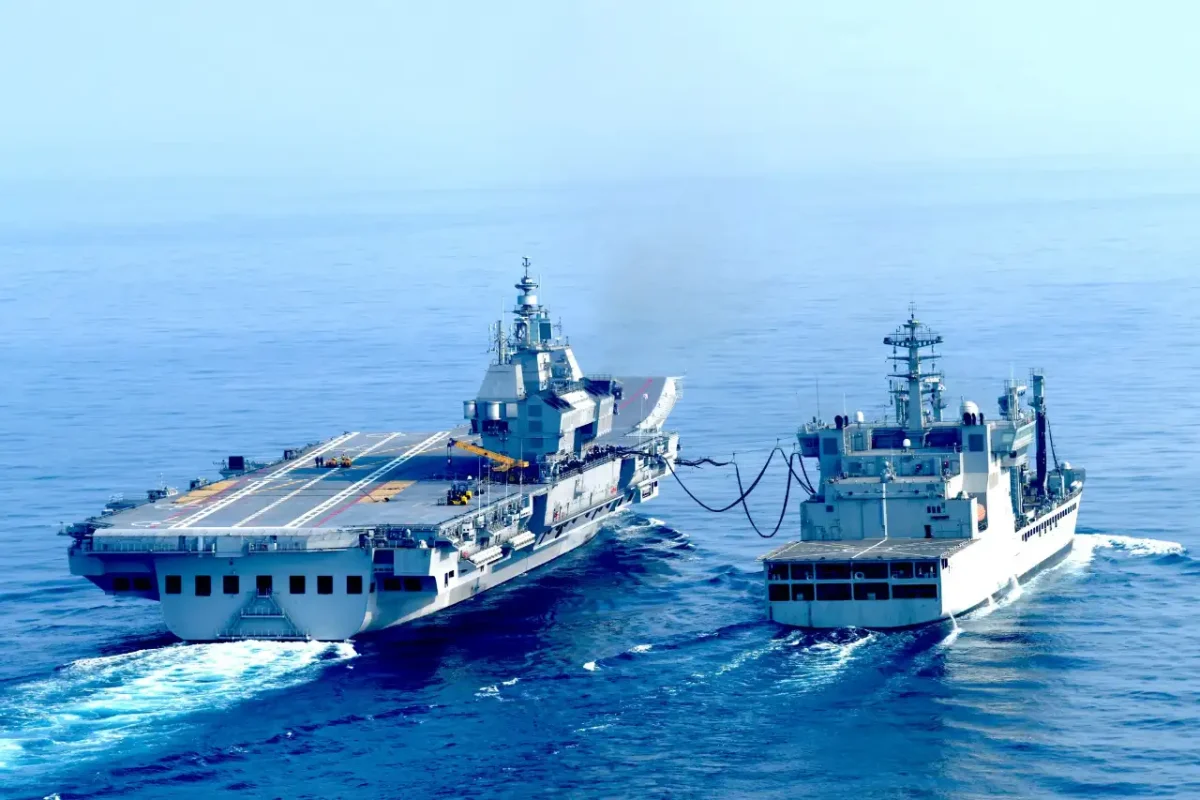
An aircraft carrier is the largest and most powerful type of warship, essentially a moving airbase. It allows a navy to carry fighter jets, early-warning and anti-submarine helicopters to any part of the ocean, protecting the fleet and striking targets far from India’s shores. Carriers are so valuable that they usually sail with a group of destroyers, frigates, submarines and a tanker, together called a Carrier Battle Group.
INS Vikramaditya is a modified Kiev-class ship (formerly the Soviet/Russian Admiral Gorshkov) that was rebuilt and handed over to India. INS Vikrant is India’s first indigenous aircraft carrier, designed by the Navy’s Warship Design Bureau and built by Cochin Shipyard Limited. It is the largest warship ever built in India, and it made India one of a small group of nations able to design and build its own carrier.
Both carriers use a ski-jump ramp for take-off and arrester wires for landing, a method known as STOBAR (Short Take-Off But Arrested Recovery). For exams, remember that the name Vikrant was earlier carried by India’s first carrier, which served from 1961 to 1997 and played an important role in the 1971 war.
2. Destroyers
Classes in service: Visakhapatnam class (Project 15B), Kolkata class (Project 15A), Delhi class (Project 15) and the older Rajput class
Newest ships: INS Visakhapatnam, INS Mormugao, INS Imphal and INS Surat (P-15B), commissioned 2021 to January 2025
Main role: Multi-role fleet escort: air defence, anti-ship strikes and anti-submarine warfare
Builder: Mazagon Dock Shipbuilders Limited, Mumbai (P-15, P-15A and P-15B)
Destroyers are large, fast and heavily armed surface combatants. In the Indian Navy they are the biggest warships after the carriers, and they are built to fight in all three dimensions: against aircraft and missiles, against enemy ships and against submarines. They usually lead task groups or protect the carrier.
The newest Visakhapatnam-class ships carry BrahMos supersonic cruise missiles and Barak-8/MRSAM surface-to-air missiles, along with torpedoes, anti-submarine rockets and helicopters. Their design evolved from the Kolkata class (INS Kolkata, INS Kochi and INS Chennai), which in turn followed the Delhi class, India’s first indigenous guided-missile destroyers, commissioned from 1997.
3. Frigates
Classes in service: Nilgiri class (Project 17A), Shivalik class (Project 17) and Talwar/Teg/Tushil class (Project 1135.6)
Newest ships: Six Nilgiri-class frigates commissioned from January 2025 to July 2026, including INS Dunagiri at Kolkata on 21 June 2026
Main role: Escort and multi-role operations; slightly smaller than destroyers
Builders: Mazagon Dock (Mumbai) and GRSE (Kolkata) for P-17A; Yantar Shipyard (Russia) and Goa Shipyard for P-1135.6
Frigates are versatile warships that are generally a little smaller and lighter than destroyers, but in modern navies the gap between the two has narrowed. Indian frigates escort convoys and carriers, hunt submarines, defend against air and missile threats and carry out patrols, anti-piracy missions and disaster relief.
The Nilgiri class is the Navy’s newest frigate class and has been inducted at a remarkable pace. These stealth ships have a clean hull and superstructure that reduce their radar signature, and they carry BrahMos and MRSAM missiles. The earlier Shivalik class (2010 to 2012) was India’s first indigenously designed and built stealth frigate class.
4. Corvettes
Classes in service: Kamorta class (Project 28) anti-submarine corvettes, Kora-class and older Khukri-class missile corvettes
Kamorta-class ships: INS Kamorta, INS Kadmatt, INS Kiltan and INS Kavaratti, commissioned 2014 to 2020
Main role: Anti-submarine warfare, coastal and regional sea control
Builder: Garden Reach Shipbuilders and Engineers (GRSE), Kolkata, for the Kamorta class
Corvettes are smaller warships, usually below the size of a frigate, designed for operations closer to the coast or in specific roles. Because they are cheaper and quicker to build, a navy can operate more of them and spread its presence over a wider area.
The four Kamorta-class ships are dedicated anti-submarine warfare (ASW) stealth corvettes. They carry torpedoes, anti-submarine rockets, a 76 mm gun and an ASW helicopter, along with sonars to detect submarines. INS Kavaratti, commissioned in October 2020, completed the class. The Kora-class and Khukri-class corvettes are older ships armed mainly with anti-ship missiles and guns.
5. Anti-Submarine Warfare Shallow Water Craft (ASW SWC)
Programme: 16 craft ordered in 2019: eight from Cochin Shipyard (Mahe class) and eight from GRSE (Arnala class)
Commissioned so far: Seven, from INS Arnala in June 2025 to INS Mangrol on 12 October 2026
Latest delivery: Amini, delivered by GRSE on 5 November 2026
Key features: About 77 metres long, waterjet propulsion, speed up to about 25 knots, over 80% indigenous content
Submarines are a serious threat close to India’s coastline and harbours, where large warships are less comfortable operating. The ASW Shallow Water Craft were designed to fill this gap. They hunt submarines in coastal and shallow waters, carry out underwater surveillance and low-intensity maritime operations, and can also undertake mine warfare tasks.
These craft carry shallow-water sonars such as the indigenous Abhay hull-mounted sonar, lightweight torpedoes, an indigenous anti-submarine rocket launcher and torpedo decoys. Their waterjet propulsion lets them manoeuvre sharply in confined waters. Ships commissioned so far include INS Arnala, INS Androth, INS Mahe, INS Anjadip, INS Agray, INS Malvan and INS Mangrol.
6. Submarines (Nuclear and Conventional)
Nuclear ballistic missile submarines (SSBN): Arihant class: INS Arihant (2016), INS Arighaat (2024) and INS Aridhaman (2026)
Conventional submarines (SSK): Kalvari class (six boats, 2017 to January 2025), Sindhughosh (Kilo) class and Shishumar class
Main role: Nuclear deterrence (SSBN); attacking ships and submarines, surveillance and mine-laying (SSK)
Builder: Kalvari class by Mazagon Dock, Mumbai, with French technology transfer
Submarines are the silent and hidden part of the fleet. The Indian Navy operates two broad kinds. Nuclear-powered ballistic missile submarines (SSBNs) of the Arihant class carry nuclear-capable ballistic missiles and form the sea-based leg of India’s nuclear triad, giving the country an assured second-strike capability. Because they are nuclear-powered, they can stay underwater for very long periods.
Conventional diesel-electric submarines (SSKs) are smaller and run on batteries charged by diesel engines. The six Kalvari-class boats, built to the French Scorpene design, are the most modern. They can fire torpedoes and anti-ship missiles, lay mines and gather intelligence. The older Sindhughosh class is of Russian (Kilo) origin, and the Shishumar class is of German design.
7. Amphibious Warfare Ships
Landing Platform Dock (LPD): INS Jalashwa, acquired from the US Navy (ex-USS Trenton) and commissioned in 2007
Landing Ship Tank (LST): Shardul class (INS Shardul, INS Kesari, INS Airavat) built by GRSE, and INS Gharial
Landing Craft Utility (LCU): Eight Mk IV LCUs built by GRSE
Main role: Carrying troops, tanks and vehicles and landing them on a beach; disaster relief and evacuation
Amphibious ships carry soldiers, vehicles and equipment across the sea and land them ashore, often on a beach without a proper port. They are essential for operations on islands, especially in the Andaman and Nicobar Islands, and for moving forces quickly in a crisis.
INS Jalashwa is the Navy’s largest amphibious ship. It has a well deck that can flood to launch landing craft and a flight deck for helicopters. The Shardul-class ships and INS Gharial can carry tanks, vehicles and troops, while the smaller Mk IV landing craft are used mainly around the islands. Plans to acquire new Landing Platform Docks have been approved by the government.
8. Offshore Patrol Vessels and Fast Attack Craft
Offshore Patrol Vessels: Saryu class (INS Saryu, Sunayna, Sumedha and Sumitra) built by Goa Shipyard, and older Sukanya-class ships
Fast Attack Craft: Car Nicobar class and similar small, fast patrol craft built by GRSE
Next Generation OPVs: 11 ships ordered in 2023 from Goa Shipyard and GRSE; Shreyas and Srishti were launched in October 2026
Main role: Patrolling the Exclusive Economic Zone, anti-piracy, protecting offshore oil assets and search and rescue
Not every naval mission needs a destroyer. India has a vast Exclusive Economic Zone (EEZ), long trade routes and offshore assets such as oil platforms. Offshore Patrol Vessels (OPVs) are built to patrol these waters for long periods at a lower cost, keeping an eye on illegal fishing, smuggling and piracy.
The Saryu-class Naval Offshore Patrol Vessels are often deployed for EEZ surveillance of friendly island nations. INS Sumitra served as the Presidential Yacht during the President’s Fleet Review in 2022. Fast Attack Craft are smaller and quicker, and are used for coastal patrol, protecting islands and responding quickly to threats near the shore.
9. Fleet Tankers and Fleet Support Ships
Ships in service: INS Deepak, INS Shakti, INS Aditya and INS Jyoti
Under construction: Five Fleet Support Ships at Hindustan Shipyard, Visakhapatnam; the first, Surya, was launched on 6 October 2026
Size of new ships: About 43,500 tonnes, more than 220 metres long
Main role: Refuelling and resupplying warships at sea with fuel, water, ammunition and stores
A fleet can only stay at sea as long as its fuel, food and ammunition last. Fleet tankers, also called replenishment ships, act as floating petrol pumps and warehouses. They sail with the warships and transfer fuel and stores while both ships are moving, a skill called Replenishment at Sea (RAS). Without them, carriers and destroyers would have to keep returning to harbour.
The Indian Navy’s current tankers include INS Deepak and INS Shakti, built in Italy and commissioned in 2011, INS Aditya, built by GRSE, and INS Jyoti. The new indigenous Fleet Support Ships will be much larger. Deliveries are expected to begin in 2027.
10. Survey Vessels and Other Special-Purpose Ships
Survey ships: Sandhayak class: INS Sandhayak (2024), INS Nirdeshak (2024), INS Ikshak (2025) and INS Sanshodhak (21 June 2026)
Diving support vessels: INS Nistar (July 2025) and INS Nipun (31 August 2026), built by Hindustan Shipyard
Ocean surveillance ship: INS Dhruv, commissioned in 2021
Training ships: Cadet training ship INS Tir and sail training ships INS Tarangini and INS Sudarshini
Some of the Navy’s most important ships never fire a missile. The Sandhayak-class Survey Vessels (Large), built by GRSE, map the seabed, chart navigation routes and collect ocean data. Each is about 110 metres long and carries multi-beam echo sounders, side-scan sonar and autonomous underwater vehicles. Accurate charts are vital for safe navigation, submarine operations and port development.
The Nistar-class Diving Support Vessels support deep-sea saturation diving, salvage and underwater intervention, and act as mother ships for the Deep Submergence Rescue Vessel used to rescue the crew of a stricken submarine. INS Dhruv, built by Hindustan Shipyard, is a specialised ocean surveillance ship that tracks satellites and missiles. Training ships of the First Training Squadron at Kochi take young officer cadets to sea, where they learn seamanship, navigation and teamwork.
Conclusion
The strength of the Indian Navy lies not in any one ship but in how these different types work together. Carriers provide air power, destroyers and frigates protect the fleet, corvettes and shallow water craft guard the coast against submarines, submarines provide deterrence and stealth, amphibious ships move troops, and tankers, survey ships and diving support vessels keep the whole system running. With most new ships now designed by the Warship Design Bureau and built in Indian shipyards, the Navy is also a symbol of India’s growing self-reliance.
For NDA, CDS and INET aspirants, try to remember at least one class and one recent ship for each type, and understand why that type exists. This kind of clear, practical knowledge is useful in the written exam, in group discussions and in the SSB personal interview.
Frequently Asked Questions (FAQs)
1. What is the difference between a destroyer and a frigate?
Destroyers are generally larger and more heavily armed, with stronger air defence. Frigates are usually a little smaller and focus on escort and anti-submarine roles, though modern Indian frigates such as the Nilgiri class are very capable multi-role ships.
2. How many aircraft carriers does the Indian Navy operate?
Two: INS Vikramaditya, commissioned in 2013, and INS Vikrant, India’s first indigenous aircraft carrier, commissioned in 2022.
3. What is an ASW Shallow Water Craft?
It is a small warship designed to hunt submarines in coastal and shallow waters. The Navy ordered 16 of them in 2019, and seven had been commissioned by October 2026.
4. Why does the Navy need fleet tankers?
Fleet tankers refuel and resupply warships at sea, so the fleet can stay deployed for long periods without returning to port.
5. What does a survey vessel do?
A survey vessel maps the seabed and collects ocean data to produce accurate nautical charts for safe navigation and naval operations. The Sandhayak class is the Navy’s newest survey ship class.