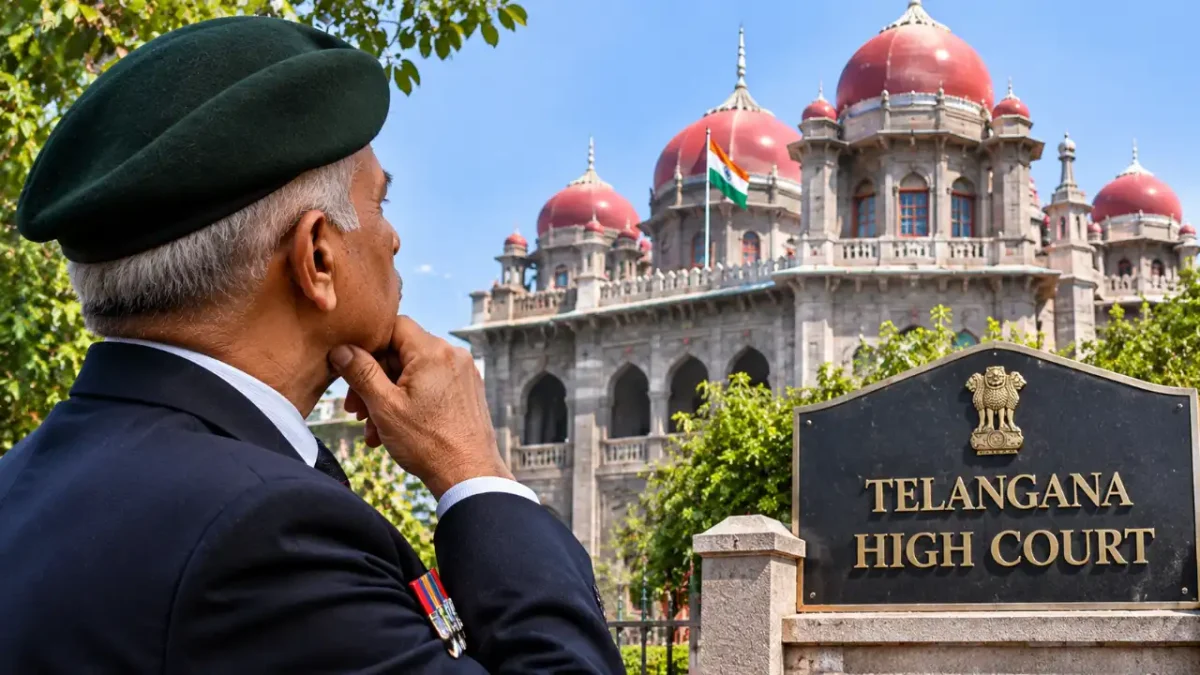
Hyderabad, November 13, 2026: Re-employed ex-servicemen cannot claim protection of their last-drawn Armed Forces pay as an automatic entitlement when their initial pay in a civilian government post is fixed, the Telangana High Court has ruled. A Division Bench of Acting Chief Justice P. Sam Koshy and Justice Narsing Rao Nandikonda dismissed a writ petition brought by former Army and Air Force personnel appointed as Social Security Assistants in the Employees’ Provident Fund Organisation (EPFO).
The petitioners had served in the Armed Forces for 18 to 20 years and retired before turning 55. They joined EPFO under the ex-servicemen quota between 2006 and 2012, and argued that their starting pay in those posts should match the last pay they drew in the Defence Services. The Central Administrative Tribunal (CAT), Hyderabad Bench, rejected their original application and review application in 2018; the High Court upheld the CAT’s orders.
Pay-fixation rules and the parties’ positions
The petitioners relied on the Central Civil Services (Fixation of Pay of Re-employed Pensioners) Orders, 1986, as amended by a Department of Personnel and Training Office Memorandum dated 5 April 2010. They cited paragraph 4(d)(i), which provides that, for ex-servicemen who held posts below Commissioned Officer rank and retired before age 55, the entire pension and the pension equivalent of retirement benefits are to be ignored when fixing initial pay on re-employment. They said this provision entitled them to fixation based on their last-drawn defence salary.
The respondents argued that ignoring pensionary benefits did not give the petitioners a right to protection of their previous Armed Forces pay. They maintained that initial pay was to be fixed at the entry pay in the revised pay structure applicable to direct recruits with effect from 1 January 2006.
Why the Court rejected the claim
The Bench found that the petitioners had not shown an enforceable legal right to have their initial civilian pay fixed at the level of their last Armed Forces pay. It held that the authorities had applied the rules and instructions for re-employment of ex-servicemen who had held posts below Commissioned Officer rank. The Court stated:
“…The petitioners have not been able to demonstrate that the fixation of their initial pay by the respondents is contrary to any mandatory provision of the applicable rules. … The contention that the petitioners are entitled to protection of the last pay drawn by them in the Defence Services, merely because their pensionary benefits are required to be ignored, is devoid of merit.”
The Bench added that setting pension aside for the purpose of initial pay fixation does not, by itself, create a separate right to preserve the last-drawn Armed Forces pay.
Supreme Court precedent and the outcome
In reaching its decision, the High Court relied on the Supreme Court judgment in Union of India and Others v. Anil Prasad (2022). The Supreme Court had clarified that re-employment in government service does not entitle an Armed Forces employee to a civil pay scale matching the last-drawn Armed Forces pay. The reference to that pay functions only as a ceiling: the pay calculated for the civil post must not exceed the basic pay, including deferred pay but excluding other emoluments, last drawn in the Armed Forces. It does not create an independent right to pay protection.
Anil Prasad concerned paragraph 8 of the 1986 Orders, which relates to Emergency Commissioned Officers and Short Service Commissioned Officers. The Telangana High Court held that its underlying principle—that last-drawn pay cannot be protected as a right without a specific provision—also applied to this case involving personnel below Commissioned Officer rank.
The Court also upheld the CAT’s rejection of the review application, noting that review cannot be treated as an appeal in disguise. It dismissed the writ petition and confirmed the CAT’s orders. The ruling confirms that, although pension is ignored when initial pay is fixed under the applicable provisions, that treatment does not automatically entitle re-employed ex-servicemen to parity with their last military pay. Pay fixation remains governed by the specific terms of the 1986 Orders and related DoPT instructions.