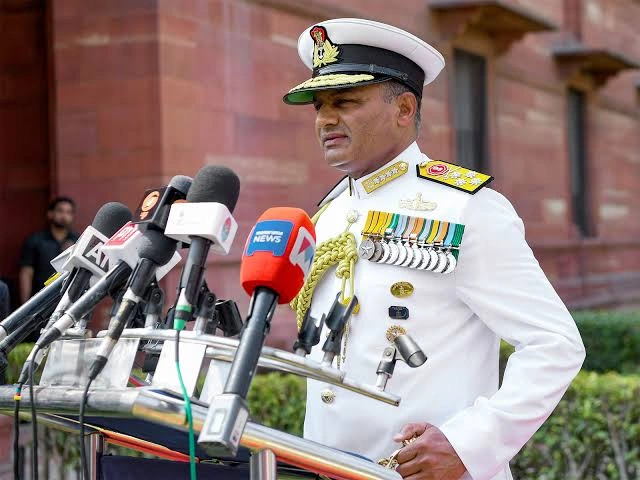
India’s current naval shipbuilding pipeline is being carried out at home: all 49 warships on order for the Indian Navy are under construction at Indian shipyards, Navy Chief Admiral Krishna Swaminathan said at the National Security Summit 3.0 in New Delhi on Monday. He described this as evidence of the country’s progress in designing and building naval vessels, while noting that some systems and technologies still rely on foreign supplies.
Admiral Swaminathan said the Navy had left behind its dependence on other countries for shipbuilding many years ago, changing from a “buyers’ navy” to a “builders’ navy”. India commissioned its 100th indigenously designed and constructed ship a few months ago and now operates more than 100 indigenous vessels, he said.
Asked when India would become self-reliant in building aircraft carriers and warships, the Navy Chief pointed to the 49 ships being procured and built in India. Their construction at Indian shipyards, however, does not mean that every component or technology aboard them is made domestically.
From early warships to INS Vikrant
Admiral Swaminathan traced India’s indigenous shipbuilding effort to 1960, when the country built its first indigenous warship, which he described as a relatively modest vessel. The Central Design Office, established in 1964, marked a further step in developing Indian expertise in naval ship design.
In 2022, India commissioned INS Vikrant, its first indigenously designed and constructed aircraft carrier. The Navy Chief said India was among a small group of nations able to design and build an aircraft carrier and a nuclear-propelled ballistic missile submarine within the country.
INS Vikrant’s commissioning demonstrated progress in delivering complex naval platforms through indigenous design and construction. Admiral Swaminathan also made clear that advances in shipbuilding have not eliminated reliance on overseas suppliers for every naval requirement.
Remaining dependencies and the 2047 goal
The Navy continues to depend on foreign supplies for certain critical components and technologies, including marine propulsion systems, some weapons, sensors and other capabilities not yet available domestically. Admiral Swaminathan expressed confidence that these gaps would narrow rapidly as India’s defence industrial ecosystem expands.
The Navy aims to become a completely Aatmanirbhar force by 2047. Meeting that objective will require domestic capabilities across the range of systems and technologies needed for naval operations, beyond the construction of ships themselves.
To support the goal, the Navy is working with the Ministry of Defence, public sector enterprises and private industry to establish an integrated ecosystem. The effort is intended to help Indian industries design and manufacture systems required by the Navy, reduce dependence on external suppliers and strengthen domestic defence manufacturing.
All 49 ships on order being built in India marks a significant step for domestic shipyards. The wider task is to extend indigenous capability across the naval supply chain, including propulsion, weapons and sensors, while addressing the remaining technological dependencies.