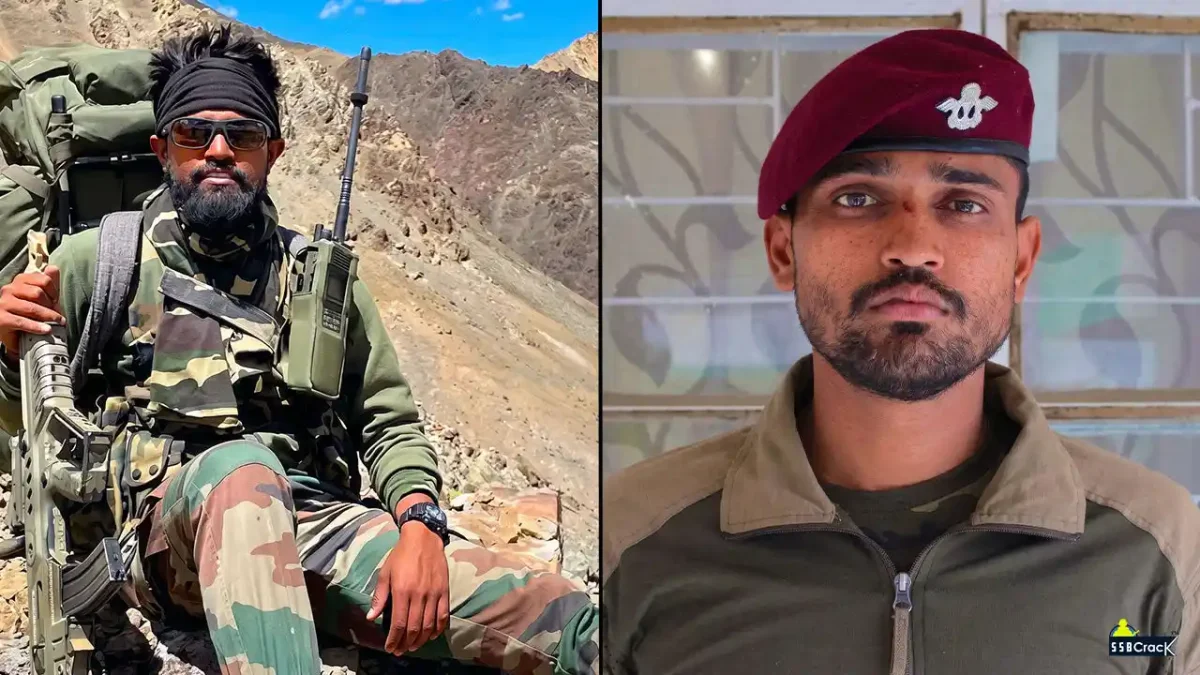
On 22 November 2023, in the thick forests of Kalakote in Jammu and Kashmir’s Rajouri district, a young Special Forces officer from Agra moved forward under fire to help his comrades. Captain Shubham Gupta of the 9th Battalion of the Parachute Regiment (Special Forces) was fatally wounded in that encounter. Two months later, on the eve of the 75th Republic Day, he was honoured with the Sena Medal (Gallantry), awarded posthumously.
For NDA, CDS, TES and SSB aspirants, Captain Gupta’s story is worth knowing in detail. He did not take the most common route into the officer corps, he chose the hardest unit he could volunteer for, and he gave his life doing the job he had asked for. Here is a look at his life, his service with 9 Para (SF) and what aspirants can take away from it.
Captain Shubham Gupta at a Glance
| Detail | Information |
|---|---|
| Hometown | Taj Ganj area, Agra, Uttar Pradesh |
| Parents | Basant Kumar Gupta (a government counsel in Agra) and Pushpa Devi Gupta |
| Sibling | Younger brother Rishabh Gupta |
| Schooling | St. George’s Inter College, Agra |
| Entry | Technical Entry Scheme (TES), 2015 |
| Training | Officers’ Training Academy, Gaya, followed by the Military College of Telecommunication Engineering, Mhow |
| Commissioned | 2018, as reported |
| Unit | 9 Para (Special Forces) |
| Service number | IC-84541K |
| Laid down his life | 22 November 2023, Kalakote, Rajouri district, J&K |
| Award | Sena Medal (Gallantry), posthumous, Republic Day 2024 |
Early Life in Agra
Shubham Gupta grew up in the Taj Ganj area of Agra, a short distance from the Taj Mahal. He was the elder son of Basant Kumar Gupta, a government counsel in Agra, and Pushpa Devi Gupta. His younger brother, Rishabh, was studying law at the time of the Rajouri encounter.
He completed his schooling at St. George’s Inter College in Agra. Interestingly, his family has said that nobody expected him to join the forces. Speaking to the press after his death, Rishabh described his elder brother as laid back and introverted as a boy, and said his decision to join the Army came as a surprise that later became an inspiration for the whole family. It is a useful reminder for aspirants that the Army does not look for one personality type. It looks for officer-like qualities, and those can be built.
The Technical Entry Scheme Route
Captain Gupta entered the Army in 2015 through the Technical Entry Scheme (TES), which takes candidates straight after Class 12 with Physics, Chemistry and Mathematics. His brother recalled that when he got into TES, he was advised to go with it rather than wait for the NDA, and he accepted that advice.
Under TES, cadets first complete basic military training at the Officers’ Training Academy, Gaya, and then move to one of the Army’s technical institutions for their engineering studies. In Captain Gupta’s case, that was the Military College of Telecommunication Engineering in Mhow. He was commissioned in 2018, according to reports, with his early service linked to the Corps of Signals. His first posting was at Panagarh in West Bengal.
Choosing the Special Forces
A technical posting did not satisfy him. His brother said that Captain Gupta found the job at Panagarh was not stimulating enough and wanted something more demanding. In 2020, he went for the three-month probation of the Parachute Regiment (Special Forces), and he stayed.
Para SF probation is one of the toughest tests in the Indian Army. Every officer and soldier is a volunteer, and the probation pushes candidates through long marches with heavy loads, sleep deprivation, tactical tasks and constant physical and mental pressure. Many drop out. Those who succeed earn the maroon beret and the Balidaan badge and join one of the Special Forces battalions.
Captain Gupta became part of 9 Para (SF), a battalion raised in 1966 with a long record in mountain warfare and counter-terrorism. By November 2023, the unit was deployed in the Rajouri sector of Jammu, an area that had seen several deadly terrorist attacks that year.
The Kalakote Encounter of November 2023
In November 2023, security forces received intelligence about terrorists hiding in the forested hills of Kalakote in Rajouri district. A joint operation by 9 Para (SF), 63 Rashtriya Rifles and the Jammu and Kashmir Police was launched, and the area within the Gulabgarh forest was cordoned and searched. On 22 November, the search teams made contact with the terrorists in the Bajimal area, and the terrorists opened fire.
What followed was an intense firefight in steep, wooded terrain. Captain Gupta was hit by gunfire during the encounter and later succumbed to his injuries. The fighting continued into the next day. When it ended, five Army personnel had made the supreme sacrifice:
- Captain Shubham Gupta, 9 Para (SF)
- Captain M V Pranjal, 63 Rashtriya Rifles
- Havildar Abdul Majid, 9 Para (SF)
- Lance Naik Sanjay Bisht, 9 Para (SF)
- Paratrooper Sachin Laur
Two Lashkar-e-Taiba terrorists were killed in the operation. The Army identified one of them as a Pakistani national called Quari, a senior LeT operative it described as a trained sniper and IED expert. He was believed to be behind the Dhangri and Kandi attacks earlier in 2023, which had killed seven civilians and five soldiers respectively.
Captain Gupta had spoken to his family only a couple of days before the encounter. His father later told reporters that his son had said he had a job to do and would come home as soon as it was done. The family had been expecting him home in early December, and his parents had been planning his wedding.
Sena Medal (Gallantry), Posthumous
On 25 January 2024, on the eve of the 75th Republic Day, President Droupadi Murmu approved gallantry awards for 80 Armed Forces personnel. The list included 53 Sena Medals (Gallantry), seven of them posthumous. Among them was IC-84541K Captain Shubham Gupta, 9th Battalion, The Parachute Regiment (Special Forces) (Posthumous).
His comrades from the same encounter were also recognised. Havildar Abdul Majid of 9 Para (SF) was awarded the Kirti Chakra posthumously, and Lance Naik Sanjay Bisht of 9 Para (SF) received the Sena Medal posthumously. Captain M V Pranjal of 63 Rashtriya Rifles and Paratrooper Sachin Laur were also honoured posthumously. Together, the awards from a single operation show how hard and costly the fight in Kalakote was.
The Sena Medal is awarded to Army personnel for individual acts of exceptional devotion to duty or courage. When given for gallantry, it recognises courage in the face of the enemy, and a posthumous award marks the highest price a soldier can pay.
Lessons for Defence Aspirants
- There is more than one way in. Captain Gupta joined through TES, not the NDA. TES, NDA, CDS, ACC and other entries all lead to the same commission. Pick the one that fits your qualification and age, and prepare for it fully.
- Your personality can grow. His family remembered him as a quiet, introverted boy. The SSB looks for qualities like initiative, courage and responsibility, and these develop with effort and exposure.
- Ask for the harder job. When his first posting did not challenge him, he volunteered for Para SF probation. Seeking responsibility is something assessors at the SSB notice in your stories and actions.
- Fitness is non-negotiable. Special Forces selection is built on endurance. Aspirants who start running, swimming and strength training early carry a real advantage into training and beyond.
- The team comes first. In Kalakote, officers and soldiers moved forward together under fire. Group tasks at the SSB test exactly this willingness to support others before yourself.
- Understand the commitment. Uniformed service can ask for everything. Aspirants should choose it knowing what it means, and with the conviction that it is worth it.
Frequently Asked Questions
1. Who was Captain Shubham Gupta?
He was an Indian Army officer from Agra, Uttar Pradesh, who served with 9 Para (Special Forces). He laid down his life in a counter-terrorism operation in Rajouri district, Jammu and Kashmir, on 22 November 2023.
2. Which gallantry award did Captain Shubham Gupta receive?
He was awarded the Sena Medal (Gallantry) posthumously in the Republic Day 2024 gallantry awards list.
3. How did he join the Indian Army?
He joined in 2015 through the Technical Entry Scheme (TES), trained at the Officers’ Training Academy, Gaya, and studied at the Military College of Telecommunication Engineering, Mhow. He later cleared Para SF probation in 2020.
4. Where did the Rajouri encounter take place?
It took place in the forested Kalakote area of Rajouri district, in the Bajimal area of the Gulabgarh forest, during a joint operation by 9 Para (SF), 63 Rashtriya Rifles and the J&K Police.
5. Who else made the supreme sacrifice in the operation?
Captain M V Pranjal, Havildar Abdul Majid, Lance Naik Sanjay Bisht and Paratrooper Sachin Laur also lost their lives. Two Lashkar-e-Taiba terrorists, including a Pakistani commander identified as Quari, were killed.
Conclusion
Captain Shubham Gupta’s journey took him from the lanes of Taj Ganj to the TES classrooms, a quiet technical posting in Bengal and finally the maroon beret of 9 Para (SF). He chose the hardest path open to him, and in the forests of Kalakote he moved forward when his comrades needed him. For every aspirant preparing for the NDA, CDS, TES or SSB, his story is a reminder of what the uniform stands for, and why the nation remembers those who wear it with such courage.