
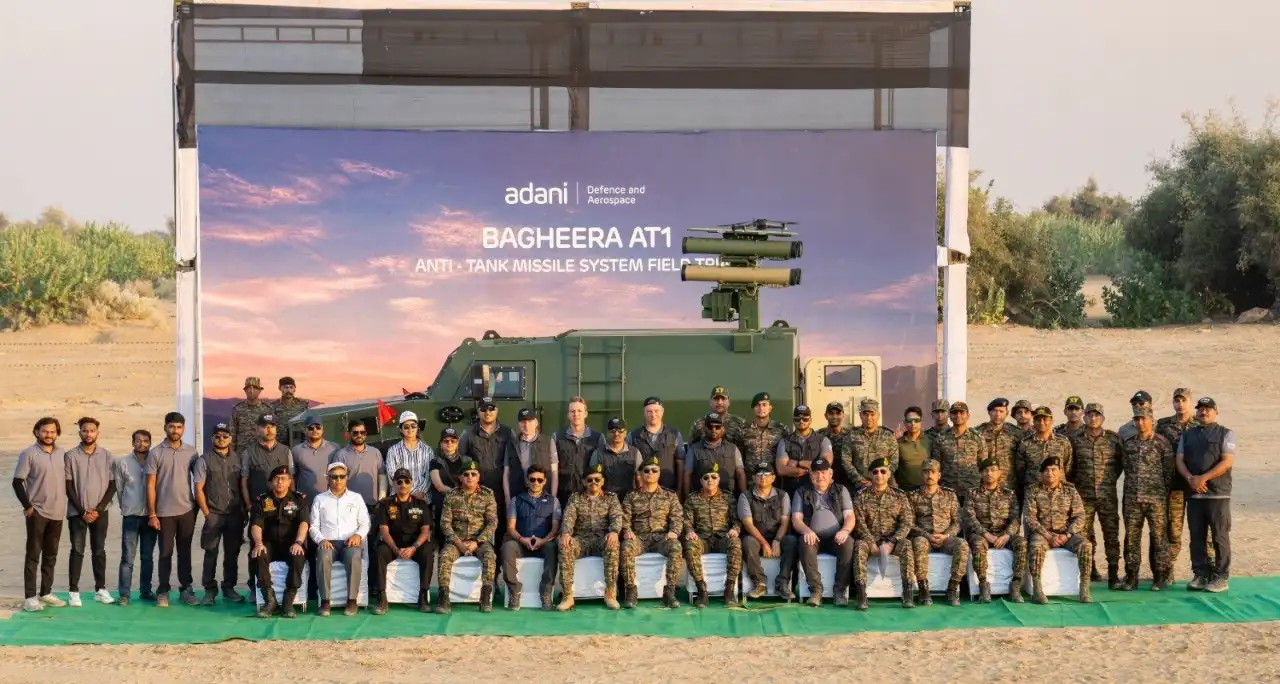
Adani Defence has put its Bagheera AT1 vehicle-mounted anti-tank guided missile (ATGM) system through a demonstration at the Pokhran firing range in Rajasthan, with senior officials from the Indian Army and the Ministry of Defence present. The company reported successful engagements in day and night trials, including against an armoured vehicle and a longer-range aerial target.
Conducted on Friday, November 20, the demonstration included two missiles fired in succession at designated targets. The tandem firing display comes amid efforts to expand domestic defence production and modernise anti-tank capabilities with greater private-sector participation.
System design and stated range
Adani Defence says development of the Bagheera AT1 took nearly 18 months. The company gives the system’s engagement range as up to 8 km, describing it as approximately twice the range of land-based anti-tank missiles currently in service with the Indian Army.
The launcher is mounted on an armoured 4×4 vehicle and combines a missile launcher with automated targeting and thermal imaging equipment. This vehicle-mounted arrangement is intended to provide a mobile anti-armour platform with integrated targeting and launch capabilities.
The system uses laser beam-riding guidance: the missile follows a laser beam directed towards its target rather than relying on a radio-frequency command link. Adani Defence says this makes the system resistant to electronic jamming. The company has highlighted this feature in the context of modern warfare, where electronic warfare and unmanned aerial systems are playing a growing role.
Protection systems and missile capacity
Adani Defence has also said the system is designed to engage tanks fitted with Active Protection Systems (APS). These systems are intended to detect and intercept incoming projectiles before they hit an armoured vehicle; the Bagheera AT1 is intended to address that challenge as part of its anti-armour capability.
The vehicle can carry 12 missiles in total. Four are positioned on the automated launcher and ready to fire, while eight more are carried for reloading, allowing multiple engagement opportunities before replenishment is required.
Evaluation and defence production context
The Indian Army continues to operate second-generation anti-tank guided missile systems, including the Milan-2T and Konkurs-M, which have been in service for around two decades. The Milan-2T also has an operational legacy dating back to the Kargil War, during which it played a role in the Army’s anti-armour capabilities.
Development of newer domestic systems forms part of a wider effort to strengthen India’s indigenous defence manufacturing ecosystem and reduce reliance on imported equipment. Under the Atmanirbhar Bharat initiative, the government has increasingly encouraged private-sector participation in developing and producing military platforms, weapons and technologies.
After the Pokhran demonstration, the Bagheera AT1 will be available for evaluation by the Armed Forces. Any future induction will depend on the evaluation outcome and the military’s requirements. The demonstration gives the system an opportunity to be assessed against operational needs and existing anti-tank capabilities.
India’s defence production reached a record ₹1.78 lakh crore in the financial year 2025-26, while defence exports stood at ₹38,424 crore. The private sector accounted for approximately 24 per cent of total defence production during the period, compared with 22 per cent in the previous financial year.
The Pokhran demonstration adds to indigenous defence development initiatives involving private companies. The Bagheera AT1’s proposed range, mobility, laser beam-riding guidance and missile capacity are among the features that will be relevant to its evaluation by the Armed Forces.