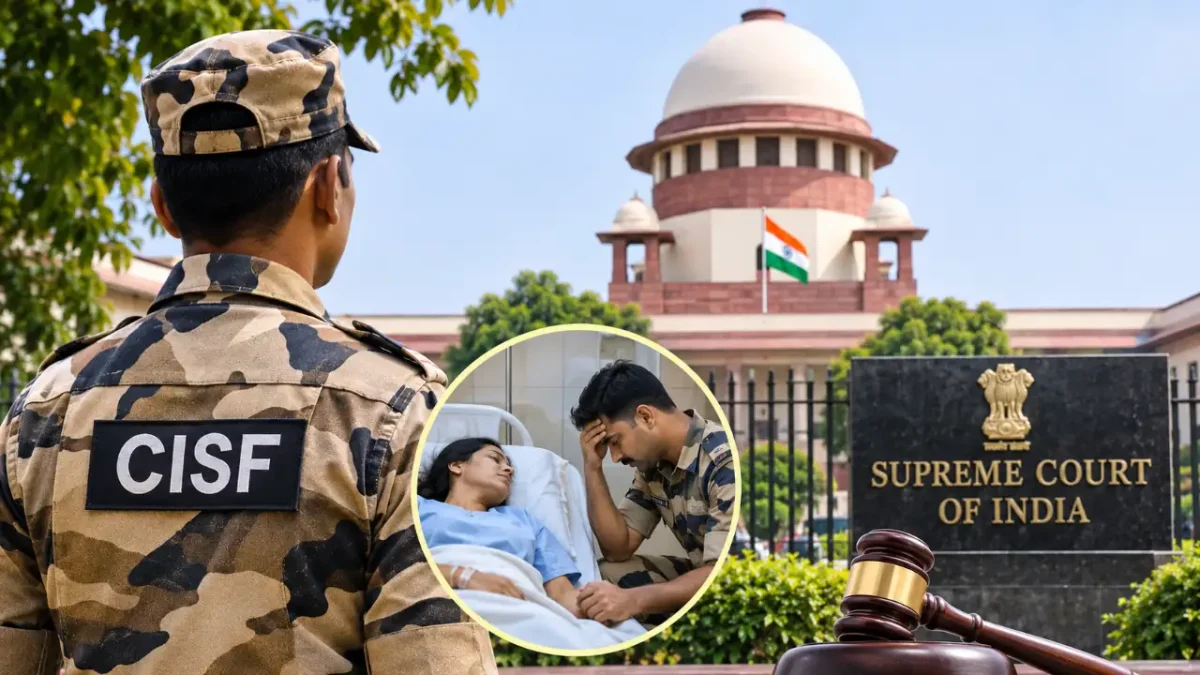
The Supreme Court has ordered the reinstatement of CISF Constable Sumit Kumar, setting aside his removal from service after he sought leave during his wife’s serious pregnancy-related medical emergency. The Court called the punishment “shockingly disproportionate” and “manifestly excessive” and directed that he receive 50 per cent of his back wages, along with consequential benefits.
A Bench of Justice Satish Chandra Sharma and Justice Nongmeikapam Kotiswar Singh delivered its judgment on November 16, 2026, in Sumit Kumar v. Union of India & Ors. (2026 INSC 1221). It quashed the removal order of May 1, 2018, as well as the appellate and revisional orders, and set aside the Delhi High Court’s judgment of February 14, 2024, and its subsequent review order.
Leave request and disciplinary proceedings
Kumar joined the Central Industrial Security Force (CISF) as a Constable (General Duty) in 2012 and served at the CISF Unit of the Uranium Corporation of India Limited (UCIL) in Jaduguda. In late October 2017, his wife developed serious pregnancy-related complications. She suffered a miscarriage and underwent major surgery on November 1.
Kumar was already on casual leave and sought an extension as his wife’s condition worsened. After briefly returning to duty, he applied for leave again and provided hospital documents. When further leave was initially declined, he submitted a conditional resignation through the departmental grievance portal on December 6, 2017, while under acute mental stress. Leave was later granted, and he returned to duty.
In January 2018, following a transfer, Kumar received a charge memorandum under the CISF Rules. The allegations included failing to appear before the Commandant with documents, circulating a video of his wife, and intimidating officers through relatives. Earlier minor penalties were also cited. A departmental inquiry found the charges proved, and he was removed from service on May 1, 2018. The Delhi High Court upheld the removal.
Supreme Court’s assessment
The Supreme Court found that the Inquiry Officer’s conclusions could not stand. It said the inquiry had not established a written direction requiring Kumar to appear before the Commandant on the relevant date. Nor was there evidence connecting him to the circulation of the video or to threats allegedly made by his relatives.
The Bench said an employee cannot be held responsible solely because of his relationship with people alleged to have committed misconduct. Disciplinary liability, it observed, must rest on conduct attributable to the employee and established through the inquiry.
The Court also held that past minor penalties, for which Kumar had already served the punishment, could not be treated as new misconduct or used to make up for gaps in proving the current charges. It noted procedural concerns, including that key documents were in English, which Kumar did not understand; Hindi translations were provided only after the prosecution evidence had closed; and his request for a defence assistant was denied.
On the penalty, the Court stated: “Even if the submission of the conditional resignation is taken to have been established, the circumstances… cannot be divorced from the serious medical condition of the appellant’s wife.” It described removal as “manifestly excessive and disproportionate to the misconduct, if any” and “shockingly disproportionate.” In view of the time that had passed, the Court declined to send the matter back for a fresh inquiry.
Reinstatement and back wages
The Supreme Court directed that Kumar be reinstated in service forthwith, with all consequential benefits and 50 per cent of the back wages due from the date of his removal until his reinstatement.
The ruling addresses proportionality in disciplinary proceedings and the need to establish charges against an employee independently, rather than infer misconduct from past penalties or unproven associations. A related judgment involving a CRPF constable who sought leave during a family medical emergency was also reported on the same day.