If you are preparing for the SSB Interview and you are someone who is extremely confident, strongly believes in your abilities, likes taking charge of situations and rarely doubts your decisions, then today’s article is especially for you.
Confidence is an important quality for an officer. An officer must be able to take decisions, accept responsibilities, face challenges and lead people in difficult situations.
But there is a very thin line between confidence and overconfidence.
Confidence means believing in your abilities, whereas overconfidence means believing that your abilities are greater than they actually are.
Sometimes, candidates who are highly confident may unintentionally dominate conversations, ignore suggestions, become defensive when criticised or find it difficult to accept their mistakes.
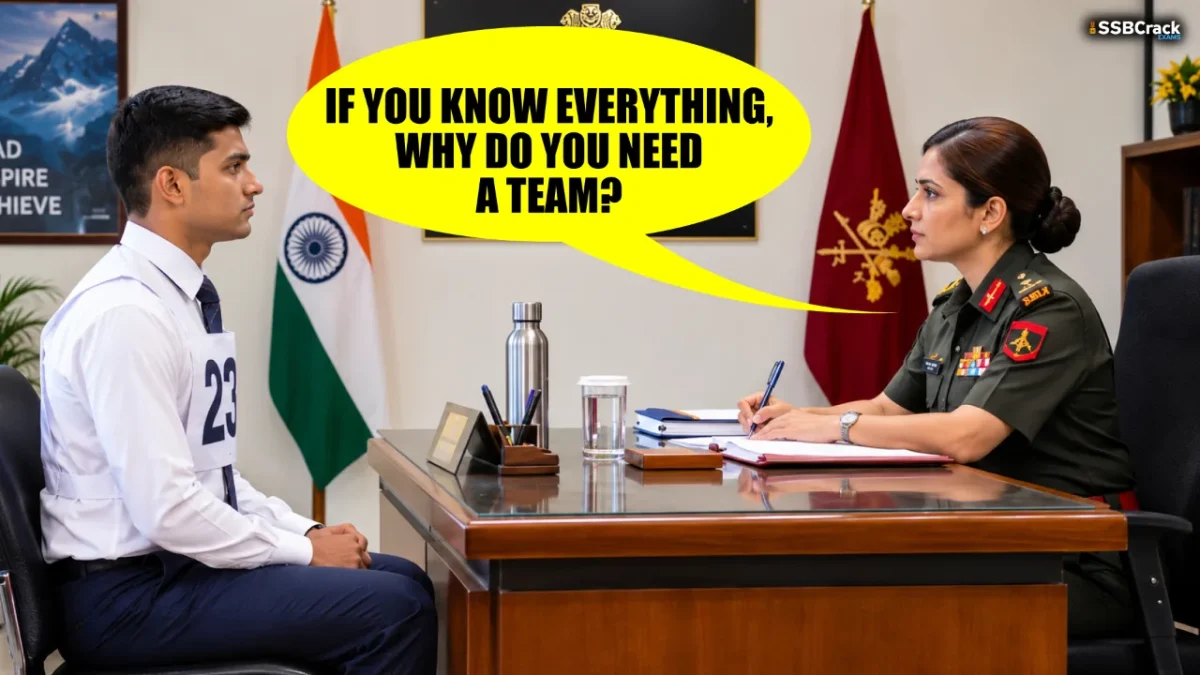
At SSB, the Interviewing Officer may therefore ask questions to understand whether your confidence is supported by actual abilities, whether you respect other people’s opinions, whether you can accept failure and whether you are capable of working under someone else’s leadership.
So, in today’s article, we will discuss 20 important SSB Interview questions for candidates with overconfidence, along with why each question is asked, how you should answer it, and a sample answer.
Remember, the objective is not to hide your confidence. The objective is to demonstrate that you are confident without becoming arrogant.
1. Do you consider yourself an overconfident person?
Why is this question asked?
The officer wants to assess your self-awareness and whether you can recognise the difference between confidence and overconfidence.
How should you answer?
Don’t immediately become defensive. Explain that you are confident but understand that sometimes you may need to control it.
Sample Answer
“Sir/Ma’am, I consider myself a confident person, but I wouldn’t like to describe myself as overconfident. However, there have been situations where I have trusted my abilities so much that I did not consider all the possibilities. I have realised that confidence should always be supported by preparation and a willingness to learn.”
2. What is the difference between confidence and overconfidence?
Why is this question asked?
The officer wants to understand whether you have a practical understanding of your own personality.
How should you answer?
Explain the difference through behaviour rather than giving only textbook definitions.
Sample Answer
“Sir/Ma’am, confidence means believing that I can perform a task while understanding that I may face difficulties or make mistakes. Overconfidence is assuming that I will succeed without considering the risks or preparing properly. A confident person is also willing to accept feedback and learn, whereas an overconfident person may ignore advice.”
3. Do you think you are always right?
Why is this question asked?
The officer wants to test your flexibility, openness to suggestions and ability to accept different viewpoints.
How should you answer?
Never claim that you are always right. Demonstrate that you can reconsider your opinion.
Sample Answer
“No, Sir/Ma’am. I may strongly believe in my decisions, but I understand that I can make mistakes. If someone presents a logical argument or better information, I am willing to reconsider my opinion. I believe being correct is more important than proving that I am right.”
4. How do you react when someone challenges your opinion?
Why is this question asked?
The officer wants to assess how you handle disagreement and whether your confidence turns into aggression.
How should you answer?
Show that you can defend your opinion without disrespecting the other person.
Sample Answer
“Sir/Ma’am, I first try to understand the reason behind the disagreement. If I believe my opinion is correct, I explain it with supporting reasons. However, if the other person provides a better argument, I am willing to change my view. I don’t think every disagreement needs to become an argument.”
5. Have you ever ignored someone’s advice because you thought you knew better?
Why is this question asked?
The officer wants to assess whether you are receptive to guidance and whether you learn from your experiences.
How should you answer?
If you have done this, acknowledge it and explain the lesson.
Sample Answer
“Yes, Sir/Ma’am. There was an occasion when I was preparing for ________ and ignored a suggestion from ________ because I believed my own approach was sufficient. Later, I realised that the suggestion could have helped me avoid a mistake. Since then, I have tried to listen to advice before deciding whether to accept or reject it.”
6. Do you find it difficult to accept your mistakes?
Why is this question asked?
The officer wants to check your accountability and emotional maturity.
How should you answer?
Don’t claim that you never make mistakes. Explain how you respond when you realise you are wrong.
Sample Answer
“Sir/Ma’am, earlier I sometimes found it difficult to accept that my approach was wrong, especially when I had invested considerable effort in it. However, I have realised that accepting a mistake is better than defending it unnecessarily. Now I try to understand what went wrong and correct it.”
7. Have you ever failed despite being confident about your success?
Why is this question asked?
The officer wants to understand how you respond when reality does not match your expectations.
How should you answer?
Give a genuine example and explain how it changed your approach.
Sample Answer
“Yes, Sir/Ma’am. I was once very confident about my performance in ________, but the result was not as good as I had expected. I realised that I had underestimated the preparation required. It taught me that confidence alone cannot guarantee success. Proper preparation and consistent effort are equally important.”
8. Do you believe you are better than your friends?
Why is this question asked?
The officer wants to understand your attitude towards others and whether you have a tendency to look down on people.
How should you answer?
Avoid comparing your overall worth with that of your friends. Recognise that everyone has different strengths.
Sample Answer
“No, Sir/Ma’am. I may be better than some of my friends in certain activities, but they may be better than me in other areas. I believe every person has different strengths and abilities. I prefer learning from people rather than ranking myself above them.”
9. What do you do when someone performs better than you?
Why is this question asked?
The officer wants to assess your attitude towards competition, humility and willingness to improve.
How should you answer?
Show that another person’s success does not threaten your confidence.
Sample Answer
“Sir/Ma’am, I appreciate their performance and try to understand what they did well. If possible, I learn from their methods and use that knowledge to improve myself. I believe healthy competition should motivate us rather than make us insecure or jealous.”
10. Have you ever dominated a group discussion?
Why is this question asked?
The officer wants to check whether you mistake speaking more for contributing more.
How should you answer?
Acknowledge that you may sometimes become very expressive, but explain how you ensure others get an opportunity.
Sample Answer
“Sir/Ma’am, I naturally participate actively in discussions, and there have been occasions when I may have spoken more than necessary. I have realised that a group discussion should not be controlled by one person. Now I try to listen carefully, keep my points relevant and allow other members to express their views.”
11. What would you do if your junior corrected you?
Why is this question asked?
The officer wants to assess humility and your ability to accept useful feedback irrespective of someone’s position.
How should you answer?
Explain that you would consider the correction on its merits rather than reacting to the person’s seniority.
Sample Answer
“Sir/Ma’am, I would listen to the correction and check whether it is valid. If I have made a mistake, I would accept it and correct it. I don’t think learning should depend only on a person’s seniority. A useful suggestion can come from anyone.”
12. Do you prefer leading or following?
Why is this question asked?
The officer wants to know whether you can cooperate and work under someone else’s leadership instead of always wanting authority.
How should you answer?
Show that you are comfortable taking responsibility but also understand the importance of teamwork.
Sample Answer
“Sir/Ma’am, I am comfortable taking leadership when the situation requires it, but I am equally comfortable following someone else’s instructions when they are responsible for the task. I believe both roles are important. The objective should be completing the task successfully rather than always being in charge.”
13. What if your team rejects your idea?
Why is this question asked?
The officer wants to test your ability to handle rejection, disagreement and group decision-making.
How should you answer?
Show that you can accept the team’s decision without becoming personally offended.
Sample Answer
“Sir/Ma’am, I would first understand why the team has rejected my idea. If their alternative is better, I would support it. If I believe my suggestion has some value, I would explain it again with relevant reasons. However, once the team reaches a decision, I would cooperate and work towards the common objective.”
14. Do you believe you can perform any task successfully?
Why is this question asked?
The officer wants to understand whether your confidence is realistic or whether you underestimate the difficulty of unfamiliar tasks.
How should you answer?
Demonstrate willingness to attempt new tasks without claiming that you can do everything perfectly.
Sample Answer
“Sir/Ma’am, I am willing to attempt unfamiliar tasks, but I wouldn’t claim that I can perform every task perfectly. Some activities may require training, guidance or additional preparation. I believe I can learn and improve if I approach the task with determination and the right attitude.”
15. How do you react when someone criticises you publicly?
Why is this question asked?
The officer wants to assess emotional control and your ability to handle uncomfortable situations.
How should you answer?
Explain that you would remain composed and focus on the content of the criticism.
Sample Answer
“Sir/Ma’am, I would try to remain calm and understand the reason for the criticism. If I have made a mistake, I would accept it and correct it. If I feel something has been misunderstood, I would clarify it respectfully. I don’t think reacting angrily would solve the problem.”
16. What is one quality you admire in someone who is better than you?
Why is this question asked?
The officer wants to see whether you can recognise and appreciate the strengths of other people.
How should you answer?
Mention a real person and a specific quality you admire.
Sample Answer
“Sir/Ma’am, I admire ________ because of his/her ability to remain calm under pressure. I have noticed that even when situations become difficult, he/she does not react impulsively and thinks carefully before acting. I would like to develop the same quality in myself.”
17. What is your biggest weakness?
Why is this question asked?
The officer wants to assess whether you have genuine self-awareness or whether you disguise weaknesses as strengths.
How should you answer?
Don’t say, “My weakness is that I am too confident” without explaining its actual impact. Mention a specific behaviour and how you are improving it.
Sample Answer
“Sir/Ma’am, sometimes I become so confident about an approach that I may not consider enough alternatives initially. I have realised that this can limit my judgment. I am working on this by listening to different viewpoints and evaluating the possible consequences before making important decisions.”
18. What would you do if you were given a responsibility by someone you consider less capable than yourself?
Why is this question asked?
The officer wants to assess your discipline, teamwork and respect for authority.
How should you answer?
Show that you can cooperate professionally without allowing personal judgments to affect your performance.
Sample Answer
“Sir/Ma’am, if someone has been assigned responsibility for a task, I would respect that role and cooperate with them. If I notice a problem, I would communicate my suggestion respectfully. I believe teamwork requires discipline and cooperation, even when we have different opinions about someone’s abilities.”
19. How would your friends describe your personality?
Why is this question asked?
The officer wants to compare your self-assessment with how people around you perceive you.
How should you answer?
Mention both positive qualities and one realistic area for improvement. Be prepared for follow-up questions.
Sample Answer
“Sir/Ma’am, my friends would probably describe me as confident, energetic and willing to take initiative. They may also say that I can sometimes become very firm about my opinions. I have received feedback about this, and I am trying to become more open to suggestions and give others enough opportunity to express themselves.”
20. Why should the Armed Forces select a candidate who may be overconfident?
Why is this question asked?
This is a challenging question designed to assess your self-awareness, humility and understanding of an officer’s responsibilities.
How should you answer?
Don’t argue that overconfidence is an advantage. Acknowledge the concern and explain how you are learning to balance confidence with discipline and humility.
Sample Answer
“Sir/Ma’am, I understand that overconfidence can affect judgment and teamwork, and I don’t consider it a desirable quality in an officer. I believe my confidence helps me take initiative and accept responsibility, but it must be supported by preparation, discipline and the ability to listen. I am aware that I need to remain open to feedback and accept my mistakes. I am working on developing that balance.”
Important Tips for Candidates with Overconfidence
- Understand that confidence and arrogance are different. Confidence is believing in your abilities; arrogance is considering yourself superior to others.
- Don’t interrupt the Interviewing Officer. Listen to the complete question before answering.
- Avoid showing off. Don’t turn every answer into an opportunity to discuss your achievements.
- Accept that you can make mistakes. No candidate is perfect, and no individual knows everything.
- Don’t claim that you are better than everyone else. Explain your strengths without putting others down.
- Listen to suggestions. A good officer must be open to information and feedback from different people.
- Don’t dominate group discussions. Participating actively is good, but allowing others to contribute is equally important.
- Respect people regardless of their position. A person’s experience or knowledge should be considered on merit.
- Don’t become defensive when questioned. The Interviewing Officer may challenge your answers to understand your reasoning.
- Avoid exaggerated claims. If you say you are excellent at something, be prepared to support it with a real example.
- Learn to accept failure. A setback should encourage improvement rather than damage your attitude towards others.
- Don’t confuse leadership with authority. Leadership involves responsibility, cooperation and accountability.
- Think before making decisions. Confidence should not become an excuse for impulsive action.
- Respect different opinions. Someone disagreeing with you does not mean that they are against you.
- Be willing to follow. You cannot lead every situation, and effective teamwork requires cooperation.
- Don’t exaggerate your achievements. Present your actual contribution honestly.
- Accept constructive criticism. Focus on what you can learn instead of who is criticising you.
- Avoid unnecessary arguments. The objective of a discussion should be to reach a better understanding or solution.
- Practise self-reflection. Regularly evaluate your decisions, behaviour and interactions with others.
- Maintain a balance. Be confident enough to take responsibility and humble enough to keep learning.
Conclusion
So, these were 20 important SSB Interview questions for candidates with overconfidence.
If you are someone who is naturally very confident, remember that confidence is definitely a positive quality, but it should never make you believe that you are always right or that you are better than everyone else.
An effective officer must have the courage to take decisions, but also the maturity to reconsider them when new information becomes available.
An officer must be able to lead people, but also be willing to listen to the people being led.
An officer must have confidence in their abilities, but also the humility to accept mistakes and learn from others.
So, don’t reduce your confidence. Refine it.
Be confident, but not arrogant.
Be assertive, but not aggressive.
Be ambitious, but not dismissive of others.
Be decisive, but not impulsive.
And most importantly, remember that true confidence does not require you to prove that you are better than everyone else. It allows you to recognise your strengths while respecting the strengths of others.
Keep preparing, stay confident, remain humble and keep improving.
All the best for your SSB journey!