Many candidates are confident while talking to their friends or family members but suddenly become nervous when they have to speak in front of a large group. Some experience trembling hands, a shaky voice, excessive sweating, hesitation or even forget what they wanted to say.
This is commonly known as stage fear or performance anxiety.
But remember one important thing:
Having stage fear does not mean that you are incapable of communicating or becoming an officer.
However, as an officer in the Armed Forces, you may have to address your team, communicate instructions, brief your seniors, participate in discussions and speak confidently in different situations.
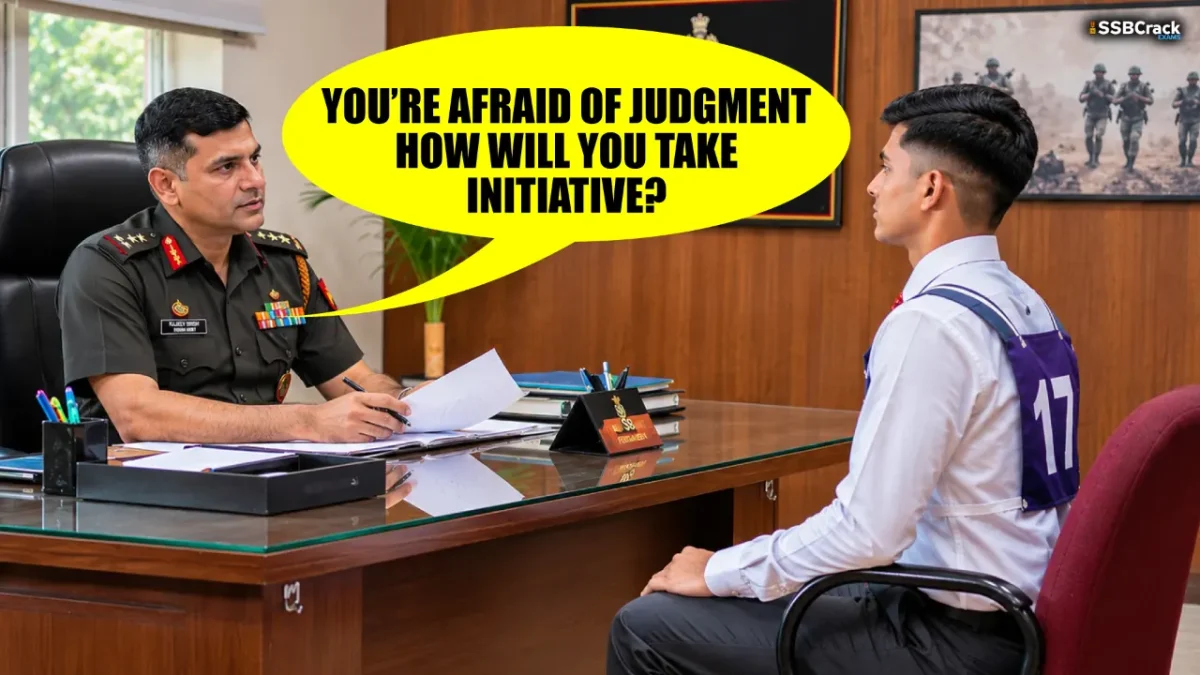
Therefore, the Interviewing Officer may ask questions to understand how you handle public speaking, whether you avoid opportunities because of nervousness, how you communicate under pressure and what steps you are taking to overcome your fear.
So, in today’s article, we will discuss 20 important SSB Interview questions for candidates with stage fear, along with why each question is asked, how you should answer it, and a sample answer.
Remember, don’t pretend that you have no fear if you genuinely experience it. Show that you recognise the problem and are making consistent efforts to overcome it.
1. Are you afraid of speaking in front of an audience?
Why is this question asked?
The officer wants to understand whether you experience stage fear and how comfortable you are with public speaking.
How should you answer?
Be honest. Explain which situations make you nervous and whether you can still speak when required.
Sample Answer
“Sir/Ma’am, yes, I sometimes feel nervous when I have to speak in front of a large audience, especially when I am not familiar with the people. However, I can communicate comfortably in smaller groups. I have been working on improving my public speaking through presentations and group activities.”
2. When did you first realise that you had stage fear?
Why is this question asked?
The officer wants to understand your self-awareness and whether you can identify situations that trigger your nervousness.
How should you answer?
Mention a genuine experience from school, college or another activity.
Sample Answer
“Sir/Ma’am, I first noticed it during a school presentation. Although I had prepared the topic properly, I became nervous when I stood in front of the class. My voice was not as clear as usual, and I forgot a few points. That experience helped me realise that I needed to work on speaking before an audience.”
3. What happens to you when you stand on a stage?
Why is this question asked?
The officer wants to understand how stage fear affects your behaviour and whether you are aware of your reactions.
How should you answer?
Describe your actual response without exaggerating it.
Sample Answer
“Sir/Ma’am, I sometimes experience nervousness before starting. My voice may become slightly shaky, and I may speak faster than usual. However, once I settle down and begin explaining the topic, I gradually become more comfortable. I am learning to control my initial nervousness through regular practice.”
4. Have you ever forgotten your speech while standing on stage?
Why is this question asked?
The officer wants to assess how you handle unexpected difficulties and recover from mistakes.
How should you answer?
If it has happened, admit it and explain how you responded.
Sample Answer
“Yes, Sir/Ma’am. During one of my presentations, I forgot a few points because I became nervous. I paused for a moment, recalled the main idea and continued with the presentation. I realised that memorising every sentence was not a good approach, so I started preparing key points instead.”
5. Do you avoid opportunities that require public speaking?
Why is this question asked?
The officer wants to know whether your fear prevents you from taking initiative and accepting responsibilities.
How should you answer?
Be honest, but demonstrate that you are learning to face such opportunities.
Sample Answer
“Sir/Ma’am, earlier I sometimes avoided opportunities that required speaking in front of a large group because I was afraid of making mistakes. However, I realised that avoiding them would not help me improve. Now I try to participate whenever such opportunities arise, even if I feel nervous initially.”
6. How do you feel when you are asked to give an impromptu speech?
Why is this question asked?
The officer wants to assess your ability to think and communicate without extensive preparation.
How should you answer?
Explain how you organise your thoughts and respond to an unexpected speaking task.
Sample Answer
“Sir/Ma’am, I initially feel a little nervous when I am asked to speak without preparation. However, I try to organise my thoughts around two or three important points and then explain them in a simple manner. I may not always give a perfect response, but I try to communicate whatever I understand about the topic.”
7. Are you comfortable speaking in front of your classmates?
Why is this question asked?
The officer wants to understand whether your fear is limited to large audiences or also affects familiar social settings.
How should you answer?
Differentiate between speaking to familiar people and unfamiliar audiences if that reflects your actual experience.
Sample Answer
“Sir/Ma’am, I am relatively comfortable speaking in front of my classmates because I know them well. However, I sometimes become nervous when I have to address a larger audience or people I have never interacted with. I am gradually trying to become equally comfortable in both situations.”
8. Have you ever refused to participate in a competition because of stage fear?
Why is this question asked?
The officer wants to assess whether fear has affected your willingness to participate in activities.
How should you answer?
Don’t hide your experience. Explain what you learned from it.
Sample Answer
“Yes, Sir/Ma’am. During school, I once avoided participating in a speaking competition because I was worried about performing in front of everyone. Later, I realised that I had lost an opportunity to learn something new. Since then, I have tried to participate in activities even when I am not completely confident.”
9. What do you do when you notice that the audience is not responding to your speech?
Why is this question asked?
The officer wants to assess your adaptability and ability to handle an audience that is not immediately engaged.
How should you answer?
Show that you would not panic or lose confidence. Explain how you would adjust your communication.
Sample Answer
“Sir/Ma’am, I would try to understand whether my explanation is clear and interesting enough. I may simplify the point, give an example or ask a relevant question to involve the audience. I would not immediately assume that I am performing badly just because the audience is quiet.”
10. Does criticism from the audience affect your confidence?
Why is this question asked?
The officer wants to understand how you handle feedback, criticism and public mistakes.
How should you answer?
Show that you can separate constructive feedback from unnecessary criticism.
Sample Answer
“Sir/Ma’am, criticism can initially affect me, especially if I have worked hard on a presentation. However, I try to understand whether the feedback is useful. If someone points out a genuine mistake, I take it positively and work on improving it. I don’t want the fear of criticism to stop me from speaking.”
11. What would you do if your voice started shaking during a speech?
Why is this question asked?
The officer wants to assess your ability to remain composed when something does not go according to plan.
How should you answer?
Explain practical steps rather than claiming that you would never become nervous.
Sample Answer
“Sir/Ma’am, I would pause briefly, take a breath and continue at a slower pace. I would focus on communicating the message rather than worrying about how my voice sounds. I understand that some nervousness is natural, and I am learning to manage it.”
12. Can you lead a team if you are afraid of speaking on stage?
Why is this question asked?
The officer wants to know whether stage fear affects your ability to take responsibility and communicate as a leader.
How should you answer?
Explain that leadership involves different forms of communication, not only public speaking, while acknowledging that public speaking is an important skill to develop.
Sample Answer
“Sir/Ma’am, I believe I can take responsibility and lead a team, but I also understand that an officer must communicate clearly in different situations. My stage fear is an area I am working on. I am comfortable communicating in smaller groups, and I am gradually improving my ability to address larger groups as well.”
13. How would you give instructions to a group of people if you were nervous?
Why is this question asked?
The officer wants to assess your ability to communicate instructions under pressure.
How should you answer?
Show that you would focus on clarity, organisation and the task rather than your nervousness.
Sample Answer
“Sir/Ma’am, I would first understand the task and organise the instructions into simple points. I would speak clearly, make sure everyone understands their responsibility and clarify any doubts. Even if I feel nervous initially, I would focus on completing the responsibility rather than allowing the nervousness to affect the team.”
14. Do you think stage fear can affect your performance at SSB?
Why is this question asked?
The officer wants to see whether you understand the relevance of communication and group participation during the selection process.
How should you answer?
Acknowledge that it may affect certain activities, but show that you are preparing to manage it.
Sample Answer
“Sir/Ma’am, it may affect my initial performance in activities that require speaking before a group. However, I don’t think it should prevent me from participating. I am practising group discussions, presentations and spontaneous speaking so that I can communicate more confidently during SSB activities.”
15. What is more important—confidence or preparation?
Why is this question asked?
The officer wants to assess your understanding of how preparation contributes to performance.
How should you answer?
Explain that both are important and that preparation can help build confidence.
Sample Answer
“Sir/Ma’am, I think both are important. Preparation gives us knowledge and structure, while confidence helps us communicate effectively. In my case, proper preparation reduces my stage fear because I know what I want to explain. However, I also understand that I should be able to communicate even when I don’t have much time to prepare.”
16. Have you ever received appreciation for a speech or presentation?
Why is this question asked?
The officer wants to understand your actual public speaking experience and how you respond to positive feedback.
How should you answer?
Mention a genuine experience. If you have never received appreciation, don’t invent one.
Sample Answer
“Yes, Sir/Ma’am. During ________, I gave a presentation on ________. My teacher appreciated the way I explained the topic. It gave me confidence that I could improve with preparation and practice. I still have to work on speaking before larger audiences, but that experience encouraged me.”
17. What is the biggest reason behind your stage fear?
Why is this question asked?
The officer wants to see whether you understand the underlying reason for your nervousness.
How should you answer?
Identify your actual difficulty, such as fear of making mistakes, being judged or forgetting your points.
Sample Answer
“Sir/Ma’am, I think my biggest concern is the possibility of making mistakes in front of a large audience. Sometimes I focus too much on how people might react rather than concentrating on what I want to communicate. I am trying to change this by focusing on the purpose of the speech instead of worrying about achieving a perfect performance.”
18. What steps are you taking to overcome stage fear?
Why is this question asked?
The officer wants to assess your initiative and willingness to improve yourself.
How should you answer?
Mention specific activities you are actually doing.
Sample Answer
“Sir/Ma’am, I am working on this through regular speaking practice. I try to participate in classroom discussions, presentations and group activities. I also practise speaking on random topics for a few minutes without memorising the content. These activities are helping me become more comfortable with spontaneous communication.”
19. What would you do if you had to address a large audience without preparation?
Why is this question asked?
The officer wants to assess your ability to handle unfamiliar situations and communicate under pressure.
How should you answer?
Explain a simple approach to organising your thoughts and delivering the message.
Sample Answer
“Sir/Ma’am, I would first identify the purpose of addressing the audience and organise my thoughts around a few relevant points. I would speak in simple language and avoid unnecessary details. I may feel nervous initially, but I would focus on delivering the message clearly rather than worrying about giving a perfect speech.”
20. Why should the Armed Forces select a candidate who has stage fear?
Why is this question asked?
The officer wants to assess your confidence, self-awareness and understanding of the communication responsibilities of an officer.
How should you answer?
Don’t argue that stage fear is irrelevant. Acknowledge that communication is important and explain the steps you are taking to improve.
Sample Answer
“Sir/Ma’am, I understand that an officer must be able to communicate clearly and address people whenever required. Stage fear is an area I am actively working on, but it does not mean that I avoid responsibility or teamwork. I am improving through regular speaking practice and participation in group activities. I am willing to learn and develop the communication skills required for the responsibilities of an officer.”
Important Tips for Candidates with Stage Fear
- Don’t hide your stage fear. If you experience nervousness while speaking before an audience, acknowledge it honestly.
- Don’t assume that nervousness means you cannot speak well. You can feel nervous and still deliver a clear and effective message.
- Practise speaking every day. Choose a simple topic and speak about it for two to three minutes without reading from a script.
- Start with a small audience. Practise before a friend or family member and gradually increase the audience size.
- Avoid memorising every sentence. Prepare key points and understand the topic instead of trying to remember a complete speech.
- Record your own speeches. Listen to your voice, observe your pace and identify areas that need improvement.
- Practise impromptu speaking. Pick random topics and speak for one or two minutes without extensive preparation.
- Control your speaking speed. Nervous candidates often speak too quickly. Make a conscious effort to pause between important points.
- Focus on the message, not the audience’s judgment. Your objective is to communicate an idea, not impress every person listening.
- Maintain natural eye contact. Look at different members of the audience instead of continuously looking at the floor or one fixed point.
- Don’t apologise repeatedly for being nervous. If you make a small mistake, pause and continue.
- Participate in group discussions. Regular participation will help you become comfortable expressing your views.
- Learn to organise your thoughts. A simple introduction, two or three main points and a conclusion can make speaking easier.
- Don’t avoid public speaking opportunities. Every opportunity to speak is a chance to improve.
- Practise breathing and relaxation techniques. Slow, comfortable breathing before speaking may help manage physical nervousness.
- Don’t compare your speaking ability with professional speakers. Focus on your own progress.
- Be prepared for unexpected questions. Practise responding to questions without trying to formulate a perfect answer.
- Remember that communication is more than public speaking. Listening, explaining, giving instructions and interacting with people are equally important.
- Don’t claim that you have completely overcome stage fear unless it is true. Explain your actual progress.
- Focus on gradual improvement. The aim is not to eliminate every feeling of nervousness but to communicate effectively even when you experience it.
Closing Lines
So, these were 20 important SSB Interview questions for candidates with stage fear.
If you feel nervous while speaking in front of an audience, remember one important thing:
You don’t have to become a perfect public speaker to become a confident communicator.
You may feel nervous before stepping onto a stage.
Your voice may shake initially.
You may forget a few points.
But none of these things should become a reason to stop participating or accepting opportunities.
Start small. Speak in front of your friends. Participate in classroom discussions. Volunteer for presentations. Practise impromptu speaking.
And gradually, challenge yourself to speak before larger groups.
Remember, at SSB, the objective is not to judge you by how entertaining or impressive your speech is. What matters is whether you can communicate your thoughts clearly, participate effectively and take responsibility when required.
So, don’t run away from the stage because you are afraid of it.
Face the stage, practise consistently and allow your confidence to grow through experience.
Keep practising, stay confident and remember—the best way to overcome the fear of speaking is to start speaking, one opportunity at a time.
All the best for your SSB journey!