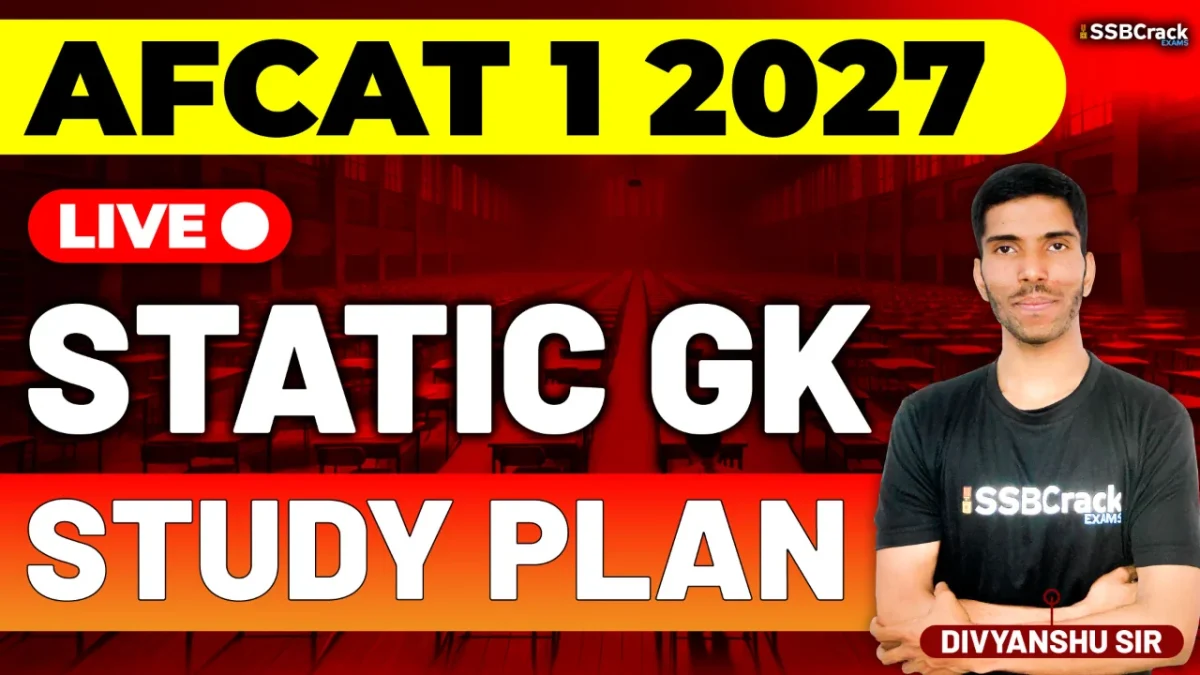
The AFCAT 1 2027 examination is an important opportunity for graduates aspiring to become commissioned officers in the Indian Air Force. A well-structured preparation strategy, consistent revision, regular mock tests and effective time management can significantly improve your chances of qualifying.
AFCAT 1 2027 Exam Static GK – Study Plan
This study plan is designed for aspirants preparing for AFCAT 1 2027, including beginners and candidates who are simultaneously preparing for NDA, CDS, CAPF or other competitive examinations.
1. Understand the AFCAT examination pattern
Before starting preparation, candidates should understand the examination structure.
| Particulars | Details |
|---|---|
| Examination | AFCAT 1 2027 |
| Conducting authority | Indian Air Force |
| Mode | Online CBT |
| Total questions | 100 |
| Maximum marks | 300 |
| Duration | 2 hours |
| Correct answer | +3 marks |
| Incorrect answer | -1 mark |
| Unattempted question | 0 marks |
The examination generally covers four major areas:
- General Awareness
- Verbal Ability in English
- Numerical Ability
- Reasoning and Military Aptitude Test
Note: Check the official AFCAT 1 2027 notification for the final examination schedule, eligibility and any updated examination instructions.
2. Subject-wise preparation strategy
A. English
Target: Improve accuracy, vocabulary and comprehension
English is an important scoring section if candidates develop a strong understanding of grammar and vocabulary.
Important topics:
- Synonyms and Antonyms
- One-word Substitution
- Idioms and Phrases
- Error Detection
- Sentence Completion
- Fill in the Blanks
- Comprehension
- Cloze Test
- Sentence Rearrangement
Preparation strategy:
- Learn 15–20 new vocabulary words daily.
- Revise important idioms and phrases.
- Practise grammar questions regularly.
- Solve previous-year AFCAT English questions.
- Read an English newspaper or editorial regularly.
B. General Awareness
Target: Strengthen static GK and current affairs
General Awareness requires continuous preparation because questions can cover both static knowledge and recent developments.
Important topics:
- Indian History
- Indian Geography
- Indian Polity
- Indian Economy
- General Science
- Defence Exercises
- Missile Systems and Defence Technology
- Indian Air Force and Military Aircraft
- Awards and Honours
- Sports
- Important National and International Events
- Current Affairs
Preparation strategy:
- Study current affairs from the last 6–8 months, giving additional attention to recent developments.
- Revise important defence-related news.
- Prepare short notes on military exercises, appointments and defence acquisitions.
- Practise static GK questions every day.
- Revise weekly current affairs through MCQs.
C. Numerical Ability
Target: Build calculation speed and mathematical accuracy
Numerical Ability tests basic mathematical concepts and the ability to solve questions within a limited time.
Important topics:
- Percentage
- Profit and Loss
- Ratio and Proportion
- Average
- Simple Interest and Compound Interest
- Time and Work
- Time, Speed and Distance
- Number System
- Decimal Fractions
- Simplification
- Mixture and Allegation
Preparation strategy:
- Memorise squares, cubes and multiplication tables.
- Practise calculations without a calculator.
- Solve 20–25 questions daily.
- Focus on shortcuts only after understanding the basic concepts.
- Maintain a notebook of formulas and frequently repeated question types.
D. Reasoning and Military Aptitude
Target: Improve logical thinking and problem-solving speed
This section evaluates logical reasoning, spatial ability and analytical skills.
Important topics:
- Verbal Reasoning
- Non-Verbal Reasoning
- Analogy
- Classification
- Series Completion
- Coding-Decoding
- Blood Relations
- Direction and Distance
- Venn Diagrams
- Figure Completion
- Embedded Figures
- Pattern Recognition
- Spatial Ability
Preparation strategy:
- Practise 25–30 reasoning questions daily.
- Develop the habit of identifying patterns quickly.
- Solve previous-year questions.
- Analyse incorrect answers to understand conceptual mistakes.
- Take timed sectional tests.
3. AFCAT 1 2027: Important dates and preparation timeline
Official examination schedule
Announced
Application starts
12 November 2026
Last date to apply
11 December 2026
Online examination
31 January 2027
Course commencement
January 2028
Source: Indian Air Force AFCAT 01/2027 notification.
Read official AFCAT 1 2027 notification
With approximately 11 weeks available from 16 November 2026 until the examination, candidates should follow a time-bound preparation strategy.
4. Complete 11-week AFCAT 1 2027 study plan
| Week | Preparation targets |
|---|---|
| Week 1 (16–22 Nov) | English grammar, percentage, number system, Indian History |
| Week 2 (23–29 Nov) | Vocabulary, ratio, average, Indian Geography |
| Week 3 (30 Nov–6 Dec) | Error detection, profit and loss, Indian Polity |
| Week 4 (7–13 Dec) | Comprehension, time and work, Indian Economy |
| Week 5 (14–20 Dec) | Idioms, SI/CI, General Science |
| Week 6 (21–27 Dec) | Sentence rearrangement, time and distance, Defence Awareness |
| Week 7 (28 Dec–3 Jan) | Non-verbal reasoning, mensuration, Sports and Awards |
| Week 8 (4–10 Jan) | Verbal reasoning, probability, International Affairs |
| Week 9 (11–17 Jan) | Complete syllabus revision and sectional tests |
| Week 10 (18–24 Jan) | Full-length mock tests and previous-year questions |
| Week 11 (25–30 Jan) | Final revision, mock analysis and formula revision |
31 January 2027: AFCAT 1 2027 Examination
The weekly targets should be adjusted according to your strong and weak subjects. Avoid leaving General Awareness and vocabulary revision until the final weeks.
5. Daily study timetable for AFCAT 1 2027
Candidates should aim for approximately 5–6 hours of focused preparation daily, depending on their existing level.
| Time | Subject | Duration |
|---|---|---|
| 6:00–7:00 AM | English | 1 hour |
| 7:00–8:00 AM | Numerical Ability | 1 hour |
| 10:00–11:00 AM | General Awareness | 1 hour |
| 4:00–5:00 PM | Reasoning & Military Aptitude | 1 hour |
| 7:00–8:00 PM | Current Affairs and Defence News | 1 hour |
| 8:00–8:30 PM | Revision and MCQs | 30 minutes |
This is a suggested timetable. Candidates can modify the timings according to their college, job or other commitments.
6. Mock Test Strategy: The Key to Improving Your Score
Mock tests are essential for understanding the examination pattern, improving speed and identifying weak areas.
Follow this mock test schedule:
| Preparation stage | Mock test target |
|---|---|
| November | 1 mock test per week |
| December | 2 mock tests per week |
| 1–15 January | 3 mock tests per week |
| 16–30 January | 1 mock test daily, if sustainable |
After every mock test, analyse:
- Questions answered incorrectly.
- Questions left unattempted.
- Time consumed in each section.
- Topics requiring additional revision.
- Accuracy and negative marking.
Do not simply attempt more mock tests. Focus on learning from your mistakes.
7. Last 15 Days Strategy
The final 15 days should be dedicated primarily to revision and examination practice.
16–20 January
- Revise complete English grammar.
- Practise important mathematical formulas.
- Revise static GK and defence current affairs.
- Solve previous-year AFCAT questions.
21–25 January
- Attempt full-length mock tests.
- Revise important vocabulary and idioms.
- Practise reasoning and numerical questions.
- Prepare short notes for General Awareness.
26–30 January
- Revise formulas, important facts and current affairs.
- Attempt timed practice papers.
- Avoid starting completely new topics.
- Maintain a proper sleep schedule.
- Keep examination documents ready.
8. Important Preparation Resources
Candidates should use limited but reliable study resources rather than collecting too many books and materials.
| Subject | Recommended resources |
|---|---|
| English | Objective General English by S.P. Bakshi |
| Mathematics | Quantitative Aptitude by R.S. Aggarwal |
| Reasoning | A Modern Approach to Verbal & Non-Verbal Reasoning |
| General Awareness | Lucent’s General Knowledge |
| Current Affairs | Monthly current affairs and defence updates |
| Practice | AFCAT previous-year papers and mock tests |
The Indian Air Force also provides an online practice test through its AFCAT portal. Candidates should use it to become familiar with the online examination environment. Indian Air Force+1
9. Important Exam-Day Instructions
Candidates should remember the following points:
- The examination will be conducted in English.
- Reach the examination centre according to the reporting instructions.
- The official schedule mentions reporting at 8:00 AM and examination timings from 10:00 AM to 12:00 noon.
- Carry the printed e-Admit Card and original Aadhaar Card.
- Carry a second original valid photo identity document.
- Do not carry prohibited electronic devices or personal items.
The e-Admit Card is scheduled to be issued four days before the examination. Career Air Force+1
10. Final Success Mantra for AFCAT 1 2027
Cracking AFCAT is not about studying for 12–14 hours a day. It is about maintaining consistency, understanding concepts and practising questions regularly.
Candidates should focus on five important principles:
- Complete the syllabus systematically.
- Practise mathematics and reasoning every day.
- Keep current affairs preparation continuous.
- Attempt mock tests and analyse mistakes.
- Revise regularly instead of repeatedly collecting new study materials.
Your Target: AFCAT 1 2027
31 JANUARY 2027
Dream of the Blue Uniform. Prepare with Discipline. Serve the Nation with Pride.
Indian Air Force – Flying and Ground Duty Branches