





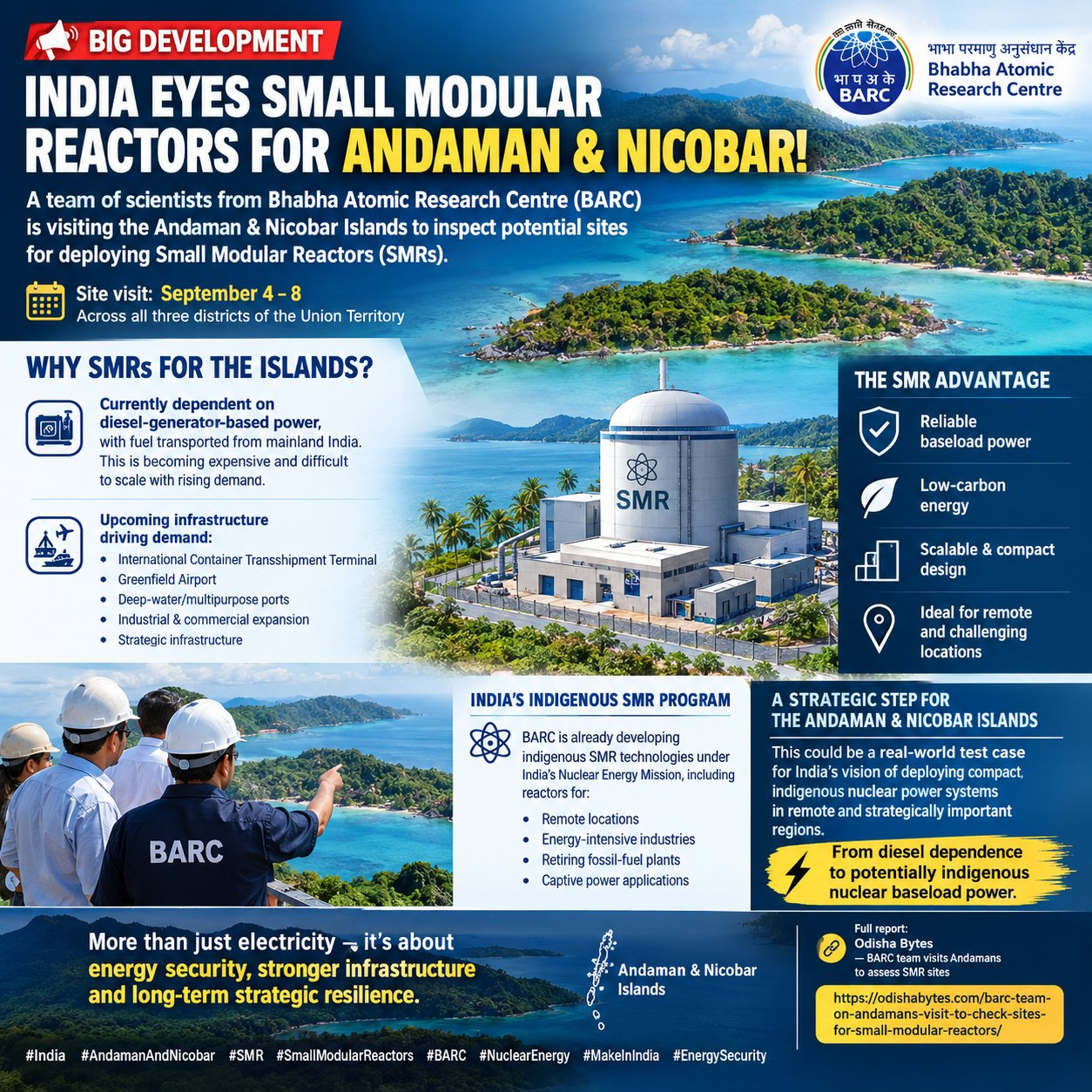
India is exploring the possibility of deploying Small Modular Reactors (SMRs) in the strategically important Andaman and Nicobar Islands, as electricity demand is expected to rise with the expansion of major infrastructure projects in the region.
Andaman & Nicobar Islands To Go Nuclear?
India is exploring the possibility of deploying Small Modular Reactors (SMRs) in the strategically important Andaman and Nicobar Islands, as electricity demand is expected to rise with the expansion of major infrastructure projects in the region.
Scientists associated with the Bhabha Atomic Research Centre (BARC) are assessing potential locations across the Union Territory for such reactors. A team from the Department of Atomic Energy (DAE) is undertaking site assessments across all three districts between September 4 and 8, 2026, according to the report.
Why are nuclear reactors being considered?
The proposed reactors are primarily linked to the anticipated growth in the islands’ electricity requirements. The Great Nicobar region, in particular, is expected to see substantial infrastructure development, which could significantly increase its demand for reliable power.
Small Modular Reactors could provide a dependable source of electricity for remote island locations while reducing dependence on conventional fuel-based power generation.
India is also developing indigenous small-reactor technologies as part of its broader nuclear-energy expansion. BARC’s nuclear research activities include reactor technology and the development of advanced nuclear systems.
What are Small Modular Reactors?
Small Modular Reactors (SMRs) are compact nuclear reactors designed to generate electricity on a smaller scale than conventional large nuclear power plants.
Their modular design can potentially make them suitable for locations where building a large conventional nuclear plant may be difficult. For geographically isolated regions such as islands, a compact and reliable electricity source can have particular advantages.
However, the proposed Andaman and Nicobar project is presently at the site-assessment and planning stage; the reported surveys do not mean that reactors have already been approved or constructed.
Strategic Importance of Andaman and Nicobar Islands
The Andaman and Nicobar Islands occupy an important position in the Indian Ocean region, particularly because of their proximity to the Strait of Malacca, one of the world’s major maritime chokepoints.
The islands therefore have significance not only for civilian infrastructure but also for India’s maritime-security strategy.
The Great Nicobar area is particularly important because of its location near major sea routes. India is simultaneously pursuing major infrastructure development in the region, including projects aimed at improving connectivity and maritime capabilities.
The islands also host important military infrastructure, including INS Baaz, a naval air station near Campbell Bay on Great Nicobar.
China Factor
The proposal comes against the backdrop of China’s expanding presence in the Indian Ocean region.
The Andaman and Nicobar chain gives India a strategically advantageous position near the western approaches to the Strait of Malacca. Greater infrastructure and energy availability could support India’s ability to maintain a sustained presence in this strategically important part of the Indian Ocean.
The development should therefore be viewed in two interconnected contexts:
Energy Security: Providing reliable electricity for rapidly expanding infrastructure.
Strategic Security: Strengthening India’s ability to develop and sustain infrastructure in a geopolitically important maritime region.
The latest reporting specifically links the nuclear-power exploration with concerns surrounding China’s growing presence in the Indian Ocean.
Great Nicobar: A Major Infrastructure Focus
Great Nicobar has emerged as an important focus of India’s infrastructure plans.
The planned development of the region involves major infrastructure intended to improve connectivity and maritime capabilities. Such projects are expected to increase electricity requirements considerably.
Consequently, ensuring a stable and dependable power supply will be an important component of the region’s long-term development.
Nuclear power is being considered as one possible solution, particularly because SMRs can potentially be deployed in locations requiring relatively compact generating facilities.
Role of BARC
The Bhabha Atomic Research Centre (BARC) is India’s premier nuclear research institution and operates under the Department of Atomic Energy.
Its research covers areas including:
- Nuclear reactor technology
- Nuclear fuel-cycle technologies
- Nuclear science
- Materials science
- Radiation monitoring
- Nuclear applications
- Advanced reactor systems
BARC’s existing research portfolio includes several types of research reactors and work on advanced reactor technologies.
Why This Development Matters
The proposed deployment of SMRs in the Andaman and Nicobar Islands could have significance beyond electricity generation.
1. Energy Independence
The islands are geographically separated from mainland India. Local nuclear generation could provide a dependable source of electricity without relying as heavily on fuel transportation.
2. Infrastructure Development
Reliable power would support the expansion of civilian and strategic infrastructure, particularly in Great Nicobar.
3. Strategic Presence
Improved infrastructure can strengthen India’s ability to maintain a sustained presence in the strategically important eastern Indian Ocean.
4. Nuclear Technology
The initiative could provide an additional application for India’s emerging Small Modular Reactor technology.
5. Maritime Security
The location of the islands near the Strait of Malacca gives them considerable importance for India’s maritime-security architecture.


