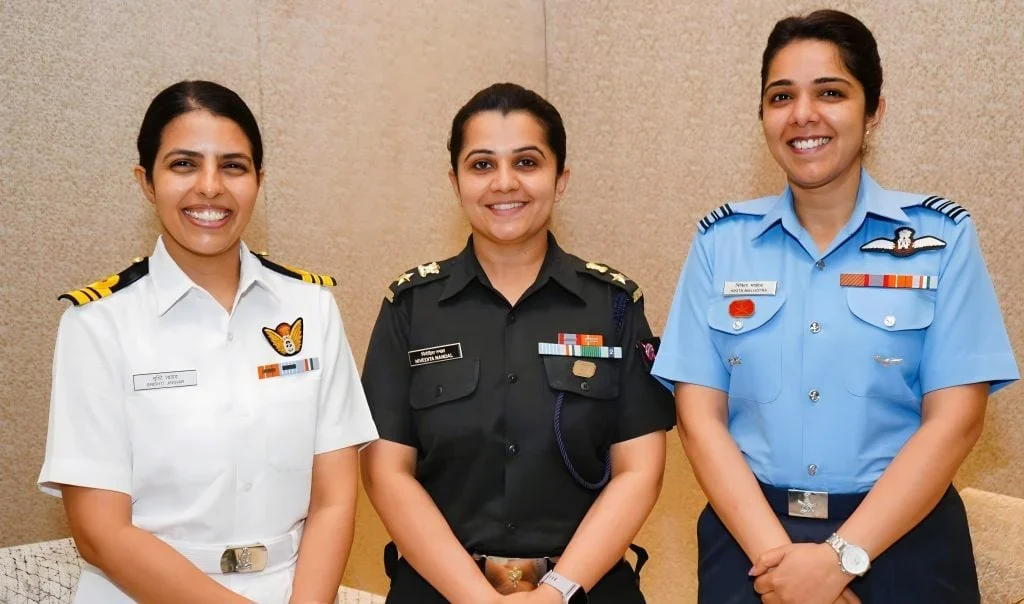
Joining the Indian Armed Forces is no longer a dream reserved for men. Today, women have multiple opportunities to serve the nation as commissioned officers, fighter pilots, engineers, medical professionals, naval officers and Agniveers.
Whether you are studying in Class 10, preparing for your Class 12 examinations, pursuing graduation or completing an engineering degree, there are several ways for women to join the Indian Army, Indian Navy and Indian Air Force in 2026.
The introduction of women cadets at the National Defence Academy (NDA), wider opportunities for Permanent Commission and increased participation in operational roles have transformed military career opportunities for female aspirants.
However, every defence entry has different eligibility requirements, age limits, educational qualifications and selection procedures.
This guide explains 12 major entry routes for women in the Indian Armed Forces in 2026, including the examinations you need to prepare for, available branches, selection procedures and training academies.
How Can Girls Join the Indian Armed Forces in 2026?
Women can join the Indian Armed Forces through competitive examinations such as NDA, CDS and AFCAT, as well as through direct-entry recruitment schemes including SSC Technical, NCC Special Entry, JAG, Navy SSC and Agniveer recruitment.
Some opportunities are available immediately after Class 12, while others require graduation, engineering or professional qualifications.
12 Ways for Women to Join Indian Army, Navy and Air Force
| Entry | Service | Qualification |
|---|---|---|
| 1. NDA Entry | Army, Navy, Air Force | Class 12 |
| 2. CDS OTA Entry | Army | Graduation |
| 3. SSC Technical Entry | Army | BE/B.Tech |
| 4. NCC Special Entry | Army | Graduation + NCC C |
| 5. JAG Entry | Army | LLB |
| 6. Military Nursing Service | Armed Forces Medical Services | 12th PCB / Nursing |
| 7. Navy 10+2 B.Tech Entry | Navy | 12th PCM + JEE Main |
| 8. Navy SSC Officer Entry | Navy | Graduation / PG |
| 9. Navy Agniveer Entry | Navy | 10th / 12th / relevant qualification |
| 10. AFCAT Entry | Air Force | Graduation / Engineering |
| 11. IAF NCC Special Entry | Air Force | Graduation + NCC Air Wing C |
| 12. IAF Agniveervayu Entry | Air Force | 12th / eligible diploma or vocational qualification |
The table is a starting guide. Gender-wise vacancies, educational requirements and date-of-birth eligibility must be verified against the relevant recruitment notification.
Best Ways for Women to Join the Indian Army in 2026
1. NDA Entry for Girls After Class 12
The National Defence Academy is one of the most prestigious routes for young women who dream of becoming officers in the Indian Armed Forces.
Female candidates can apply for the NDA examination conducted by the Union Public Service Commission (UPSC).
The NDA examination is generally conducted twice a year, offering eligible female candidates opportunities to pursue officer training after completing their school education.
Eligibility criteria
- Age: Approximately 16.5 to 19.5 years, subject to the notification’s date-of-birth window.
- Educational qualification: Class 12 passed or appearing.
- Army Wing: Class 12 from a recognized board.
- Navy and Air Force: Class 12 with Physics, Chemistry and Mathematics.
- Marital status: Unmarried, as prescribed by UPSC.
Selection process: UPSC NDA written examination, SSB interview, medical examination and final merit list.
Selected candidates undergo three years of training at the National Defence Academy in Khadakwasla, Pune, followed by service-specific training.
The NDA is particularly suitable for female aspirants who want to begin preparing for an officer career immediately after Class 10 or Class 12.
Students can follow the NDA examination preparation courses offered by SSBCrackExams to strengthen their Mathematics, English, General Ability and examination preparation.
2. CDS OTA Entry for Women After Graduation
The Combined Defence Services Examination (CDS) is one of the most popular routes for female graduates who want to become officers in the Indian Army.
Women applying through CDS are considered for the Officers’ Training Academy (OTA), Chennai, under the applicable women’s Short Service Commission entry.
Unlike the CDS written examination for IMA, INA and AFA, the OTA written examination consists of English and General Knowledge papers. There is no Mathematics paper for OTA.
Eligibility criteria
- Age: Generally around 19–25 years, as defined by the specific UPSC notification.
- Educational qualification: Bachelor’s degree from a recognized university.
- Final-year graduation candidates may apply subject to the notification.
- Marital status: As prescribed for the women’s OTA course.
Selection process: CDS written examination, SSB interview, medical examination and final merit list.
Successful candidates undergo pre-commission training at OTA Chennai before being commissioned as Army officers.
Female graduates from Arts, Commerce, Science and other recognized disciplines can consider this entry.
For focused preparation, candidates can explore the CDS OTA examination courses covering English, General Knowledge and mock examinations.
3. SSC Technical Entry for Women Engineers
The Indian Army Short Service Commission Technical Entry is an excellent opportunity for female engineering graduates.
Unlike NDA and CDS, this entry normally does not require a separate UPSC written examination.
Candidates are shortlisted based on the eligibility requirements and academic performance specified in the recruitment notification.
Eligibility criteria
- Age: Generally 20–27 years.
- Educational qualification: BE/B.Tech in an engineering discipline notified for that recruitment cycle.
- Final-year engineering students may be eligible, subject to the notification.
- Only notified engineering streams are accepted.
Selection process: Application shortlisting, SSB interview, medical examination and merit list.
Selected female candidates undergo training at OTA Chennai.
This entry is particularly attractive for women studying Computer Science, Mechanical Engineering, Electronics, Electrical Engineering, Civil Engineering and other disciplines when their respective streams are included in the vacancy notification.
4. NCC Special Entry for Women
Female graduates holding an eligible NCC ‘C’ Certificate can apply for the Indian Army NCC Special Entry Scheme.
This route allows eligible candidates to appear for the SSB selection process without taking the CDS written examination.
Eligibility criteria
- Age: Generally 19–25 years.
- Educational qualification: Graduation with at least 50% aggregate marks.
- NCC requirement: NCC Senior Wing ‘C’ Certificate and the prescribed NCC service and grading requirements.
- Final-year students may apply if they meet the notified conditions.
Selection process: Application shortlisting, SSB interview, medical examination and merit list.
The NCC Special Entry is especially useful for female students already participating in the National Cadet Corps during their college years.
NCC experience helps candidates develop discipline, teamwork, responsibility and leadership—qualities also assessed during the SSB interview.
5. JAG Entry for Women Law Graduates
Women who have completed their law degree can join the Indian Army through the Judge Advocate General (JAG) Entry Scheme.
JAG officers serve as legal professionals within the Army, advising on military law, disciplinary proceedings and other legal matters.
Eligibility criteria
- Age: Generally 21–27 years.
- Educational qualification: LLB degree with the minimum marks prescribed in the notification, commonly 55%.
- CLAT PG score: Required in recent recruitment notifications.
- Candidates must meet the prescribed eligibility for enrolment as advocates.
Selection process: Shortlisting, SSB interview, medical examination and final merit.
The JAG Entry offers a distinctive career opportunity for women interested in both the legal profession and military service.
6. Military Nursing Service (MNS) for Women
The Military Nursing Service provides a professional career for women who wish to serve in the Armed Forces healthcare system.
One prominent route is admission to the four-year BSc Nursing course at institutions associated with the Armed Forces Medical Services.
Eligibility for BSc Nursing admission
- Educational qualification: Class 12 with Physics, Chemistry, Biology and English.
- NEET UG: Required for admission through the notified process.
- Additional selection stages and medical standards apply.
- Age and marital-status requirements depend on the relevant admission notification.
Candidates pursuing the BSc Nursing route should distinguish college admission from subsequent appointment or commissioning requirements.
Already-qualified nursing professionals should check separate MNS recruitment notifications, where eligibility and selection may differ.
MNS personnel provide healthcare support to military personnel and their families across military medical establishments.
Best Ways for Women to Join the Indian Navy in 2026
7. Indian Navy 10+2 B.Tech Cadet Entry for Girls
The Indian Navy’s 10+2 B.Tech Cadet Entry Scheme is an excellent opportunity for female students who have studied Physics, Chemistry and Mathematics in Class 12.
Through this scheme, eligible women can join the Indian Naval Academy (INA), Ezhimala, and pursue a four-year B.Tech course before receiving a Permanent Commission.
Eligibility criteria
- Age: Generally 17–19.5 years, subject to the notified birth-date range.
- Education: Class 12 with at least 70% aggregate marks in Physics, Chemistry and Mathematics.
- English: At least 50% in Class 10 or Class 12.
- JEE Main: Candidates must have appeared for JEE Main and obtained a valid rank.
- Marital status: Unmarried.
Selection process: Shortlisting through JEE Main rank, SSB interview, medical examination and merit list.
The January 2026 course notification explicitly invited applications from both men and women, with a specified allocation of vacancies for female candidates. Join Indian Navy
This route allows female students to pursue engineering education while preparing for a professional career as an Indian Navy officer.
8. Indian Navy SSC Officer Entry for Women Graduates
The Indian Navy recruits female officers through Short Service Commission (SSC) entries in several executive, technical and education specialisations.
Depending on the recruitment notification, women may apply for branches and cadres such as Pilot, Naval Air Operations Officer, Air Traffic Controller, Logistics, Naval Armament Inspectorate, Information Technology, Education, Engineering, Electrical and Naval Constructor.
Eligibility criteria
- Age: Varies by branch, commonly within approximately 19–27 years.
- Educational qualification: Relevant BE/B.Tech, postgraduate, professional or other prescribed degree.
- Minimum marks: Often 60% for specified entries, although some branches have different requirements.
- Marital status: As specified in the recruitment notification.
Selection process: Shortlisting based on academic qualifications, SSB interview, medical examination and merit list.
Selected candidates undergo training at the Indian Naval Academy, Ezhimala.
The Navy’s June 2026 SSC recruitment notification included vacancies for women across multiple branches, including Pilot, Naval Air Operations Officer and technical cadres. Join Indian Navy
Female aspirants interested in aviation, engineering, maritime operations or leadership should regularly check the latest Navy officer recruitment notifications.
9. Indian Navy Agniveer Entry for Women
Women who wish to join the Indian Navy after school can explore recruitment under the Agnipath scheme.
The Navy recruits eligible women through Agniveer entries such as Senior Secondary Recruit (SSR) and Matric Recruit (MR), subject to the vacancies and eligibility conditions in the specific notification.
Eligibility criteria
- Age: Usually around 17.5–21 years, with the exact date-of-birth window specified in the notification.
- Agniveer SSR: Class 12 with Mathematics and Physics, or an eligible engineering diploma or vocational qualification.
- Agniveer MR: Class 10, subject to the current notification.
- Candidates must meet the applicable physical, medical and marital-status requirements.
Selection process: Recruitment examination, physical fitness assessments, medical examination and merit-based selection, according to the relevant recruitment cycle.
Women selected as Agniveers serve under the Agnipath scheme for four years, including training. This is different from joining the Navy as a commissioned officer.
After the initial service period, up to 25% of Agniveers from a batch may be considered for enrolment in the regular cadre, depending on service requirements and the prevailing policy. Continued service is not guaranteed.
The Navy’s Agniveer SSR recruitment covering the 2026 batches expressly included unmarried female candidates. Tentative Timeline
Best Ways for Women to Join the Indian Air Force in 2026
10. AFCAT Entry for Women – Flying and Ground Duty Branches
The Air Force Common Admission Test (AFCAT) is one of the most popular pathways for female graduates seeking to become commissioned officers in the Indian Air Force.
Through AFCAT, women may apply for eligible vacancies in the Flying Branch, Ground Duty (Technical) and Ground Duty (Non-Technical) branches.
The specific branches and commission types offered to women depend on the recruitment cycle.
Flying Branch eligibility
- Age: Generally 20–24 years.
- Applicants holding qualifying Commercial Pilot Licences may receive the notified age relaxation.
- Class 12: At least 50% marks each in Mathematics and Physics.
- Graduation: Generally at least 60% aggregate, or an eligible BE/B.Tech qualification.
Ground Duty (Technical) eligibility
- Age: Generally 20–26 years.
- Educational qualification: BE/B.Tech or another specifically accepted engineering qualification.
- Eligible engineering disciplines and marks requirements depend on the technical branch.
Ground Duty (Non-Technical) eligibility
- Age: Generally 20–26 years.
- Education: Graduation or postgraduate qualification, as required for the selected branch.
- Branches may include Administration, Logistics, Accounts, Education, Meteorology and Weapon Systems.
Selection process: AFCAT written examination, Air Force Selection Board (AFSB) assessment, medical examination and merit list. Additional testing may apply to flying candidates.
Selected candidates undergo training at the Air Force Academy, Dundigal, Hyderabad, or other designated training establishments.
The AFCAT 01/2026 notification included openings for women in the Flying Branch and several Ground Duty branches, with both Permanent Commission and Short Service Commission vacancies in certain technical categories. Career Air Force
Female candidates preparing for AFCAT can explore the AFCAT preparation programmes available through SSBCrackExams.
11. Indian Air Force NCC Special Entry for Women
Female NCC cadets holding a valid Air Wing ‘C’ Certificate can apply for the Flying Branch through the Indian Air Force NCC Special Entry Scheme.
This is particularly valuable for female graduates who want to pursue aviation careers and already have NCC experience.
Eligibility criteria
- Age: Generally 20–24 years, with specified relaxation for eligible CPL holders.
- Education: Class 12 with at least 50% marks each in Mathematics and Physics.
- Graduation: Generally at least 60% aggregate or an eligible engineering qualification.
- NCC: Valid NCC Air Wing ‘C’ Certificate.
- Marital status: Unmarried.
Selection process: Application shortlisting, AFSB testing, medical examination and merit list.
NCC Special Entry candidates are generally not required to take the AFCAT written examination, but must satisfy the separate shortlisting and selection requirements.
Women entering through this route are considered for Short Service Commission in the Flying Branch under the applicable recruitment terms. Indian Air Force
12. Indian Air Force Agniveervayu Entry for Women
Female candidates can also explore opportunities in the Indian Air Force through Agniveervayu recruitment under the Agnipath scheme.
This entry is designed for eligible young candidates who want to serve in the Air Force in non-commissioned roles.
Eligibility criteria
- Age: Usually around 17.5–21 years, subject to the exact date-of-birth range in the notification.
- Science subjects: Class 12 with the prescribed Mathematics, Physics and English requirements, or an eligible technical diploma or vocational qualification.
- Other-than-Science subjects: Eligible Class 12 or vocational qualifications with prescribed marks.
- Medical, physical and marital-status criteria apply.
Selection process: Online test, physical fitness test, adaptability assessments and medical examination, as applicable.
Selected candidates serve for four years under the Agnipath scheme, including training.
Agniveervayu recruitment should not be confused with AFCAT or NDA officer entry. The roles, ranks, career structure and conditions of service are different.
Female aspirants should check whether their chosen Agniveervayu intake includes women’s vacancies before applying.
Other Career Opportunities for Women in the Armed Forces
The 12 pathways above are not an exhaustive list of all opportunities available to women.
Women with MBBS and postgraduate medical qualifications can explore recruitment into the Armed Forces Medical Services, including medical officer opportunities. BDS and MDS graduates may also be eligible for Indian Army Dental Corps recruitment under the applicable notifications.
Graduate women with civilian employment may explore Territorial Army officer recruitment where the applicable recruitment rules provide for female candidates.
The appropriate pathway depends on educational qualifications, professional registration, employment status and the conditions of the relevant recruitment cycle.
Which Defence Entry Is Best for Girls After Class 10, 12 or Graduation?
Choosing the correct entry is an important step in becoming a defence officer.
| Your qualification | Suitable options |
|---|---|
| Studying in Class 10 | Prepare for NDA; consider future Agniveer eligibility |
| Class 12 Arts or Commerce | NDA Army Wing; eligible Agniveer routes |
| Class 12 PCM | NDA Army/Navy/Air Force, Navy B.Tech, eligible Agniveer entries |
| Class 12 PCB | MNS BSc Nursing, medical education pathways |
| BA/BSc/BCom | CDS OTA, NCC Special Entry, eligible AFCAT branches |
| BE/B.Tech | Army SSC Technical, Navy SSC, AFCAT, eligible NCC entries |
| LLB | Army JAG and notified Navy Law entries |
| MBBS/BDS | Armed Forces medical and dental recruitment |
A girl who wants to become an Army officer after graduation should strongly consider CDS OTA. An engineering student can explore SSC Technical and Navy SSC entries, while a graduate interested in military aviation should examine AFCAT Flying Branch eligibility.
How to Prepare for NDA, CDS, AFCAT and SSB Interview in 2026
Clearing the written examination is only one stage of becoming a commissioned officer.
Candidates must also demonstrate the leadership qualities, intelligence, communication skills, decision-making ability and overall suitability expected of officers.
Step 1: Select the Right Defence Entry
Identify which entry matches your age, academic qualifications and career goals.
You should also check whether the entry offers a Permanent Commission, Short Service Commission or service under the Agnipath scheme.
Step 2: Prepare for the Written Examination
For NDA, candidates should concentrate on Mathematics, English, Science, General Knowledge and current affairs.
For CDS OTA, the written examination primarily tests English and General Knowledge.
For AFCAT, preparation should cover General Awareness, Verbal Ability, Numerical Ability, Reasoning and Military Aptitude.
Students can choose suitable SSBCrackExams online defence preparation courses based on the entry they are targeting.
Step 3: Prepare for the SSB Interview
The Services Selection Board evaluates candidates through multiple assessments, including screening, psychological testing, group tasks and personal interviews.
Major components include:
- Officer Intelligence Rating (OIR) Test
- Picture Perception and Discussion Test (PPDT)
- Thematic Apperception Test (TAT)
- Word Association Test (WAT)
- Situation Reaction Test (SRT)
- Self-Description Test (SDT)
- Group Testing Officer (GTO) tasks
- Personal Interview and Conference
Candidates should focus on developing genuine officer-like qualities rather than memorising scripted responses.
Books such as Let’s Crack SSB Interview, Breaking the Code of SSB Psychological Tests and the SSB Interview Psychological Tests Workbook can help candidates understand the testing system and practise important exercises.
Explore the best SSB interview preparation books recommended by SSBCrackExams.
Step 4: Improve Physical Fitness
Physical fitness is important for women preparing to join the Armed Forces.
Candidates should develop a consistent fitness routine involving running, cardiovascular exercise, strength training, flexibility and mobility.
Physical and medical requirements vary by service and entry. Applicants should not assume that all Army, Navy and Air Force branches use identical medical standards.
Step 5: Build Confidence and Leadership Skills
The Armed Forces look for candidates who demonstrate responsibility, initiative, cooperation, effective communication and the ability to make decisions under pressure.
Participating in NCC activities, sports, debates, volunteering, public speaking and group projects can help candidates develop these qualities.
Frequently Asked Questions About Girls Joining the Indian Armed Forces
1. Can girls join the Indian Army after Class 12?
Yes. Eligible female candidates can apply for the NDA examination after Class 12 and join the Indian Army as commissioned officers after successfully completing the prescribed selection and training process.
2. Can a girl join NDA without Mathematics?
Yes, girls from non-PCM streams can apply for the Army Wing of NDA if they meet the applicable eligibility criteria. However, the NDA written examination includes a compulsory Mathematics paper.
Candidates applying for the Navy or Air Force through NDA generally require the specified PCM subjects in Class 12.
3. Can girls become fighter pilots in the Indian Air Force?
Yes. Women can become fighter pilots in the Indian Air Force through eligible Flying Branch pathways, subject to merit, medical fitness, training and service requirements.
4. Which defence examination is best for girls after graduation?
CDS OTA is a major option for graduates seeking to join the Indian Army. AFCAT is an important option for the Indian Air Force. NCC Special Entry and several direct-entry recruitment schemes may also be suitable depending on qualifications.
5. Can girls join the Indian Navy after Class 12?
Yes. Eligible girls can pursue NDA Naval entry or the Indian Navy 10+2 B.Tech Cadet Entry Scheme. Female candidates may also apply for eligible Agniveer recruitment.
6. Is there any direct SSB entry for women without a written examination?
Yes. Entries such as Army SSC Technical, NCC Special Entry, JAG and certain Navy SSC schemes generally involve application shortlisting followed by SSB assessment without a separate UPSC written examination.
However, shortlisting can be highly competitive, and some entries may require another examination score, such as CLAT PG or JEE Main.
7. Can married women join the Indian Armed Forces?
Eligibility depends on the recruitment scheme. Several entry routes for young officer aspirants require candidates to be unmarried, but marital-status rules are not identical across all military and professional entries.
Candidates should carefully examine the official notification.
8. Is the SSB interview different for male and female candidates?
The SSB interview follows the same broad officer-assessment principles for male and female candidates. Candidates are evaluated for qualities considered necessary for military leadership, although arrangements and applicable selection standards may differ.
9. Can women get a Permanent Commission in the Indian Armed Forces?
Yes. Women can receive Permanent Commissions through eligible entries and branches. However, Permanent Commission is not automatically available through every entry, and the terms must be checked in the recruitment notification.
10. Can girls join the Indian Armed Forces without graduation?
Yes. NDA, the Navy’s 10+2 B.Tech entry and eligible Agniveer recruitment schemes provide opportunities that do not require a completed bachelor’s degree at the application stage.
Conclusion
The Indian Armed Forces offer a growing range of career opportunities for women who want to serve the nation with courage, discipline and dedication.
From joining NDA after Class 12 to entering the Indian Army through CDS, pursuing aviation careers through AFCAT or becoming a naval officer through specialised recruitment schemes, female aspirants have numerous pathways to build a military career.
The key is to select an entry that matches your educational qualifications, age, career interests and long-term goals.
Candidates should begin preparing early, remain physically active, develop leadership qualities and regularly check official notifications for vacancies and selection procedures.
With disciplined preparation and the right guidance, the dream of wearing the uniform of the Indian Army, Indian Navy or Indian Air Force can become a reality.
Also Read: