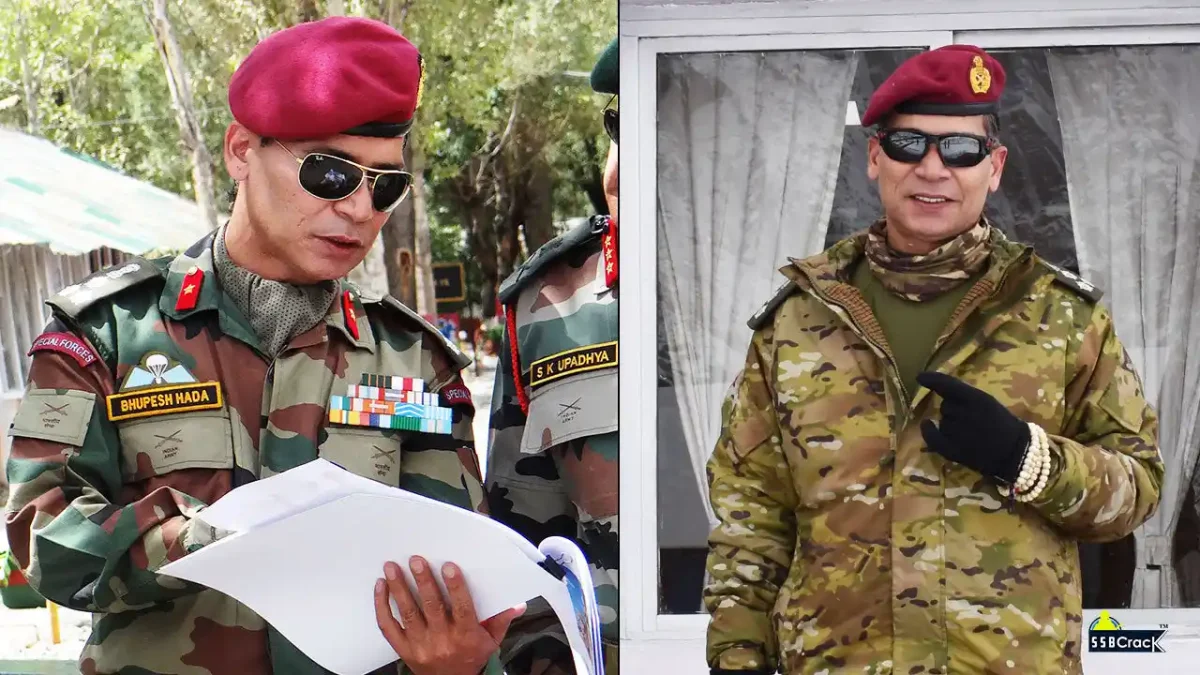
Some soldiers spend an entire career in one kind of fight. Brigadier Bhupesh Singh Hada, SC, VSM, served in almost every kind the Indian Army knows. He hunted terrorists in the Kashmir Valley with 10 Para (Special Forces), held the line on the Siachen Glacier, wore the blue helmet of the United Nations in Africa and went on to serve with the National Security Guard (NSG), India’s Black Cats.
His story is a useful one for every NDA, CDS and SSB aspirant. It shows how a young officer from a Sainik School can volunteer for the hardest unit in the Army, earn a gallantry award, and then keep growing as a leader, trainer and mountaineer over more than three decades of service.
Brigadier Bhupesh Singh Hada at a Glance
| Detail | Information |
|---|---|
| Born | 1970, Bundi (Boondi), Rajasthan |
| Schooling | Sainik School, Chittorgarh |
| Training | National Defence Academy (NDA) and Indian Military Academy (IMA) |
| Commissioned | 1991, Madras Regiment |
| Special Forces unit | 10 Para (Special Forces), the ‘Scorpions’ |
| Gallantry award | Shaurya Chakra (1999), for counter-terrorist operations in Jammu and Kashmir |
| Distinguished service award | Vishisht Seva Medal (VSM), for service in Siachen |
| Key commands | Siachen Brigade; served with the National Security Guard |
| Length of service | About 33 years |
Early Life in Bundi
Bhupesh Singh Hada was born in 1970 in Bundi, the old princely town in Rajasthan’s Hadauti region. His father, Maharaja Vijayraj Singh, was known as an educationist and social reformer, and the young Bhupesh grew up in a home where duty, honour and service were part of everyday life.
He later married Padmaja Rathore of Jasol in Barmer district, and the couple have a son, Raghav. Family and roots remained an important part of his identity, a fact that would come full circle long after he had made his name in uniform.
From Sainik School to the NDA and IMA
Like many officers who rose to senior rank, Bhupesh Singh Hada began his military journey early. He studied at Sainik School, Chittorgarh, one of the schools set up to prepare boys for a career as officers in the armed forces.
From there he cleared his way into the National Defence Academy at Khadakwasla, and then completed his pre-commissioning training at the Indian Military Academy in Dehradun. In 1991 he was commissioned into the Madras Regiment, one of the oldest infantry regiments of the Indian Army.
For aspirants, this path is worth noting. The Sainik School to NDA route remains one of the most reliable ways to join the forces as a permanent commissioned officer, and the training at NDA and IMA builds the physical and mental base that later special forces selection demands.
Volunteering for 10 Para (Special Forces)
After about three years with his infantry battalion, the young officer did what only a few volunteer for and even fewer complete. He opted for the Special Forces and was selected for 10 Para (Special Forces), a battalion of the Parachute Regiment popularly known as the ‘Scorpions’.
Para SF selection is voluntary and probation is famously harsh. Officers and men are tested for endurance, judgement under pressure and the ability to keep functioning when exhausted. Those who pass go on to train in parachuting, close-quarter battle and long-range operations in deserts, jungles and mountains. It was in this unit that Bhupesh Singh Hada’s reputation as a fighting officer was built.
Over the years he also qualified in a wide range of specialist skills associated with special forces work, including combat free-fall parachuting and combat diving.
Operations and the Shaurya Chakra
Across his career, Brigadier Hada took part in several major military operations, including:
- Operation Rhino – counter-insurgency operations in Assam
- Operation Orchid
- Operation Vijay – the 1999 Kargil War
- Operation Meghdoot – the Army’s deployment on the Siachen Glacier
- Counter-terrorist operations in Jammu and Kashmir
It was in Kashmir that he earned his gallantry award. For his leadership during anti-terrorist operations in the Valley in 1998, he was awarded the Shaurya Chakra in 1999. The Shaurya Chakra is India’s third-highest peacetime gallantry award, after the Ashoka Chakra and the Kirti Chakra, and is given for gallantry otherwise than in the face of the enemy.
Serving Under the UN Flag in Africa
His service was not limited to India’s borders. Brigadier Hada served as a Senior Sector Military Observer with the United Nations Mission in Ethiopia and Eritrea (UNMEE). Military observers in such missions monitor ceasefires, patrol buffer zones and report violations, often with little protection and in difficult terrain.
For his work in the mission he received the UN Force Commander’s Appreciation. India is one of the largest contributors to UN peacekeeping, and assignments like this give officers valuable experience in diplomacy and multinational operations.
Commanding the Siachen Brigade
One of the most demanding appointments of his career was command of the Siachen Brigade during Operation Meghdoot. The Siachen Glacier is often called the world’s highest battlefield, where soldiers face extreme cold, thin air, avalanches and crevasses as much as any enemy.
Leading troops there calls for careful planning of logistics, acclimatisation and medical support, as well as constant attention to the morale of men posted at isolated high-altitude posts. For his distinguished service in Siachen he was awarded the Vishisht Seva Medal (VSM).
He also passed on his high-altitude experience to others as Deputy Commandant and Chief Instructor of the High Altitude Warfare School (HAWS) at Gulmarg, which trains soldiers for mountain and snow warfare. In addition, he commanded a battalion of the Special Frontier Force and was the raising Deputy Commander of an independent infantry brigade deployed on the northern borders.
With the NSG Black Cats
Later in his career, Brigadier Hada served with the National Security Guard, India’s federal counter-terrorism force under the Ministry of Home Affairs. Raised in 1984 and known as the Black Cats for their black uniform and insignia, the NSG draws heavily on Army officers and soldiers for its Special Action Groups.
For a Para SF veteran, the move to the NSG was a natural one. The skills learned in counter-terrorist operations in Kashmir, from planning raids to leading small teams under fire, are exactly what the NSG needs for hostage rescue and urban counter-terror missions.
Other Honours and Commendations
Apart from the Shaurya Chakra and the VSM, his recognitions include:
- Chief of the Army Staff Commendation Card
- UN Force Commander’s Appreciation for service in Ethiopia and Eritrea
- Several commendations for operations, training and adventure activities
The Mountaineer in Uniform
Brigadier Hada’s appetite for challenge went beyond operations. In 2012 he led an Army mountaineering expedition to Mount Everest and Mount Lhotse, the world’s highest and fourth-highest peaks, and summited Everest. He also took part in the Everest Marathon, one of the highest marathons in the world.
Adventure activities are taken seriously in the Indian Army because they build exactly the qualities soldiers need: fitness, risk assessment, teamwork and the will to keep going when the body wants to stop.
Titular King of Bundi
On 12 December 2021, Brigadier Hada was ceremonially installed as the titular king of Bundi, becoming the 26th head of the Hada Chauhan lineage that ruled the former princely state. Royal titles have no official standing in India since the 26th Constitutional Amendment of 1971, and the role is purely social and ceremonial.
He has described it as a responsibility to keep the community united and to help preserve the history and culture of the region, rather than a claim to any property or power. For a serving officer at the time, it was a rare meeting of military service and family heritage.
Lessons for Defence Aspirants
- Start early, but keep growing. Sainik School and NDA gave him a strong base, but he kept adding new skills throughout his career.
- Volunteer for challenges. Special Forces selection is voluntary. Officers who seek out difficult tasks often gain the most.
- Leadership is about people. From Kashmir to Siachen, his appointments demanded care for the soldiers under his command.
- Fitness is a lifelong habit. Everest and a marathon in his forties show that physical fitness does not end after training.
- Know the awards. Questions on the Shaurya Chakra, Vishisht Seva Medal and special forces units are common in GK papers and SSB interviews.
FAQs
1. Which Para SF unit did Brigadier Bhupesh Singh Hada serve in?
He served with 10 Para (Special Forces), a battalion of the Parachute Regiment known as the ‘Scorpions’.
2. Which gallantry award did he receive?
He was awarded the Shaurya Chakra in 1999 for anti-terrorist operations in Jammu and Kashmir. He also holds the Vishisht Seva Medal for distinguished service in Siachen.
3. Which regiment was he commissioned into?
He was commissioned into the Madras Regiment in 1991 after training at the NDA and IMA.
4. Why is he called the king of Bundi?
On 12 December 2021 he was ceremonially installed as the titular king of Bundi, Rajasthan. The title is social and ceremonial and carries no official status.
Conclusion
Brigadier Bhupesh Singh Hada’s journey runs from Sainik School Chittorgarh to the Scorpions of 10 Para SF, from the snows of Siachen to the Black Cats of the NSG and the summit of Everest. It is a reminder that a career in the Indian Army offers far more than one role, and that the officers who make the most of it are those who keep volunteering for the next hard task. For every aspirant preparing for the NDA, CDS or SSB, his life is proof of what discipline and courage can build over a lifetime of service.