




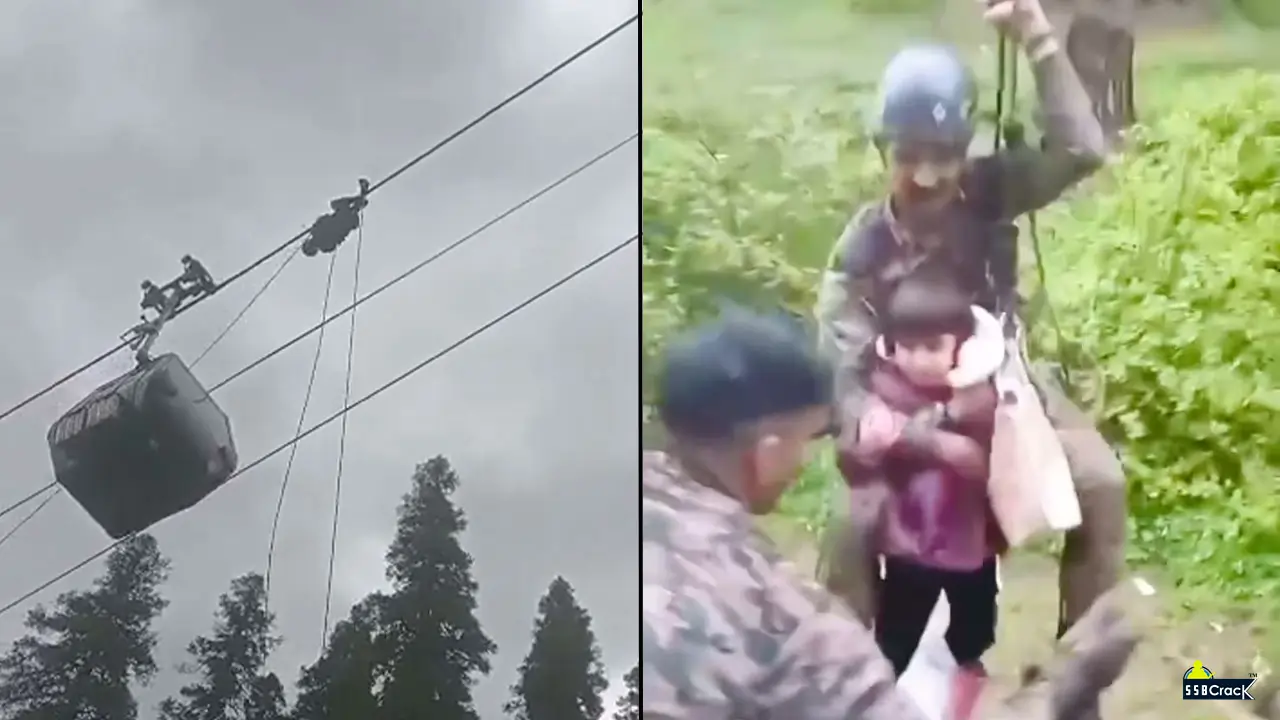
In a remarkable display of courage during a cable car emergency in Jammu and Kashmir, Colonel Shailendra Singh Negi of the Indian Army played a pivotal role in the rescue operation that unfolded on May 25, 2026. The incident occurred when the renowned Gulmarg Gondola experienced a significant technical failure, stranding over 300 tourists—families and children alike—in cabins suspended hundreds of feet in the air.
The malfunction, attributed to a gearbox issue, left cabins precariously dangling between the base station and the Phase-1 station. Panic quickly ensued among those trapped, as many found themselves in dire conditions, clinging to hope while hundreds of feet above steep mountain slopes.
Responding to the emergency, the Indian Army’s Chinar Corps, alongside personnel from the High Altitude Warfare School (HAWS) in Gulmarg, collaborated with the State Disaster Response Force, National Disaster Response Force, local police, and civil administration for a coordinated rescue effort. The challenging mountain terrain, combined with the height of the suspended cabins and the fragility of the cable system, created a complex situation for the rescue teams.
Colonel Negi, known for his expertise in high-altitude warfare and mountain rescue, stepped forward to undertake one of the most perilous tasks—climbing nearly 500 feet along the suspended cable to reach a cabin where a child was trapped. As he ascended, each movement tested his balance and composure, with the potential for tragedy lurking with even the slightest misstep. However, with calm determination, Colonel Negi successfully reached the stranded child and facilitated their safe evacuation.
The operation was a testament to the effectiveness of HAWS, a premier Indian Army institution trained in mountain warfare and survival in extreme environments. Their advocacy for safety and efficiency in critical situations proved essential in transforming a potentially disastrous scenario into a well-executed rescue mission.
After several hours, all trapped passengers were evacuated safely, with no reported injuries. This achievement underscored the vital importance of civil-military coordination in Jammu and Kashmir, especially during emergencies involving challenging terrain and tourism infrastructure.
Colonel Negi’s bravery in confronting danger to rescue a child has garnered widespread acclaim from citizens, veterans, and defense analysts alike. It epitomizes the noble traditions of the Indian Army, signifying that service extends beyond the battlefield, focusing instead on humanitarian efforts during times of crisis.
In the aftermath of the incident, the Gulmarg Gondola, renowned as one of the highest cable car systems globally, has remained closed for thorough technical inspections. Authorities initiated an investigation to ascertain the cause of the malfunction and to implement measures to preclude such occurrences in the future.
For Colonel Shailendra Singh Negi, the rescue has added an inspiring narrative to his distinguished career, highlighting that true heroism is often manifested in acts of bravery outside the combat zone. The events in Gulmarg will be etched in memory not just as a successful rescue operation but also as a profound example of courage, professionalism, and humanity in uniform.


