In Current Affairs for 19 December 2025, we will see the latest national and international current affairs news. These important current affairs will be beneficial for your upcoming NDA, CDS, CDS OTA, AFCAT, TA, Agniveer Army, Agniveer Navy, Agniveer Air Force, Women Military Police, INET, MNS, ACC exams, SCO, PCSL, CAPF, and SSB interviews, and direct entries for Army, Navy, and Air Force like SSC Tech, TGC, JAG, NCC, TES, 10+2 Cadet. Download a PDF file about current events at the end of this article. Let us now see the Current Affairs.
Current Affairs 19 December 2025
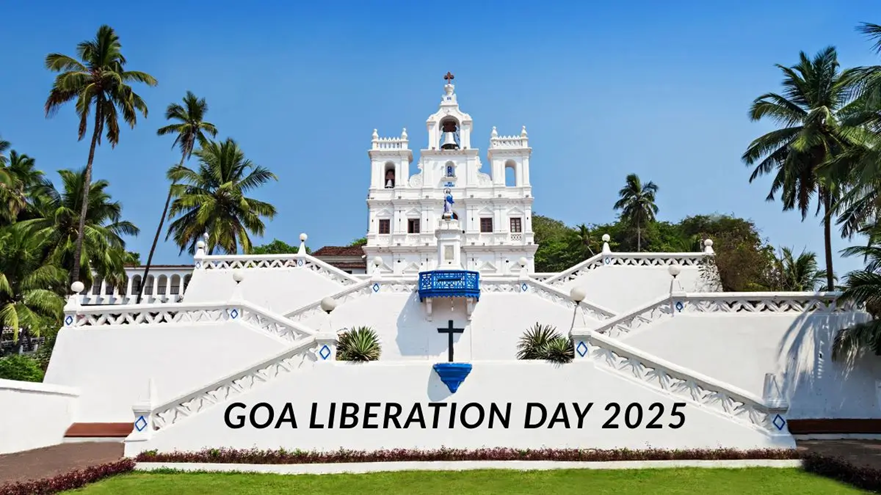
Goa Liberation Day 2025: Remembering the End of Colonial Rule
Goa Liberation Day 2025 is being commemorated on 19 December with deep pride and patriotic spirit throughout the state. This significant day marks the liberation of Goa from more than four centuries of Portuguese domination in 1961, bringing an end to one of the longest periods of European colonial rule in India.
The observance holds immense national relevance as it symbolizes the final chapter of foreign colonialism on Indian soil. It reaffirmed India’s firm commitment to sovereignty, territorial unity, and national integration. The liberation of Goa reflected the country’s determination to safeguard its people and complete the process of unification after independence.
The day also serves as a solemn reminder of the sacrifices made by soldiers and freedom fighters. During Operation Vijay, about 22 Indian soldiers and nearly 30 Portuguese personnel lost their lives. Their contribution remains an enduring symbol of India’s struggle for unity and freedom.
Historically, Goa, situated along India’s southwestern coastline, came under Portuguese control in 1510. Even after India gained independence on 15 August 1947, Goa, Daman, and Diu continued as Portuguese territories. India initially adopted a peaceful diplomatic route to integrate these regions, but Portugal refused discussions, insisting that Goa was an overseas province and not a colony.
Operation Vijay and Liberation of Goa
The situation escalated in December 1961 when Portuguese forces fired upon Indian fishermen and attempted to detain Indian civilians. In response to these provocations, Prime Minister Jawaharlal Nehru, acting on the advice of Defence Minister V. K. Krishna Menon, approved military action.
Operation Vijay was launched on 18 December 1961, involving nearly 30,000 Indian troops, supported by coordinated operations of the Army, Navy, and Air Force. The mission concluded swiftly within 48 hours, and on 19 December 1961, Goa was formally liberated, ending 451 years of Portuguese rule.
Following liberation, Goa, along with Daman and Diu, was administered as a Union Territory. Major General K. P. Candeth was appointed the first Lieutenant Governor to oversee the transition. Goa later achieved full statehood on 30 May 1987, becoming India’s 25th state, marking its complete constitutional integration into the Indian Union.
Prime Minister Modi Conferred Oman’s Highest Civilian Honour
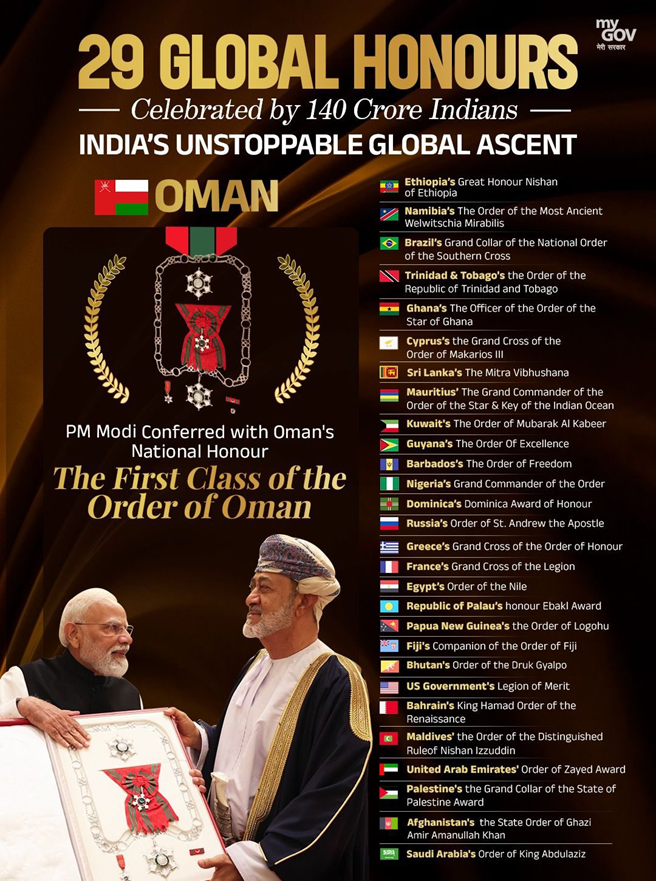
Prime Minister Narendra Modi has been awarded The First Class of the Order of Oman, the highest national civilian honour of the Sultanate of Oman. This recognition marks another landmark in India’s growing diplomatic presence on the global stage.
With this honour, Prime Minister Modi has now received 29 top foreign state honours, highlighting both India’s rising international stature and his personal diplomatic influence. The award was presented during his visit to Muscat, which was the concluding leg of his three-nation foreign tour.
The Order of Oman has previously been conferred upon globally respected leaders such as Nelson Mandela, Queen Elizabeth II, Emperor Akihito of Japan, Queen Máxima, and King Abdullah of Jordan. Prime Minister Modi’s inclusion in this distinguished list reflects the depth, trust, and maturity of India–Oman bilateral relations.
India and Oman Sign Comprehensive Economic Partnership Agreement (CEPA)
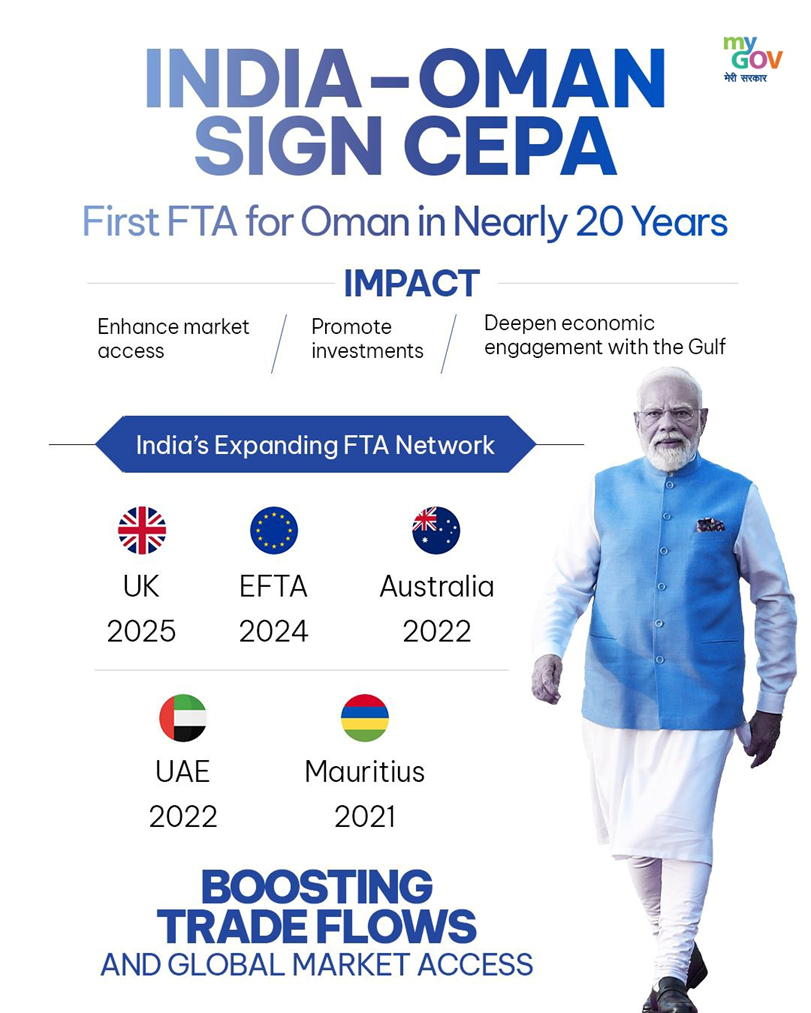
India and Oman have signed a Comprehensive Economic Partnership Agreement (CEPA), marking a major advancement in India’s economic engagement with the Gulf region. The agreement reinforces India’s strategy of entering into high-quality trade partnerships with non-competing economies.
The agreement was signed in the presence of Prime Minister Narendra Modi and Sultan Haitham bin Tarik of Oman, underlining its strategic and political importance.
Key Trade Benefits for India
- Zero-duty access on 98.08% of Oman’s tariff lines
- Covers 99.38% of India’s exports by value
- Immediate tariff removal on 97.96% of tariff lines
Major beneficiary sectors include textiles, leather, footwear, gems and jewellery, engineering goods, pharmaceuticals, automobiles, plastics, furniture, and agricultural products.
India has offered tariff liberalisation on 77.79% of tariff lines, covering 94.81% of imports from Oman by value.
Strategic Importance
The CEPA strengthens India’s economic footprint in the Gulf, boosts exports and employment, enhances supply-chain resilience, and positions Oman as a gateway for India’s trade with the Middle East and Africa, while protecting sensitive domestic sectors.
Viksit Bharat G RAM G Bill Passed in Lok Sabha
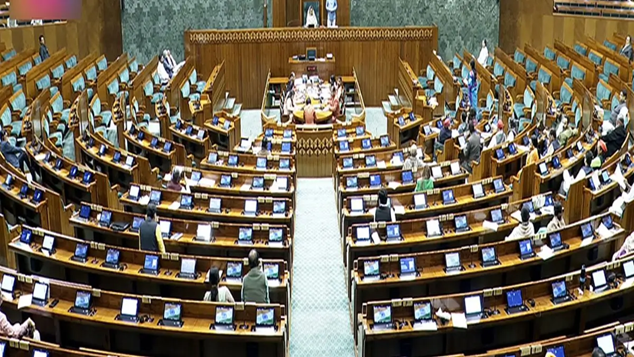
On 18 December 2025, the Lok Sabha passed the Viksit Bharat Guarantee for Rozgar and Ajeevika Mission (Gramin) [VB-G RAM G] Bill, 2025, following an intense debate amid protests. The legislation seeks to reform rural employment and livelihood schemes by restructuring provisions earlier covered under MGNREGA.
The government stated that while MGNREGA played a vital role in reducing rural distress, the new framework aims to promote long-term productivity, infrastructure-linked employment, technology-driven transparency, and alignment with the Viksit Bharat 2047 vision.
Key Objectives
- Expansion of rural employment opportunities
- Shift from short-term relief to durable livelihood assets
- Integration with national infrastructure planning
- Faster wage payments on a weekly cycle
- Stronger penalties for violations (up to ₹10,000)
- Focus on climate-resilient assets
- Special provisions for vulnerable groups including single women, elderly persons, persons with disabilities, and transgender individuals
Sixth Session of the 18th Lok Sabha Concludes
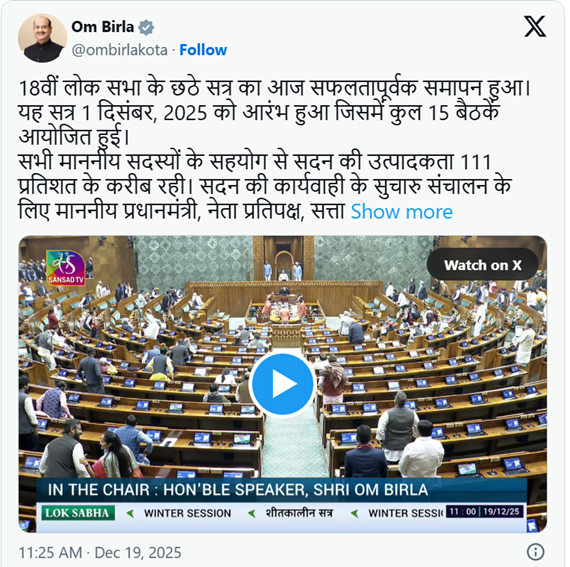
The Sixth Session of the Eighteenth Lok Sabha, which began on 1 December 2025, has concluded after 15 sittings, totaling 92 hours and 25 minutes of proceedings. Lok Sabha Speaker Om Birla informed that the House achieved a productivity level of 111% during the session.
During the session, 10 Government Bills were introduced, and 8 Bills were passed, including amendments related to GST, central excise, insurance laws, nuclear energy reforms, rural employment, and appropriation matters.
Parliament Passes SHANTI Bill: A New Era for Nuclear Energy
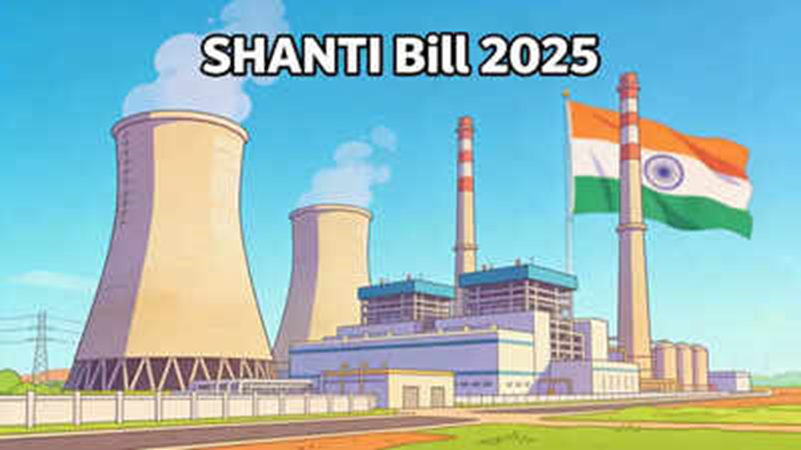
Prime Minister Narendra Modi welcomed the passage of the Sustainable Harnessing and Advancement of Nuclear Energy for Transforming India (SHANTI) Bill, 2025, describing it as a transformative step for India’s technological and energy future.
The Lok Sabha cleared the Bill by voice vote during the Winter Session. Introduced by Minister of State for Atomic Energy Dr. Jitendra Singh, the Bill opens parts of India’s nuclear energy sector to private participation for the first time, marking a major policy shift.
The legislation aims to support India’s target of achieving 100 GW of nuclear power capacity by 2047. It grants statutory status to the Atomic Energy Regulatory Board (AERB), empowering it to inspect facilities, investigate incidents, issue binding directions, and suspend unsafe operations.
A restructured licensing framework will clearly define responsibilities for building and operating nuclear facilities, ensuring higher accountability, safety, and transparency.
Review Questions
- Goa Liberation Day is observed every year on which date?
A) 18 December
B) 19 December
C) 30 May
D) 15 August
Answer: B) 19 December - Goa was liberated from Portuguese colonial rule in which year?
A) 1947
B) 1956
C) 1961
D) 1987
Answer: C) 1961
- For approximately how many years was Goa under Portuguese rule?
A) 250 years
B) 350 years
C) 400 years
D) Over 450 years
Answer: D) Over 450 years
- Goa attained full statehood on which date?
A) 19 December 1961
B) 26 January 1950
C) 30 May 1987
D) 15 August 1987
Answer: C) 30 May 1987
- Goa became which numbered state of India after attaining statehood?
A) 23rd
B) 24th
C) 25th
D) 26th
Answer: C) 25th
- After Goa attained statehood, Daman and Diu remained a:
A) Separate state
B) Autonomous region
C) Union Territory
D) Protectorate
Answer: C) Union Territory
- India signed a Comprehensive Economic Partnership Agreement (CEPA) with
which country?
A) Saudi Arabia
B) UAE
C) Oman
D) Qatar
Answer: C) Oman
- Which is the highest national honour of Oman conferred upon Prime Minister
Narendra Modi?
A) Order of Renaissance
B) Order of the Rising Sun
C) The First Class of the Order of Oman
D) Sultan Qaboos Award
Answer: C) The First Class of the Order of Oman
- The SHANTI Bill, 2025 is related to which sector?
A) Renewable energy
B) Atomic energy
C) Defence manufacturing
D) Space technology
Answer: B) Atomic energy
- India aims to achieve how much nuclear power capacity by 2047 under the
SHANTI Bill framework?
A) 50 GW
B) 75 GW
C) 100 GW
D) 150 GW
Answer: C) 100 GW