





In Defence Current Affairs for 08 August 2026, we will see the latest national and international current affairs news. These important current affairs will be beneficial for your upcoming NDA, CDS, CDS OTA, AFCAT, TA, Agniveer Army, Agniveer Navy, Agniveer Air Force, Women Military Police, INET, MNS, ACC exams, SCO, PCSL, CAPF, and SSB interviews, and direct entries for Army, Navy, and Air Force like SSC Tech, TGC, JAG, NCC, TES, 10+2 Cadet. Download a PDF file about current events at the end of this article. Let us now see the Current Affairs.
Defence Current Affairs 08 August 2026
India Explores Participation in France-Led Sixth-Generation Fighter Programme
India has begun exploring the possibility of joining the Future Combat Air System (FCAS) programme, a French-led initiative aimed at developing next-generation combat aircraft. The move reflects India’s growing focus on preparing its air power for future warfare, where advanced technology, networked operations and highly capable combat platforms are expected to play a decisive role.
A Parliamentary Standing Committee on Defence has recommended that India establish a clear roadmap for the development and acquisition of sixth-generation fighter aircraft. The committee emphasised that maintaining technological relevance is essential because modern warfare is becoming increasingly dependent on air power and advanced aerospace systems.
According to the PPT, two major international groups are currently working on sixth-generation fighter programmes. One involves the United Kingdom, Italy and Japan, while the other brings together France and Germany. India is considering collaboration with one of these groups to avoid falling behind in the development of advanced combat aviation.
The development of India’s Advanced Medium Combat Aircraft (AMCA) is also progressing, with its design completed and discussions concerning its production underway.
Significance
Participation in an international sixth-generation fighter programme could provide India with access to advanced aerospace technologies while supporting the country’s long-term goal of developing an increasingly capable indigenous air force.

Saudi Arabia, Türkiye and Pakistan Sign Joint Defence Agreement
Saudi Arabia, Türkiye and Pakistan have signed a joint defence agreement amid heightened security tensions in the wider Middle East. The agreement is intended to strengthen cooperation among the three countries and establish a framework for collective deterrence against potential aggression.
Under the agreement, an armed attack against any one of the three countries would be treated as an attack against all three, according to their joint statement. The countries described the arrangement as a mechanism for strengthening collective security and promoting regional stability.
The agreement comes against the backdrop of continuing tensions involving regional powers. The three countries have emphasised that the arrangement is defensive in nature and is not directed against a particular state. Türkiye has also indicated that the framework remains open to other regional countries and does not replace existing bilateral or multilateral security arrangements.
Saudi Arabia’s strategic importance is linked to its position as a major energy exporter, while Türkiye possesses one of NATO’s largest militaries. Pakistan brings extensive military experience and is the only nuclear-armed Muslim-majority state.
Significance
The agreement could reshape security cooperation among the three countries and strengthen their ability to coordinate responses to emerging regional security challenges.

Bhawana Kanth Becomes India’s First Woman Fighter Combat Leader
Indian Air Force Squadron Leader Bhawana Kanth has achieved another milestone by becoming the first Indian woman pilot to successfully complete the Fighter Combat Leader (FCL) course. She completed the advanced training programme on 6 August 2026 at the Tactics and Air Combat Development Establishment (TACDE), Gwalior.
The FCL course is a highly specialised 20-week programme designed for selected IAF fighter pilots. It focuses on advanced air-combat tactics, leadership and the ability to command complex frontline missions. The course has a highly selective completion rate, with only around one percent of selected pilots reportedly completing it successfully.
Bhawana Kanth was commissioned into the Indian Air Force in June 2016 as part of the country’s first batch of women fighter pilots. The batch also included Avani Chaturvedi and Mohana Singh. In 2019, Kanth became the first Indian woman fighter pilot to qualify for daytime combat missions.
She has flown the MiG-21 Bison and later transitioned to the Su-30MKI. She was also awarded the Nari Shakti Puraskar in 2020 and became the first female fighter pilot to appear in the Indian Air Force’s Republic Day parade tableau in 2021.
Significance
Her achievement represents an important milestone in the increasing participation of women in India’s combat aviation and leadership roles.

FCRA Amendment Bill 2026
- Breaking its silence over concerns expressed by international stakeholders
regarding the Foreign Contribution (Regulation) Amendment (FCRA) Bill, 2026,
the Ministry of External Affairs on Friday (August 7, 2026) said that “legislative
matters concerning India are internal affairs”. - “We have seen the comments. Legislative matters concerning India are our
internal affairs to be decided by our Parliament. May I point out that several
nations, including the U.S. regulate the flow of foreign funds,” Official
Spokesperson of the Ministry of External Affairs, Randhir Jaiswal, said at the bi
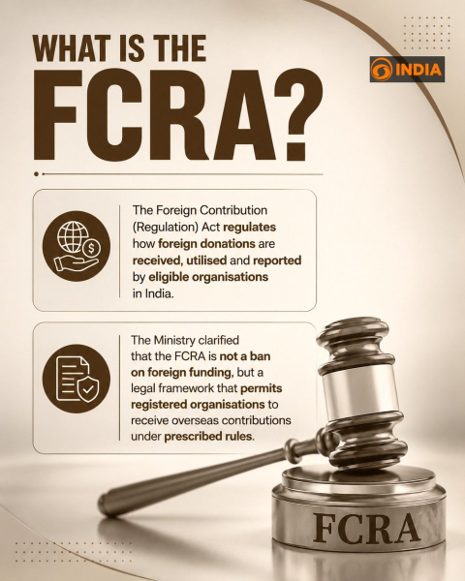
weekly press briefing. - What is the FCRA?
- The FCRA regulates the receipt and utilisation of foreign contributions by
organisations and individuals covered under the law. It lays down conditions
regarding who can receive foreign funds, how such funds must be received, how
they can be used and what information must be disclosed to the authorities. - The legislation was originally enacted in 1976 and was replaced by the present
FCRA in 2010. It was subsequently amended in 2016, 2018, 2020 and 2026. - Is the FCRA a Ban on Foreign Donations?
- No. The FCRA does not completely prohibit foreign contributions.
- Eligible organisations can receive overseas funding after obtaining FCRA
registration or prior permission, provided they comply with the prescribed
conditions and reporting requirements. - According to the Ministry, around 16,200 associations were registered under
the Act during 2024–25 and collectively received approximately ₹22,963 crore in
foreign contributions. - This demonstrates that the FCRA operates primarily as a regulatory, registration
and disclosure framework, rather than as a blanket prohibition on foreign
donations. - Main Objectives of the FCRA
- The framework focuses on five broad principles:
- Transparency
- Accountability
- Protection of sovereignty
- Facilitation of genuine developmental activities
- Maintaining public confidence
- Organisations receiving foreign contributions are required to disclose donor
information, amounts received and the purpose for which the funds are utilised.
They must also submit annual audited returns electronically. - Which Activities Can Receive Foreign Contributions?
- Foreign contributions can be utilised for a wide range of legitimate activities,
including: - Education
- Healthcare
- Rural development
- Social welfare
- Environmental protection
- Scientific research
- Disaster relief
- Cultural preservation
- Certain charitable and faith-based activities
- The objective is to permit genuine international cooperation while maintaining
regulatory safeguards. - Who Cannot Receive Foreign Contributions?
- The Act restricts certain categories of persons and organisations from receiving
foreign contributions. These include: - Election candidates
- Legislators
- Judges
- Government/public servants
- Political parties and their office-bearers
- Organisations considered to be of a political nature
- Certain persons associated with newspapers and news or current-affairs media
- These restrictions are linked to the constitutional and public importance of the
roles occupied by these categories. - How Does FCRA Registration Work?
- An organisation seeking foreign contributions can generally follow one of two
routes: - 1. FCRA Registration
- An organisation that has been operational for at least three years may apply for
full FCRA registration. - 2. Prior Permission
- An organisation that does not meet the conditions for registration may seek
permission for receiving foreign contributions for a specific project or purpose. - FCRA registration is valid for five years and requires renewal subject to
compliance requirements. - Banking and Utilisation Requirements
- Foreign contributions must initially be received through a designated FCRA
account at the State Bank of India’s New Delhi Main Branch before being
transferred to operational accounts. - The funds must be used only for the objectives declared by the organisation.
- Another important requirement is that administrative expenditure cannot
exceed 20% of the annual foreign contribution. Organisations must also file
audited annual returns containing details of receipts, donors and expenditure. - Major Changes Proposed in 2026
- The proposed FCRA Amendment Bill, 2026 seeks to address certain operational
and enforcement issues. - Management of Assets
- One major proposal concerns assets created using foreign contributions when
an organisation’s FCRA registration comes to an end. - Such assets could be provisionally placed under a designated authority. If the
organisation successfully restores or renews its registration within the
prescribed period, the assets can be returned. If restoration does not occur, the
assets could permanently vest with the authority for public purposes. - The proposal applies to assets created from foreign contributions rather than
the organisation’s entire property. - Right of Revision and Judicial Appeal
- The proposed framework also provides mechanisms for revision and allows
judicial appeal before a District Judge against orders of the designated
authority. - Changes in Penalties
- The proposed Bill seeks to reduce the maximum imprisonment under certain
provisions from five years to one year. - Central Approval for Investigations
- Another proposal requires state agencies to obtain prior approval from the
Central Government before beginning investigations under the FCRA. The stated
purpose is to promote coordinated enforcement of a central law involving
foreign relations and national security. - Revised FCRA Rules, 2026
- The revised Rules notified in June 2026 introduce additional disclosure and
monitoring requirements. - FCRA registration certificates will specify the purpose and geographical area for
which foreign contributions may be received. Existing organisations have been
given a transition period to provide the required information. - Organisations seeking renewal must also demonstrate utilisation of at least ₹10
lakh in foreign contributions during the preceding two years. - The revised disclosure requirements include:
- Project-wise utilisation details
- Activity-wise expenditure information
- Organisation websites
- Social-media accounts
- Identification of the ultimate foreign donor, even where funds pass through
intermediaries - These provisions are intended to improve the traceability of foreign
contributions from their original source to their final utilisation. - Does the FCRA Target Any Particular Religion?
- The Ministry has stated that the FCRA applies uniformly irrespective of religion,
community or ideology. - Faith-based charitable activities can continue to receive foreign contributions
when they comply with the law. The revised Rules provide greater clarity about
permissible religious purposes, while restrictions concerning conversion
oriented activities funded through foreign contributions apply across religious
groups. - International Context
- India is not the only country regulating foreign funding and foreign influence.
The Ministry has pointed to similar transparency-related laws and regulatory
frameworks in countries including the United States, Australia, the United
Kingdom and Canada. - The broader international trend is towards greater disclosure and oversight of
foreign funding and influence. - Significance of the 2026 Changes
- The proposed amendments and revised Rules seek to create greater
transparency in the foreign-funding ecosystem. Stronger disclosure
requirements can make it easier to identify the source of funds and understand
how they are ultimately used. - At the same time, the framework continues to permit foreign contributions for
legitimate developmental, charitable, scientific and social activities.
Review Questions
- Which sixth-generation fighter programme is India exploring participation in?
A) GCAP
B) Future Combat Air System (FCAS)
C) Tempest
D) NGAD
Answer: B) Future Combat Air System (FCAS) - What is the primary significance of India’s proposed participation in the French-led
FCAS programme?
A) Development of civilian aircraft
B) Expansion of commercial aviation
C) Access to advanced next-generation combat-aircraft technology and cooperation
D) Development of passenger aircraft
Answer: C) Access to advanced next-generation combat-aircraft technology and
cooperation - Bhawana Kanth became the first Indian woman pilot to successfully complete
which course?
A) Combat Air Controller Course
B) Basic Fighter Training Course
C) Fighter Combat Leader (FCL) Course
D) Test Pilot Course
Answer: C) Fighter Combat Leader (FCL) Course - Which three countries signed the joint defence agreement discussed in the article?
A) Saudi Arabia, Iran and Türkiye
B) Türkiye, Qatar and Pakistan
C) Saudi Arabia, Türkiye and Pakistan
D) Saudi Arabia, UAE and Pakistan
Answer: C) Saudi Arabia, Türkiye and Pakistan - The Foreign Contribution (Regulation) Act is commonly known by which
abbreviation?
A) FCRA
B) FEMA
C) FRCA
D) FCDA
Answer: A) FCRA - The original Foreign Contribution Regulation law was enacted in which year?
A) 1968
B) 1976
C) 1986
D) 1991
Answer: B) 1976 - Under the FCRA framework, foreign contributions received by eligible
organisations are primarily subject to:
A) No reporting requirements
B) Only state-level approval
C) Registration/prior permission and reporting requirements
D) Automatic approval for every organisation
Answer: C) Registration/prior permission and reporting requirements - What is the maximum proportion of foreign contribution that can generally be
used for administrative expenses under the FCRA framework?
A) 10%
B) 15%
C) 20%
D) 30%
Answer: C) 20% - Which ministry is primarily responsible for administering the FCRA?
A) Ministry of Finance
B) Ministry of External Affairs
C) Ministry of Corporate Affairs
D) Ministry of Home Affairs
Answer: D) Ministry of Home Affairs - Consider the following statements about the FCRA: 1. The original FCRA was enacted in 1976. 2. The present FCRA was enacted in 2010. 3. FCRA registration is generally valid for five years. 4. The Act completely prohibits foreign contributions in India.
Which of the statements given above is/are correct?
A) 1 and 2 only
B) 1, 2 and 3 only
C) 2, 3 and 4 only
D) 1, 2 and 3 only
Answer: D) 1, 2 and 3 only
ALSO READ:
- Latest Daily Current Affairs and Defence Updates
- Latest Daily Current Affairs July 2026[DOWNLOAD PDF]
- Latest Daily Current Affairs June 2026[DOWNLOAD PDF]
- Latest Daily Current Affairs May 2026[DOWNLOAD PDF]
- Latest Daily Current Affairs April 2026[DOWNLOAD PDF]
- Latest Daily Current Affairs March 2026[DOWNLOAD PDF]
- Latest Daily Current Affairs February 2026[DOWNLOAD PDF]
- Latest Daily Current Affairs January 2026[DOWNLOAD PDF]
- Latest Daily Current Affairs November 2025[DOWNLOAD PDF]
- Latest Daily Current Affairs October 2025[DOWNLOAD PDF]
- Latest Daily Current Affairs August 2025[DOWNLOAD PDF]
- Latest Daily Current Affairs July 2025[DOWNLOAD PDF]


