


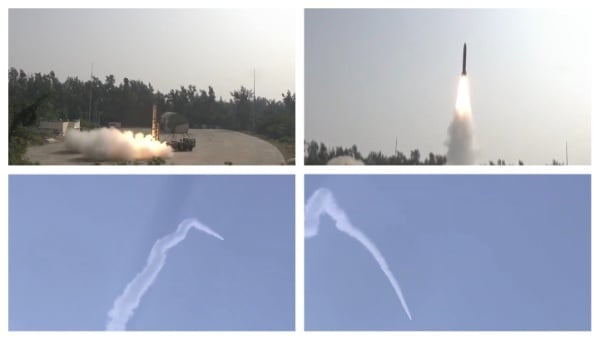
The Defence Research and Development Organisation (DRDO) has marked a significant milestone in India’s defense capabilities with the successful test firing of the ‘Pralay’ surface-to-surface short-range ballistic missile (SRBM). The test took place early in the morning from Abdul Kalam Island off the coast of Odisha.
Executed at 9:35 AM, the missile successfully accomplished all its mission objectives, validating crucial performance parameters. This test not only showcases India’s growing competence in developing indigenous missile systems but also aligns with the Atmanirbhar Bharat initiative, which seeks to reduce the nation’s dependence on foreign defense imports.
The ‘Pralay’ missile is a canisterised, road-mobile ballistic missile specifically designed for precision strikes on high-value military targets, such as enemy air bases, logistics hubs, and concentrations of troop forces. With a strike range between 150 to 500 kilometers and the capability to carry payloads of up to 1,000 kg, ‘Pralay’ significantly enhances the strategic depth and rapid-launch capabilities of the Indian armed forces.
One of the missile’s standout features is its quasi-ballistic flight profile. While it adheres to a ballistic trajectory, the missile is designed with the capability to maneuver both mid-course and during terminal phases, which complicates interception efforts. Furthermore, it is equipped with advanced guidance systems, including inertial navigation and a radio frequency seeker, which enhance its accuracy during terminal guidance.
The missile’s quick reaction time—taking less than 10 minutes from transport to launch—offers operational flexibility and increases survivability in contested environments. Despite its comparable size and weight to the Prithvi series, the ‘Pralay’ missile provides a greater range and lethality, all while remaining within the confines of the nuclear threshold.
Defence sources indicate that the missile is intended for deployment along both the Line of Control (LoC) with Pakistan and the Line of Actual Control (LAC) with China. This strategic positioning provides a robust and swift conventional strike option in the face of provocation or aggression.
The successful test further cements India’s tactical missile capabilities and underscores the DRDO’s ongoing advancements in developing next-generation indigenous weapon systems. This achievement reflects a commitment to enhancing national security and fortifying India’s defense infrastructure.