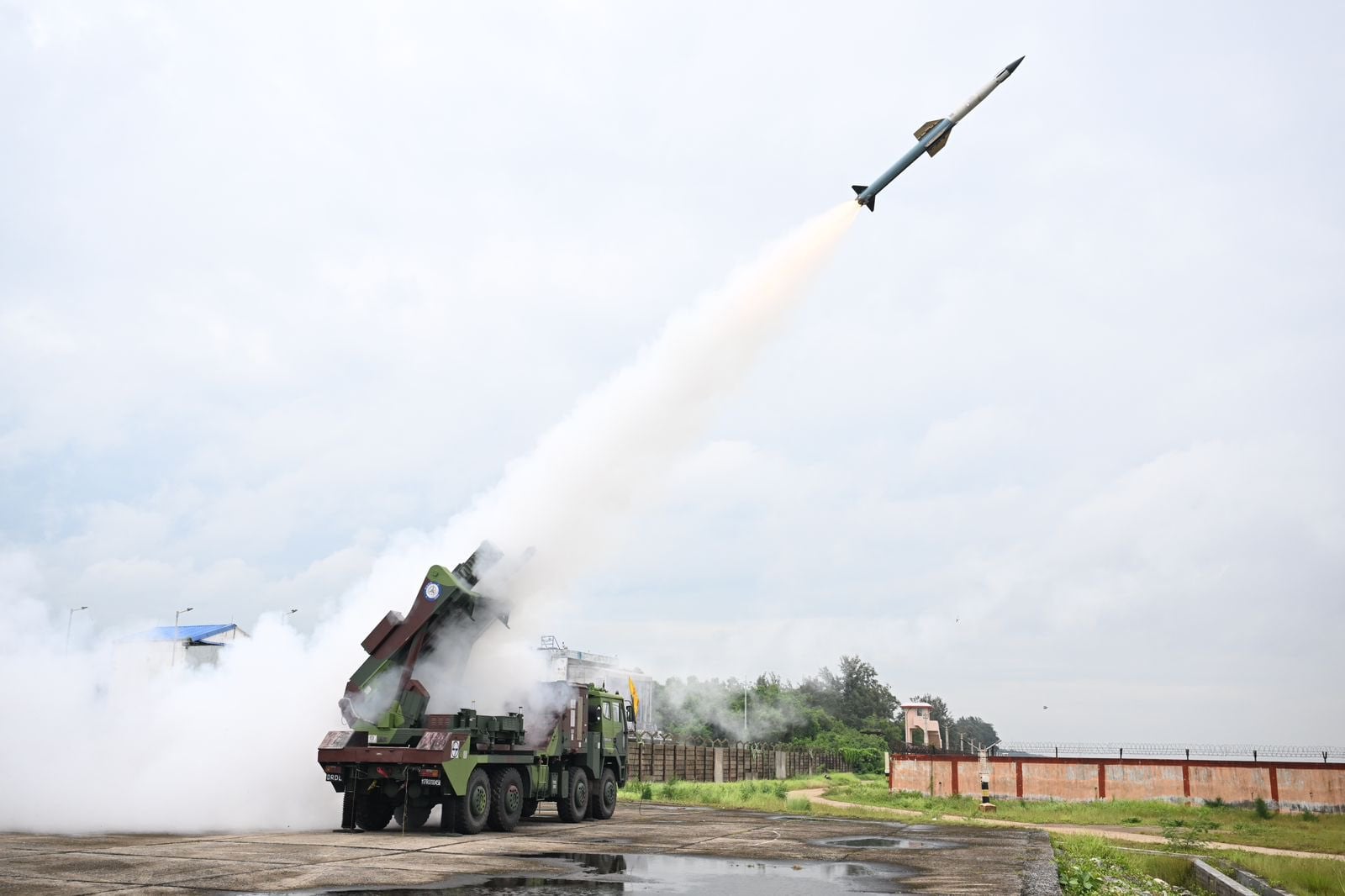
India is advancing its defense capabilities with the impending deployment of a home-grown integrated air defense system aimed at bolstering the protection of the national capital region. This development follows the completion of the first flight test of the multilayered Integrated Air Defence Weapon System (IADWS), which took place in August.
The project is gaining momentum, especially in light of recent tensions with Pakistan. In May, a Pakistani Fatah-II guided rocket artillery projectile was intercepted approximately 250 kilometers from Delhi. This incident highlighted the need for enhanced air defense measures, prompting India to move ahead with the IADWS initiative.
Significantly, the Indian government appears to be shifting away from the previously considered National Advanced Surface-to-Air Missile System (NASAMS) II, developed by the US and Sweden. Reports suggest that the NASAMS II is viewed as too costly, influencing India’s decision to develop its own solution. Earlier negotiations regarding the acquisition of NASAMS II, which offers defense capabilities for Washington, DC, were advanced when the US State Department approved a potential $1.9 billion sale in 2020.
The Indian Air Force is set to deploy the IADWS to ensure the safety of critical assets in the national capital region. The Defence Research and Development Organisation (DRDO) will oversee the coordination with various production agencies to integrate networking and command-and-control functions within the system.
The IADWS features several advanced components designed to provide comprehensive air defense coverage. Developed by the DRDO, this integrated system combines indigenous Quick Reaction Surface-to-Air Missiles (QRSAM), Advanced Very Short Range Air Defence System (VSHORADS) missiles, and a high-powered, laser-based Directed Energy Weapon (DEW).
Key features include a centralized command-and-control center developed by the Defence Research & Development Laboratory, which facilitates the system’s operational coordination. The QRSAM boasts a surveillance range of 120 kilometers (about 75 miles) and can track targets up to 80 kilometers (50 miles) away. It is capable of engaging six incoming targets simultaneously at ranges of up to 30 kilometers (19 miles), utilizing advanced electronic counter-countermeasures and a sophisticated radio-frequency seeker to resist jamming.
In addition, the portable VSHORADS is specifically designed to neutralize low-altitude aerial threats at short ranges, with an effective range of around 6 kilometers (3.72 miles) and a maximum engagement altitude of about 3 kilometers (1.86 miles).
Earlier this year, the DRDO also successfully tested its Mk-II (A) DEW, engineered to disable unmanned aerial vehicles and small fixed-wing aircraft. The organization is actively pursuing further advancements in directed energy technology, including a 300-kilowatt laser weapon known as Surya, with a demonstration scheduled for 2027. This continuous innovation underscores India’s commitment to strengthening its air defense capabilities in an increasingly complex security environment.