




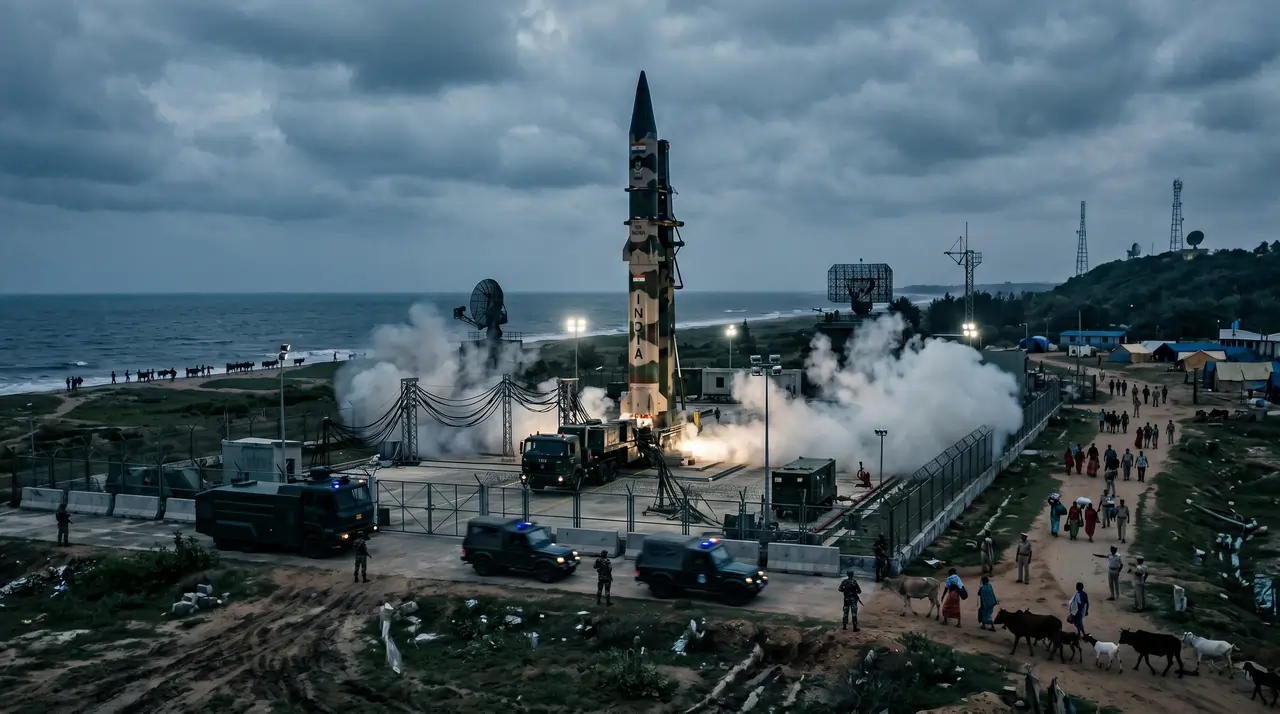
As the morning dawned on 11 June 2026, Indian authorities ramped up efforts to ensure public safety through a large-scale precautionary evacuation ahead of a planned missile test from Launch Complex-3 (LC-3) at the Integrated Test Range (ITR) in Chandipur, situated in the Balasore district of Odisha. Reports and social media chatter have closely associated the upcoming test with India’s much-anticipated Agni-6 intercontinental ballistic missile (ICBM). However, there has been no official confirmation of the missile type from the Defence Research and Development Organization (DRDO), the Ministry of Defence, or district officials.
Evacuation efforts have led to the relocation of over 11,400 residents and livestock from a designated exclusion zone, specifically the villages within a radius of 1 km to 3.5 km around the testing site. The evacuation process adhered to standard safety protocols for missile trials, with residents safely housed in temporary shelters such as the Bardhanpur Multipurpose Cyclone Shelter, Bardhanpur High School, and several other facilities. Senior district officials, backed by police, coordinated the operation, ensuring the safety and security of all individuals involved. Residents have been informed that they can return only once the test is completed and authorities have declared the area safe.
Heightened security measures have been instituted around the test zone as the area braces for the impending launch. While reports indicated that the test is “imminent,” as of the early hours of 11 June, there has been no public verification that the launch has actually occurred.
Speculation surrounding the Agni-6 has gained momentum, particularly from media outlets such as Firstpost, which suggested that the test is anticipated to take place from LC-3. Analysts on social media have amplified this narrative, citing the extensive preparations underway. Yet, a number of experts express skepticism regarding these assertions. Historically, LC-3 has been utilized for shorter- to intermediate-range missiles, like the Prithvi-II and Agni-1, while longer-range systems such as the Agni-5 are typically tested from Abdul Kalam Island, allowing for trajectories over the Bay of Bengal.
Concerns about limited airspace restrictions, reportedly spanning around 350 km, further complicate the narrative regarding a potential full-range ICBM test. The DRDO has opted for silence on the specific missile being tested, following a common practice of only issuing statements post successful completion and validation.
The Agni-6 is projected as India’s next-generation ICBM, designed to succeed the Agni-5 and boasting advanced capabilities. Key expected specifications include being a three- or four-stage solid-propellant missile featuring Multiple Independently Targetable Re-entry Vehicle (MIRV) capabilities, with an estimated range of between 8,000 to 12,000 km, and possibly beyond. It is expected to be capable of carrying 10 to 11 nuclear warheads, with advanced features to counteract potential missile defense systems.
The current developmental phase for the Agni-6 suggests hardware realization is underway, with design work reportedly complete. With aspirations to significantly bolster India’s strategic reach and second-strike capability, the program is built on existing technologies from previous Agni models and K-series submarines. Recent missile tests earlier in May 2026, including the successful trial of a variant of the Agni-5, had earlier sparked speculation about the Agni-6’s imminent testing.
As preparations for the missile test at Chandipur continue, the immediate situation remains uncertain, with speculation abounding about the nature of the system being tested. A full test of the Agni-6 would represent a significant achievements in India’s defense capabilities. Meanwhile, official updates from the DRDO or the Ministry of Defence are anticipated following any successful launch. Observers are encouraged to remain vigilant and rely on official sources for verified information, given the fluidity of the developing situation.


