



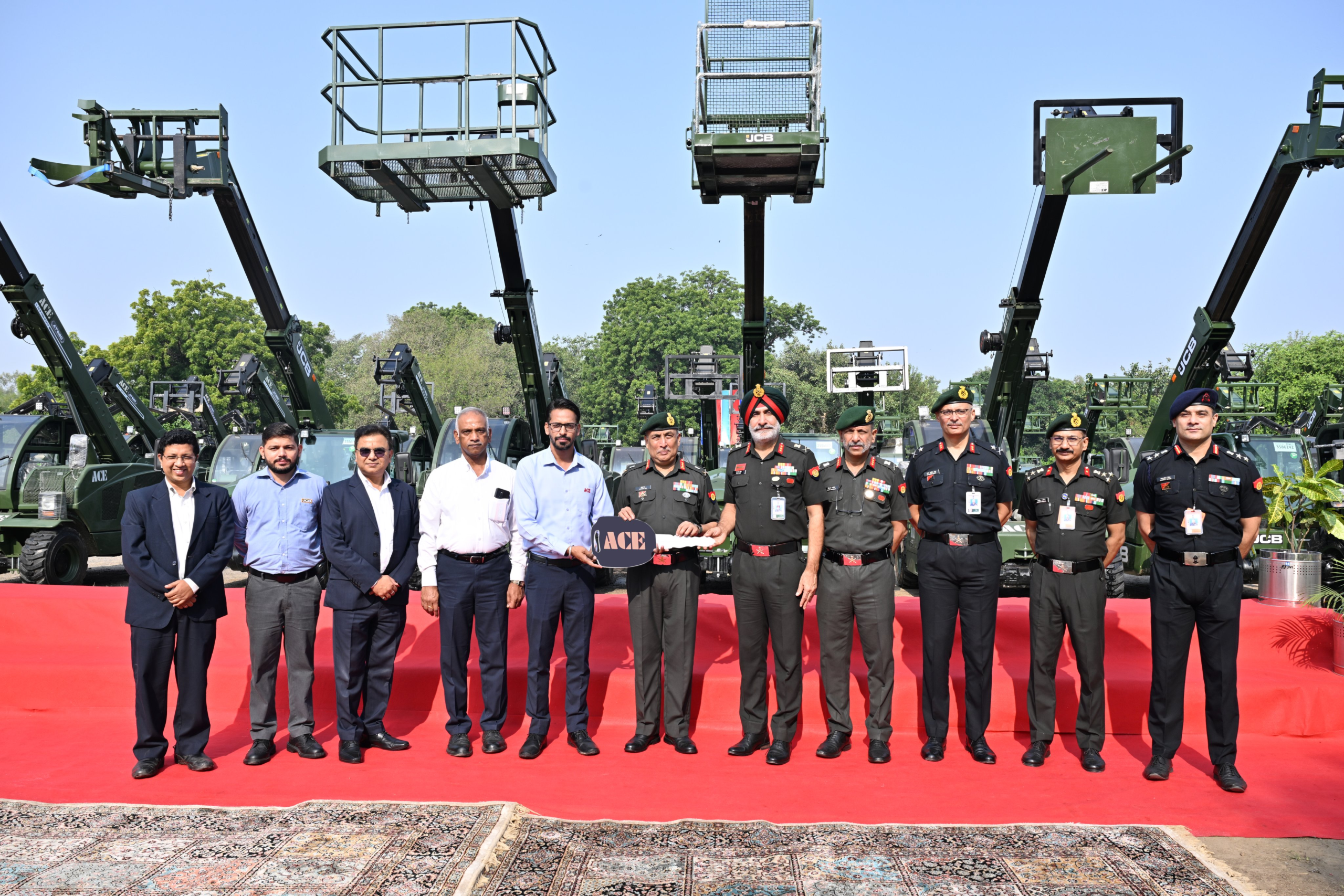
New Delhi, October 14, 2026: The Indian Armed Forces have added indigenously developed Rough Terrain Forklift Trucks (RTFLTs) to their logistics fleet, in a development aimed at improving support across the Army, Navy and Air Force.
Lieutenant General Sandeep Jain, Vice Chief of the Army Staff (VCOAS), led the induction ceremony. The event was presented as another step in the modernisation of India’s military logistics system.
The new RTFLTs are intended to raise material-handling capability and make logistics operations more efficient across the three services. The reported focus is on quicker and smoother movement of stores, equipment and other essential supplies.
Rough terrain forklift trucks are specialised vehicles used for lifting, transporting and handling heavy loads in difficult ground conditions. Their utility lies in places where standard forklifts may not perform effectively.
According to the report, such vehicles can be useful in remote deployment locations, forward operational areas and field logistics installations. These settings often require equipment that can operate reliably on uneven or challenging ground.
The induction is said to align with the Government of India’s Atmanirbhar Bharat initiative, which emphasises domestic manufacturing, technological self-reliance and indigenous defence production.
By introducing locally developed logistics platforms, the Armed Forces aim to improve operational preparedness while lowering dependence on imported equipment. That stated goal is part of a wider effort to strengthen support systems within the services.
The addition of RTFLTs is also expected to help speed up movement of vital supplies and equipment in demanding operational environments. The source describes this as a practical gain for day-to-day logistics work.
Overall, the induction reflects the Armed Forces’ continuing push to modernise logistics infrastructure. It is being positioned as a move toward a more resilient, efficient and self-reliant military support structure.
In tri-service terms, the development is framed as relevant to operational effectiveness across the Indian Army, Indian Navy and Indian Air Force. The report presents indigenous technology and improved logistical preparedness as the main factors behind this step.