




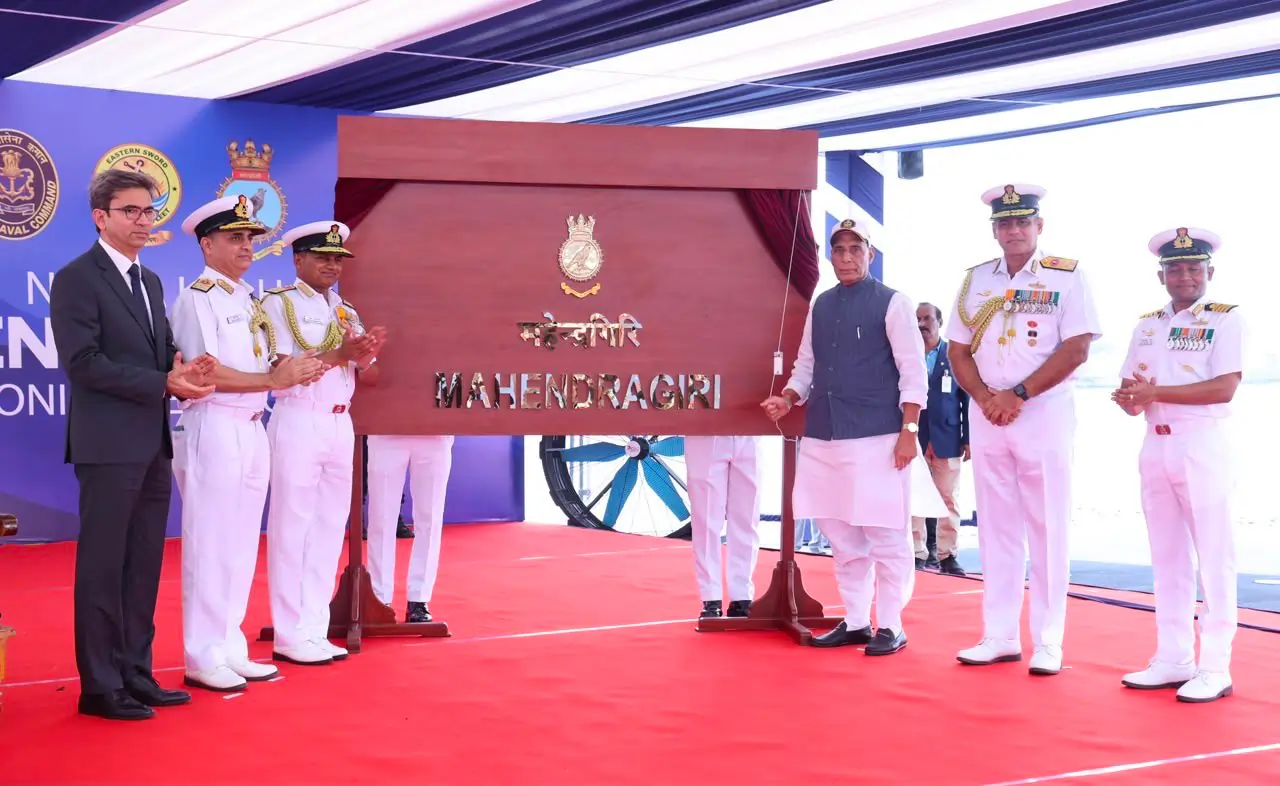
In a significant advancement for India’s naval capabilities, the Indian Navy officially commissioned the advanced stealth frigate INS Mahendragiri into its Eastern Fleet during a ceremony held in Visakhapatnam. Defence Minister Rajnath Singh presided over the event, marking another step forward in India’s indigenous warship construction initiative.
INS Mahendragiri, constructed under Project 17A and designed by the Indian Navy’s Warship Design Bureau, is the sixth frigate to be commissioned within just 18 months. This rapid progression follows the earlier commissioning of vessels such as INS Nilgiri, INS Udaygiri, and INS Himgiri, demonstrating the accelerated pace of the country’s naval modernization efforts.
Weighing in at 6,670 tonnes, INS Mahendragiri boasts over 75% indigenous content, reflecting India’s growing self-reliance in defense manufacturing. The warship is capable of achieving speeds of up to 28 knots and is designed to conduct a plethora of maritime operations. These include fleet air defense, anti-surface warfare, anti-submarine warfare, maritime interdiction, and humanitarian assistance and disaster relief missions.
Equipped with state-of-the-art technologies, INS Mahendragiri features advanced stealth capabilities, network-centric combat systems, and modern sensors. It integrates potent armaments such as supersonic surface-to-surface missiles, medium-range surface-to-air missiles, and anti-submarine warfare systems, along with an embarked multi-role helicopter. Notably, the vessel can be armed with BrahMos supersonic cruise missiles, and is outfitted with multifunction radar, indigenous rocket launchers, torpedo launchers, an Integrated Anti-Submarine Defence System, and an electronic warfare suite.
Highlighting the significance of INS Mahendragiri, Rajnath Singh referred to it as a symbol of Aatmanirbhar Bharat, emphasizing India’s advancing design expertise and manufacturing capabilities. He acknowledged that, while modern warfare is being transformed by emerging technologies like artificial intelligence and cyber warfare, traditional military strength remains crucial for national defense. The minister reiterated the government’s commitment to investing in next-generation technologies while bolstering conventional military assets.
Furthermore, Singh underscored the strategic importance of maritime security for India, noting that the country’s economic growth, trade routes, and energy supplies rely on secure maritime domains. He reaffirmed India’s position as a net security provider in the Indo-Pacific under the SAGAR vision, commending the Indian Navy’s recognition as a First Responder and Preferred Security Partner in the region through various missions, including humanitarian aid, anti-piracy operations, and evacuation efforts.
In reference to Operation Urja Suraksha during the West Asia conflict, Singh mentioned that the Navy successfully escorted 18 merchant vessels, protecting cargo worth over ₹9,000 crore, thereby underscoring its role in safeguarding India’s economic interests. He expressed optimism that the induction of INS Mahendragiri would enhance India’s blue-water capabilities and reinforce its presence in the Indian Ocean Region.
Admiral Krishna Swaminathan, Chief of the Naval Staff, praised INS Mahendragiri as a testament to India’s increasing maritime prowess and technological self-reliance. Noteworthy achievements under the Project 17A program include a significant reduction in the launch-to-delivery timeline, with the process now taking only 31 months instead of the previous 63 months, and a decrease in overall construction time from 95 months to 75 months, alongside condensed technical analyses encapsulated within a single sea trial.
Named after the Mahendragiri mountain range located in the Eastern Ghats, INS Mahendragiri carries the motto “Mighty, Majestic, Matchless.” Its development involved contributions from over 200 Indian industries, including various MSMEs. The commissioning of INS Mahendragiri into the Eastern Fleet not only enhances the operational capability of the Indian Navy but also reinforces India’s vision of a self-reliant, future-ready maritime force.


