




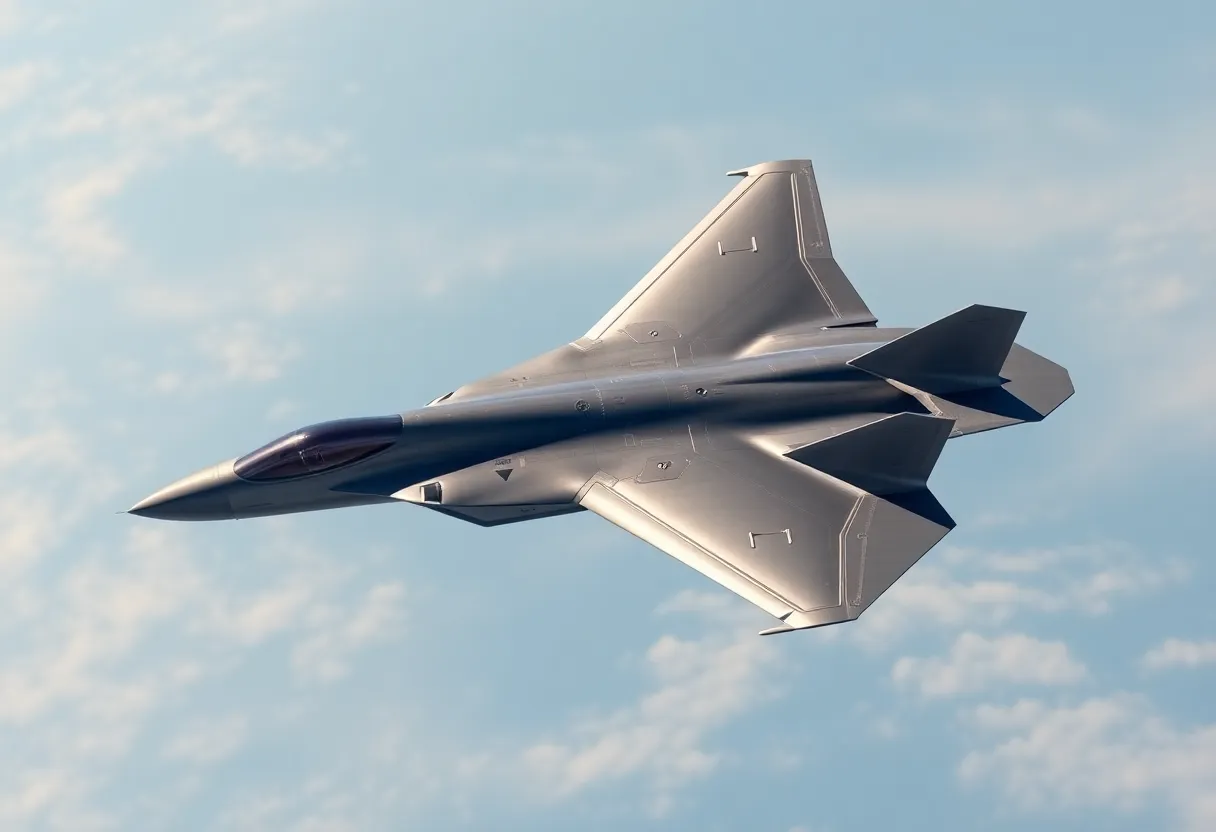
The F-47 fighter jet is emerging as a pivotal player in the U.S. Air Force’s Next Generation Air Dominance (NGAD) program, representing the forefront of military aviation technology. As a sixth-generation fighter jet, the F-47 aspires to exceed the capabilities of the F-22 Raptor, integrating cutting-edge technologies address the challenges posed by a rapidly evolving security landscape.
The F-47’s development journey is grounded in the Air Force’s enduring commitment to upholding air superiority amid a complex global environment. The NGAD initiative, initiated in 2018, paved the way for this next-gen fighter. Boeing was awarded the contract to spearhead the F-47’s development, marking a significant milestone in military aviation and defense technology.
Designed to replace the aging F-22 Raptor, which has held the mantle of U.S. air superiority for years, the F-47 addresses the pressing need for a more advanced, versatile fighter. As international threats evolve, the F-47 aims to bolster air capabilities with enhanced stealth, speed, and sensor functionalities, ensuring that the U.S. military remains ahead in aerial combat.
The design and technology behind the F-47 have benefited from extensive experimentation with prototype aircraft, known as X-planes, which have accrued hundreds of flight hours. This groundwork has allowed engineers to fine-tune the innovations that will ultimately characterize the F-47. Notably, the involvement of the Defense Advanced Research Projects Agency (DARPA) has been crucial in defining the aircraft’s design and operational capabilities.
Among the remarkable features anticipated for the F-47 are its advanced stealth capabilities, which will render it “virtually unseeable” on radar. This essential trait will enable the aircraft to penetrate enemy airspace undetected, a critical factor in modern warfare where air superiority can decisively influence conflict outcomes.
Additionally, the F-47 is set to leverage enhanced sensor fusion technology. This innovation will allow pilots to achieve a holistic situational awareness by integrating information from numerous onboard and external sources, thus facilitating timely and informed decision-making in combat scenarios.
Moreover, the F-47’s design emphasizes synergy between manned and unmanned aerial operations. It will be capable of collaborating with unmanned aerial vehicles (UAVs), positioning the U.S. military to adopt a more responsive and dynamic combat strategy. This collaborative capability will expand operational reach and effectiveness by enabling the coordination of drone swarms and other unmanned systems.
The implications of the F-47’s introduction extend far beyond technological advancements; it fundamentally alters U.S. air superiority and military strategy. As adversaries develop their own advanced aerial platforms, the F-47 is poised to safeguard the U.S. military’s dominance in aerial engagements. Its improved range, speed, and stealth will enable it to counter sophisticated threats effectively, ensuring a continued American presence in the skies.
Within the NGAD framework, the F-47 is a critical component of a comprehensive “family of systems” approach. This strategy envisions an interconnected network of manned and unmanned platforms that work cohesively to achieve air dominance. The integration of various systems aims to create a more adaptable and resilient combat environment.
Future-proofing is another defining characteristic of the F-47, as it is engineered for versatility and adaptability. This design philosophy allows for upgrades and enhancements as emerging technologies are developed, thereby ensuring that the aircraft remains a relevant asset in an increasingly complex threat landscape.
While specific cost details remain classified, preliminary estimates suggest that developing the F-47 may surpass $20 billion, reflecting the advanced complexities involved in its technology. This multi-billion-dollar investment positions the F-47 as one of the costliest military aircraft projects in history.
The U.S. Air Force envisions having the F-47 operational by the end of the decade, though this timeline hinges on the successful completion of testing phases and the integration of cutting-edge technologies. The production of the F-47 is expected to bolster Boeing’s military aviation division, particularly its fighter production facilities in St. Louis, Missouri, providing a much-needed boost for the company after recent operational challenges.
In summary, the F-47 fighter jet stands as a symbol of innovation for the U.S. Air Force, reinforcing its commitment to maintaining air superiority in a challenging global landscape. With advanced stealth features, sensor fusion technology, and the capability for unmanned system integration, the F-47 is set to redefine the nature of aerial combat, making it imperative to closely follow its development and the future of military aviation.


