KNDS Deutschland has announced a significant contract worth 33 million euros (approximately $38.6 million) to provide three Leguan bridge layers for the Danish Armed Forces. This advancement underscores the strategic importance of tactical bridge layers in military operations, enabling forces to navigate obstacles and maintain mobility in difficult terrains.
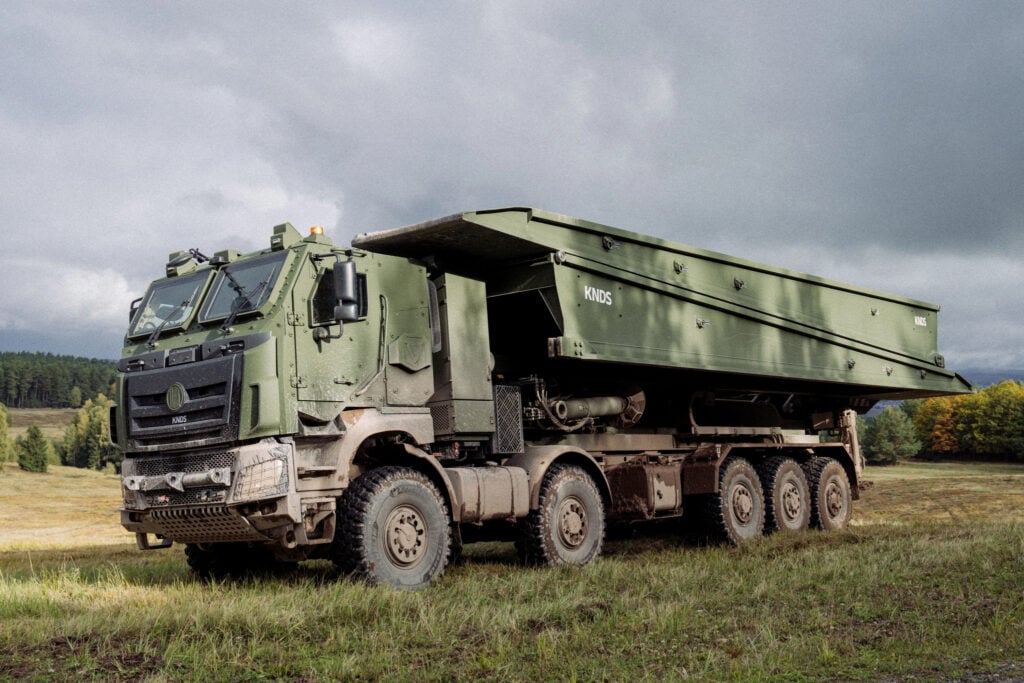
The order specifically includes the latest-generation Leguan system, which is mounted on a 10×10 wheeled truck developed by Tatra Defence Vehicles, a Czech Republic-based manufacturer. This contract also encompasses comprehensive logistics support and the necessary tooling to keep these vehicles operational throughout their service life.
Notably, the agreement includes an option for an additional three wheeled bridge layers, along with their respective Leguan sets and associated equipment, valued at 25 million euros (around $29.2 million). A decision from Copenhagen regarding this option is anticipated in 2026.
Moreover, the procurement framework established by this contract is available for other Scandinavian nations to join through Denmark, indicating a collaborative approach to military resource sharing in the region.
The Leguan Modular Bridge system, which is popular among various armed forces, is typically deployed using a Leopard 2 main battle tank chassis. A two-person crew operates the system, which features an automatic folding bridge capable of spanning up to 14 meters (46 feet). The system supports vehicles up to NATO Military Load Classification 50, accommodating weights of roughly 45 tonnes (99,208 pounds) for tracked vehicles and 53 tonnes (116,845 pounds) for wheeled vehicles.
Denmark has previously operated the Leguan system on the Leopard 2 platform, but this latest order signifies an expanding interest in the more modern wheeled configuration, marking its inaugural integration into the Danish military operations.
According to KNDS, “The new wheeled LEGUAN generation secures a modern and optimized combat support and furthermore is perfectly suited to perform disaster relief operations.” The system has already been adopted by nineteen armed forces globally, praised for its outstanding performance and ease of handling, facilitating resource pooling and collaboration among users for mutual benefits.