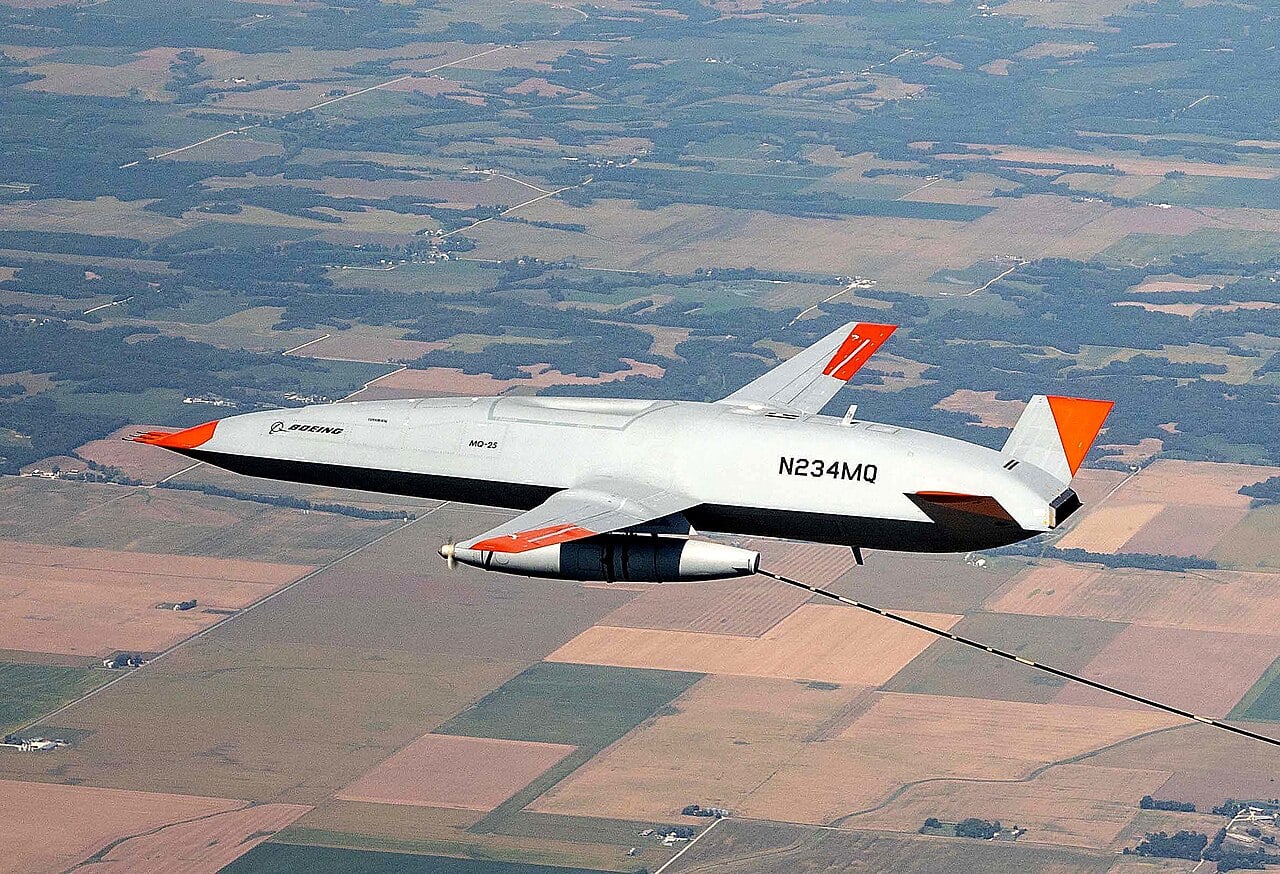
The MQ-25A Stingray is revolutionizing carrier operations as the first unmanned aerial vehicle (UAV) designed for aerial refueling deployed from aircraft carriers. This innovative drone is set to enhance the capabilities of naval aviation by enabling fighter jets to extend their range significantly while operating at sea. Its introduction marks a transformative step in integrating uncrewed aircraft into standard flight operations, beyond niche missions.
The Stingray, developed by Boeing, is engineered specifically for carrier-based operations. It boasts impressive specifications, including a length of approximately 51 feet, a wingspan of 75 feet that folds for efficient storage, and a maximum takeoff weight of 44,000 pounds. The aircraft is powered by a Rolls-Royce AE 3007N turbofan engine, which optimizes endurance and efficiency. Its ability to autonomously take off, navigate, and land on aircraft carriers sets it apart from traditional manned tankers in the fleet.
Initially conceived in the mid-2000s under the Unmanned Carrier-Launched Airborne Surveillance and Strike (UCLASS) program, the MQ-25A evolved over time. Budget considerations and changing operational needs shifted its primary focus from strike capabilities to aerial refueling, ultimately leading to its selection for development by the US Navy in 2018 through an $805 million contract.
Recent advancements in flight testing, particularly with the Boeing-owned prototype, have demonstrated the MQ-25A’s competence in performing refueling operations with various aircraft, including the F/A-18 Super Hornet and the F-35C Lightning II. As it transitions from testing to operational status, recent milestones include a successful autonomous taxi test, an important step toward routine carrier operations.
The MQ-25A’s design incorporates advanced navigation and flight control systems, enabling it to execute complex missions autonomously. The probe-and-drogue refueling system allows the drone to offload up to 15,000 pounds of fuel, significantly boosting the operational range of carrier-based fighters. This capability not only enhances the strategic reach of naval forces but also allows manned aircraft to focus on combat roles instead of refueling responsibilities.
While the MQ-25A brings remarkable advantages to carrier air wings, challenges remain. The complexity of integrating autonomous systems on carrier decks prompts ongoing testing and validation, including efforts to ensure reliable operations in dynamic maritime environments. Additionally, while its primary role is as a tanker, the potential for expanded missions, including ISR (intelligence, surveillance, and reconnaissance), is being explored.
As of early 2026, the integration of the MQ-25A into the fleet is advancing, with expectations to be operationally deployed by the mid-2020s. This promising UAV’s success may not only reshape US Navy operations but also influence allied maritime aviation strategies, potentially paving the way for broader applications of unmanned systems on a global scale.
Looking ahead, the MQ-25A is seen as a pivotal element of future carrier operations, with discussions surrounding potential land-based variants and expanded mission capabilities. Its integration will likely enhance the effectiveness and reach of naval operations, particularly as carrier strike groups operate more distantly from shore, fundamentally reshaping tactical options in maritime engagements.