





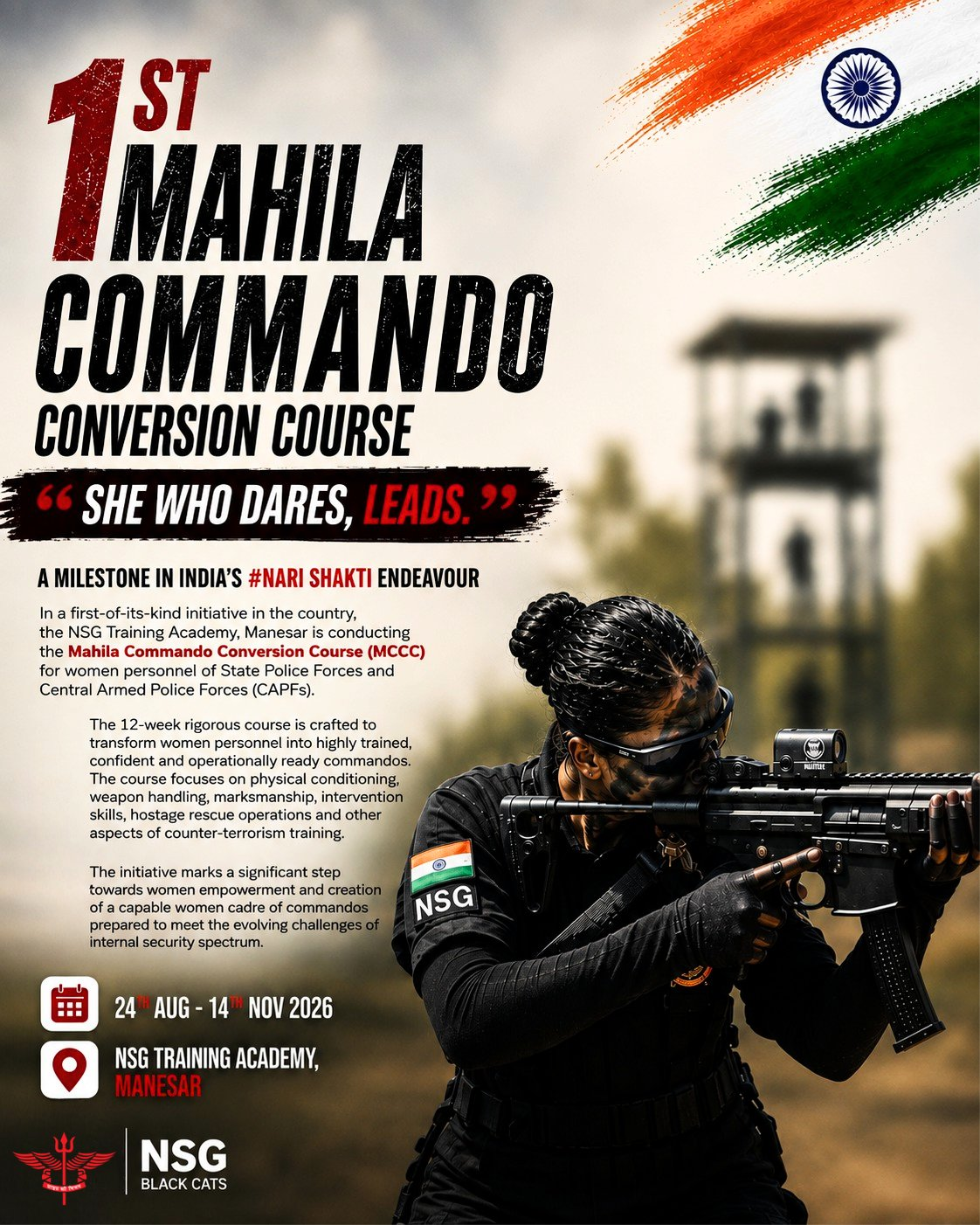
The National Security Guard (NSG) has launched India’s first Mahila Commando Conversion Course (MCCC) at its Training Academy in Manesar, Haryana.
National Security Guard Launches First All-Women Commando Course
The National Security Guard (NSG) has launched India’s first Mahila Commando Conversion Course (MCCC) at its Training Academy in Manesar, Haryana.
The programme began on 24 August 2026 and is designed to train selected women personnel from State Police Forces and Central Armed Police Forces (CAPFs).
The course is a 12-week residential programme focusing on advanced operational skills required for counter-terrorism and high-risk security operations.
Training includes physical conditioning, weapons handling, marksmanship, tactical intervention and hostage rescue drills.
The first batch consists of 25 women constables from the Rajasthan Armed Constabulary’s 5th Battalion at Ghatgate.
The programme has adopted the theme “She Who Dares, Leads.”
Key Points
- Organisation: National Security Guard
- Course: Mahila Commando Conversion Course
- Venue: NSG Training Academy, Manesar
- Duration: 12 weeks
- First batch: 25 women constables
- Training areas: Counter-terrorism, weapons, marksmanship and hostage rescue
- Theme: “She Who Dares, Leads”
The National Security Guard (NSG) is one of India’s specialised security forces, created to deal with serious terrorist threats and other exceptional security situations. Commonly known as the “Black Cats,” the NSG functions under the Ministry of Home Affairs (MHA) and serves as the Government of India’s nodal national counter-terrorism force.
Formation and History
The NSG was established in the aftermath of the security challenges faced by India in the 1980s. The Union Cabinet took the decision in 1984 to create a specialised national counter-terrorism force. The organisation was formally established under the National Security Guard Act, 1986. The NSG’s official history records that the legislation received presidential assent on 22 September 1986.
The force was designed around the concept of a highly trained and specially equipped unit capable of responding rapidly to critical terrorist situations. Its operational philosophy emphasises speed, surprise, stealth, precision and accuracy.
The NSG was modelled broadly on specialised counter-terrorism organisations such as the SAS of the United Kingdom and GSG 9 of Germany.
Why is NSG Called the “Black Cats”?
NSG personnel are popularly referred to as “Black Cats”, a name associated with their distinctive black combat attire and their reputation as a highly trained counter-terrorism force.
Its official motto is:
“Sarvatra Sarvottam Suraksha”
which broadly conveys the idea of “Best Security Everywhere.”
Organisation of NSG
The NSG has two major operational components:
1. Special Action Group (SAG)
The Special Action Group consists primarily of personnel drawn from the Indian Army. It forms the principal assault element for specialised counter-terrorism operations.
2. Special Ranger Groups (SRG)
The Special Ranger Groups comprise personnel drawn from the Central Armed Police Forces and State Police Forces. They provide complementary operational support to the NSG’s specialised teams.
The organisation also has specialised capabilities and institutions dealing with areas such as bomb data analysis and other technical aspects of counter-terrorism. The National Bomb Data Centre (NBDC), for example, collects and analyses information relating to terrorist bombing incidents and supports bomb-disposal knowledge and preparedness.
Major Roles of NSG
The NSG is specially trained and equipped for exceptional situations involving serious terrorist threats. Its responsibilities include:
- Counter-terrorism operations
- Counter-hijacking operations
- Hostage rescue
- Bomb disposal and post-blast analysis
- Specialised intervention
- Close protection duties
- Support during important national and international events
- Development of specialised capabilities such as anti-drone operations
The NSG itself describes its purpose as maintaining a specialised force capable of responding swiftly and effectively to terrorism.
Training and Selection
NSG personnel are drawn from organisations such as the Indian Army, Central Armed Police Forces and police forces. Selection and training are designed to prepare personnel for highly demanding counter-terrorism situations.
The NSG Training Centre also contributes to capacity building by providing specialised training and knowledge to other police and security organisations, including personnel from friendly foreign countries.
Important Operations
Over the years, NSG personnel have participated in several major counter-terrorism and hostage-rescue operations.
Some notable operations listed in the source material include:
- Operation Black Thunder
- Operation Ashwamedh
- Operation Black Tornado
- Operation Vajra Shakti
- Operation Black Hawk
- Counter-insurgency operations in Jammu and Kashmir and the Northeast
Operation Black Thunder
One of the important early operations associated with the NSG was Operation Black Thunder, conducted at the Golden Temple complex in Punjab in 1986 and again in 1988. The operations demonstrated the force’s specialised counter-terrorism and intervention capabilities.
Operation Ashwamedh
In 1993, NSG commandos carried out Operation Ashwamedh at Amritsar airport to deal with a hijacked Indian Airlines aircraft. The operation resulted in the hijackers being neutralised without harm to the hostages.
Operation Black Tornado
The NSG played a prominent role during the 2008 Mumbai terrorist attacks, with commandos deployed to deal with terrorists and rescue hostages at locations including the Taj Mahal Palace Hotel and Oberoi Trident. The operation became one of the most significant chapters in the history of India’s counter-terrorism response.
Modernisation and Specialised Capabilities
The NSG has continued to upgrade its capabilities in response to changing security threats. These include improvements in night-fighting capabilities, bomb detection and disposal systems, anti-drone technology and specialised K9 capabilities.
The organisation’s approach is increasingly focused on technology, specialised training and rapid response to emerging forms of terrorism.
Headquarters and Leadership
The NSG is headquartered in New Delhi and comes under the Ministry of Home Affairs, Government of India. The current official NSG website lists Shri Brighu Srinivasan, IPS, as the Director General.
The force also maintains regional hubs, including locations such as Mumbai, Hyderabad, Chennai, Kolkata and Gandhinagar, supporting faster deployment when required.
Importance for India
The NSG occupies a specialised position within India’s internal-security framework. Unlike conventional military formations or regular police forces, it is designed specifically for situations requiring highly trained counter-terrorism and intervention capabilities.
Its development also reflects India’s efforts to maintain a rapid-response capability against terrorism, hostage situations, hijacking and other high-risk security threats.


