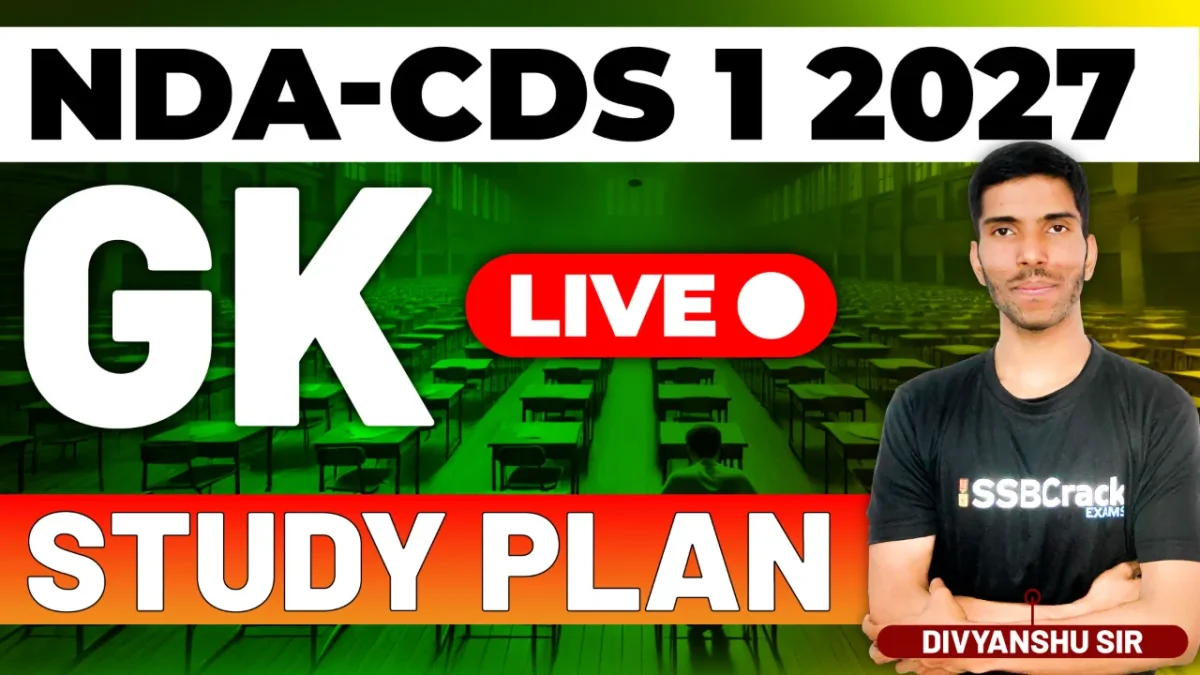
Preparing for NDA & CDS 1 2027 requires a well-planned General Knowledge (GK) strategy, consistent revision and regular practice of previous years’ questions. General Knowledge is an important part of both examinations, and candidates need to develop a strong understanding of History, Geography, Polity, Economics, General Science and Current Affairs.
NDA & CDS 1 2027 GK Study Plan
1. Understand the GK Exam Pattern
Before starting preparation, candidates should understand the difference between the NDA and CDS examination patterns.
| Particulars | NDA & NA | CDS |
|---|---|---|
| GK marks | 400 | 100 |
| Paper | General Ability Test (Part B) | General Knowledge |
| Duration | Included in 2½-hour GAT | 2 hours |
| Question type | Objective | Objective |
| Negative marking | One-third | One-third |
Important points:
- In NDA, General Knowledge is part of the 600-mark General Ability Test (GAT), which also contains 200 marks of English.
- In CDS, GK is a separate 100-mark paper.
- CDS candidates appearing for IMA, INA and AFA also have a Mathematics paper, while OTA candidates do not.
- Both examinations require conceptual clarity, factual knowledge and strong current-affairs preparation.
UPSC+2
2. Subject-Wise GK Preparation Strategy
The following subjects should form the foundation of your preparation.
A. History – Ancient, Medieval and Modern India
History is an important component of both examinations. Give special attention to Modern Indian History and the Indian National Movement.
Important topics:
- Indus Valley Civilisation
- Vedic Period
- Buddhism and Jainism
- Mauryan and Gupta Empires
- Delhi Sultanate and Mughal Empire
- Arrival of Europeans in India
- Revolt of 1857
- Indian National Congress
- Moderate and Extremist phases
- Gandhian movements
- Revolutionary movements
- Important freedom fighters
- Governor-Generals and Viceroys
- Constitutional developments during British rule
Preparation strategy: Complete Ancient and Medieval History through concise notes, but dedicate additional revision time to Modern History and the freedom struggle. Practise previous years’ questions after completing every topic.
B. Geography – India and World
Geography requires conceptual understanding, map practice and regular revision.
Important topics:
- Earth and its structure
- Latitude and longitude
- Rotation and revolution
- Interior of the Earth
- Rocks and minerals
- Volcanoes and earthquakes
- Atmosphere and layers
- Winds and pressure belts
- Ocean currents
- Indian rivers and drainage systems
- Indian climate and monsoon
- Soil types and agriculture
- Minerals and industries
- National parks and wildlife sanctuaries
- Important straits, seas and international boundaries
Preparation strategy: Use maps regularly. Focus on Indian physical geography, rivers, mountain ranges, passes, national parks and important geographical locations.
C. Indian Polity and Constitution
Polity is particularly important for understanding India’s political and constitutional framework.
Important topics:
- Historical background of the Constitution
- Making of the Indian Constitution
- Preamble
- Fundamental Rights
- Fundamental Duties
- Directive Principles of State Policy
- President and Vice-President
- Prime Minister and Council of Ministers
- Parliament
- Supreme Court and High Courts
- Governor and Chief Minister
- Constitutional bodies
- Election Commission
- Emergency provisions
- Panchayati Raj
- Important constitutional amendments
Preparation strategy: Read the Constitution-related topics systematically. Make short notes of important Articles, Schedules, amendments and constitutional bodies.
D. General Science – Physics, Chemistry and Biology
General Science is an important scoring area, particularly for NDA candidates.
Physics:
- Motion and Laws of Motion
- Force and Gravitation
- Work, Energy and Power
- Heat and Temperature
- Sound and Waves
- Light and Reflection
- Refraction and Lenses
- Electricity and Magnetism
- Units and Measurements
- Scientific Instruments
Chemistry:
- Matter and its States
- Atoms and Molecules
- Elements and Compounds
- Periodic Table
- Acids, Bases and Salts
- Metals and Non-metals
- Chemical Reactions
- Carbon and its Compounds
- Fuels and Combustion
- Everyday Chemistry
Biology:
- Cell and Cell Organelles
- Human Digestive System
- Respiratory System
- Circulatory System
- Nervous System
- Diseases and Vaccines
- Vitamins and Minerals
- Nutrition
- Human Reproduction
- Plant Physiology
- Ecology and Environment
Preparation strategy: NCERT Science textbooks from Classes 6 to 10 provide a useful foundation. NDA candidates should give particular attention to Physics and Chemistry.
E. Indian Economy
Economics should be prepared with a focus on fundamental concepts and important developments.
Important topics:
- Basic concepts of Economics
- GDP and GNP
- National Income
- Inflation and Deflation
- Banking System
- Reserve Bank of India
- Monetary Policy
- Fiscal Policy
- Union Budget
- Taxation
- Poverty and Unemployment
- Agriculture and Industries
- Government Economic Schemes
- Financial Institutions
Preparation strategy: Understand basic economic terminology before moving towards current economic developments. Avoid memorising complicated figures without understanding their significance.
F. Current Affairs – National and International
Current Affairs is an essential part of NDA and CDS GK preparation. Candidates should regularly follow important national and international developments.
Important areas to cover:
- Defence exercises and military operations.
- Important defence deals and acquisitions.
- Missile tests and indigenous defence systems.
- DRDO and ISRO developments.
- National and international appointments.
- Important awards and honours.
- Sports tournaments and achievements.
- International organisations and summits.
- Government schemes and initiatives.
- Important national and international days.
- Science and technology developments.
- Books, authors and important personalities.
Special focus for defence aspirants: Pay additional attention to the Indian Armed Forces, military exercises, defence technology, naval developments, aircraft, missiles, military appointments and international defence cooperation.
3. NDA & CDS GK 5-Month Study Roadmap
A structured preparation plan from November 2026 to April 2027 can help candidates complete the syllabus, practise questions and revise effectively.
Phase 1 – November 2026
Build your foundation
Target: Complete basic concepts
- Ancient and Medieval History
- Basic Indian Geography
- Fundamental Rights and Duties
- Physics: Motion, Force and Work
- Chemistry: Matter, Atoms and Molecules
- Start daily newspaper and current affairs revisionPhase 2 – December 2026Complete core subjectsTarget: Cover maximum syllabus
- Modern Indian History
- Indian Constitution and Parliament
- Physical and Indian Geography
- Physics: Light, Sound and Electricity
- Chemistry: Periodic Table and Chemical Reactions
- Biology: Human Body and Diseases
- Basic EconomicsPhase 3 – January 2027Strengthen preparationTarget: Complete remaining topics
- Indian Economy
- Environment and Ecology
- Science and Technology
- Defence Current Affairs
- International Relations
- Important Government Schemes
- Complete pending subject-wise PYQsPhase 4 – February 2027Practice and revisionTarget: Improve accuracy and speed
- Revise all six GK subjects
- Solve NDA and CDS previous years’ questions
- Attempt sectional tests
- Prepare monthly current affairs notes
- Identify weak topics
- Practise elimination techniquesPhase 5 – March to April 2027Final preparationTarget: Exam-oriented revision
- Revise short notes and important facts
- Attempt full-length mock tests
- Revise defence exercises and appointments
- Practise important science concepts
- Revise maps, Articles and historical events
- Analyse mistakes from mock tests
- Avoid starting too many new books
Note: This is a suggested preparation roadmap, not an official UPSC schedule. The UPSC examination calendar page currently lists the NDA I and CDS I 2027 dates as yet to be announced. The reported 11 April 2027 examination date should be treated as tentative until confirmed by UPSC. UPSC+1
4. Daily GK Study Timetable
Candidates should maintain a consistent routine instead of studying for long hours without a clear target.
| Activity | Daily Time |
|---|---|
| History | 30 minutes |
| Geography | 30 minutes |
| Polity | 25 minutes |
| Physics/Chemistry/Biology | 45 minutes |
| Economy | 20 minutes |
| Current Affairs | 30 minutes |
| MCQs and PYQs | 40 minutes |
| Revision | 20 minutes |
| Total | 4 hours |
Candidates who have additional time should use it for Mathematics and English according to their respective examination requirements.
5. Best Books and Study Materials for NDA & CDS GK
Avoid collecting too many books. Select reliable study materials and revise them multiple times.
| Subject | Recommended Study Material |
|---|---|
| History | NCERT + Spectrum Modern History |
| Geography | NCERT + Oxford Student Atlas |
| Polity | NCERT + M. Laxmikanth |
| Physics | NCERT Classes 9–10 |
| Chemistry | NCERT Classes 9–10 |
| Biology | NCERT Classes 6–10 |
| Economics | Basic NCERT Economics |
| Current Affairs | Monthly Current Affairs Magazine |
| Practice | NDA & CDS Previous Year Papers |
Most important resource: Previous Year Questions (PYQs). Analyse questions from at least the last 5–10 years to understand the examination pattern and identify frequently tested concepts.
6. How to Prepare Current Affairs for NDA & CDS 1 2027?
Current Affairs preparation should be continuous rather than limited to the final month.
I recommend dividing current affairs into the following categories:
- Defence Current Affairs: Exercises, missiles, defence agreements, military appointments and new acquisitions.
- National Affairs: Government policies, schemes, important committees and national developments.
- International Affairs: Summits, bilateral relations, international organisations and global developments.
- Sports: Championships, winners, records and important tournaments.
- Awards: National and international awards, books and personalities.
- Science & Technology: ISRO, DRDO, space missions and technological achievements.
Prepare monthly notes from November 2026 onwards and revise them regularly.
7. Importance of PYQs and Mock Tests
One of the biggest mistakes candidates make is studying GK without practising examination-level questions.
Follow this approach:
- Complete one topic.
- Solve 30–50 MCQs from that topic.
- Attempt previous years’ questions.
- Identify incorrect answers.
- Revise the topic within 48 hours.
- Reattempt difficult questions after one week.
Attempt at least two full-length GK tests every week initially, increasing the frequency during the final preparation phase.
Remember that both NDA and CDS have negative marking. Therefore, accuracy and intelligent question selection are just as important as the number of questions attempted.
8. Five Common Mistakes to Avoid
- Studying multiple GK books without completing any one resource.
- Ignoring Science, especially Physics and Chemistry.
- Memorising current affairs without revision.
- Avoiding previous years’ question papers.
- Attempting mock tests without analysing mistakes.
9. Final Strategy: How to Maximise Your GK Score
Your preparation should revolve around three important principles:
Conceptual Learning
Understand the fundamentals of every subject.
Regular Revision
Revise short notes, important facts and current affairs repeatedly.
Practice and Analysis
Solve PYQs, attempt mock tests and improve accuracy.
Conclusion
Cracking NDA & CDS 1 2027 requires discipline, consistency and a smart preparation strategy. General Knowledge cannot be mastered in a few days; it requires continuous learning and systematic revision.
Start with NCERT fundamentals, strengthen important subjects, follow defence and national current affairs, and practise previous years’ questions regularly.
Remember: Your goal should not be to study more books but to develop a stronger command over the syllabus.
Prepare smart, revise regularly and stay focused on your dream of joining the Indian Armed Forces.