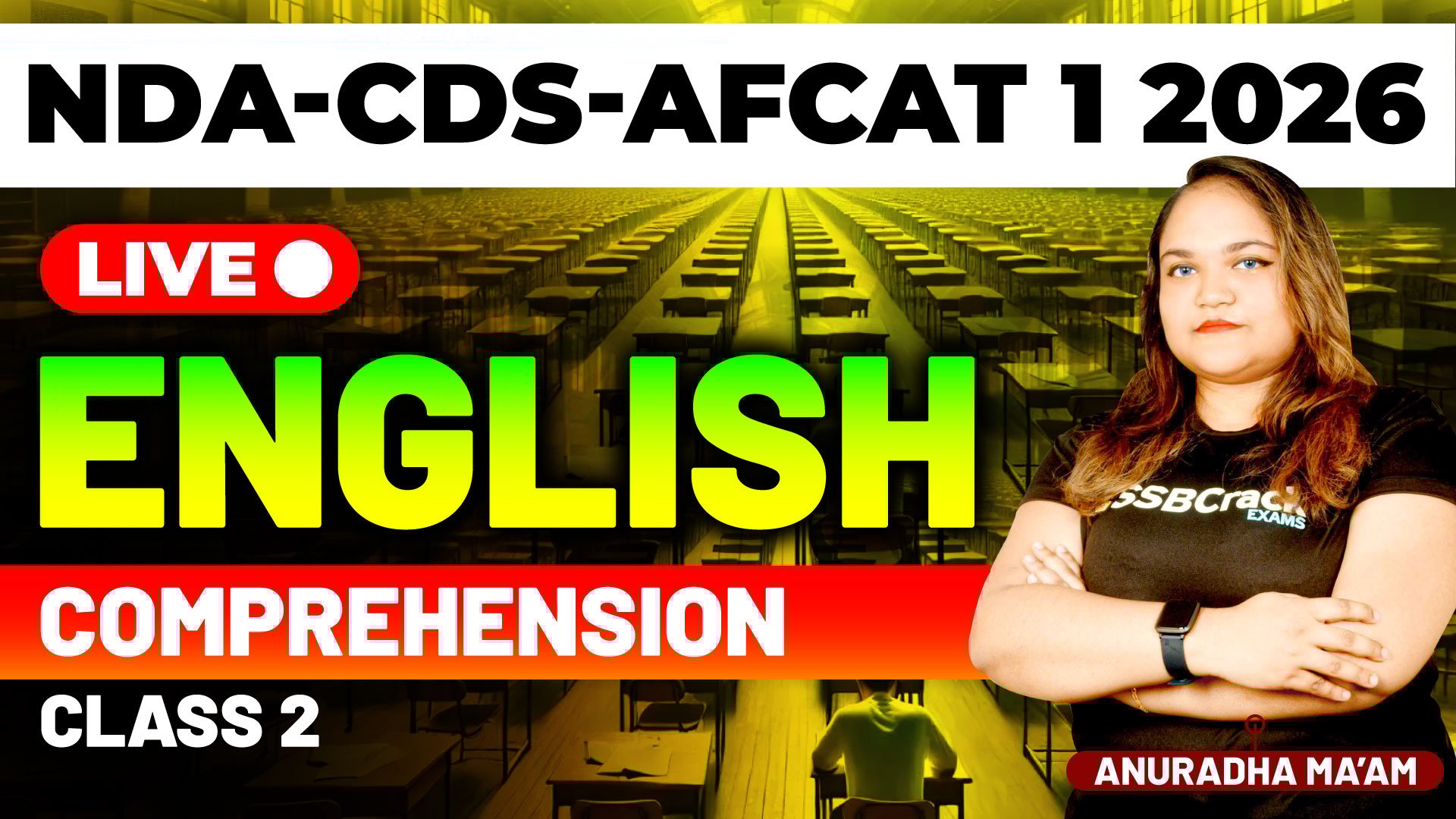
The second live class on Comprehension for NDA, CDS & AFCAT 1 2026 aspirants focused on advanced problem-solving, complex inferential questions, and higher-order MCQs typically asked in defence examinations. While Class 1 built the foundation, Class 2 strengthened analytical reading, multi-layered understanding, and precision-based answering—skills crucial for scoring high in the English section.
This article summarises all major learning highlights, MCQ types practiced, and strategies discussed to improve comprehension performance.
Focus of Live Class 2: From Basic Understanding to Deep Analysis
Class 2 was designed to help students move from surface-level reading to deep comprehension, enabling them to:
✔ Identify subtle ideas hidden in the passage
✔ Handle factual, inferential, and analytical MCQs
✔ Decode context-based vocabulary
✔ Understand viewpoint, tone, and intention
✔ Manage time efficiently during the exam
The class emphasized reading beyond what is written—a key requirement for scoring 80–90% accuracy in comprehension.
How Reading Skills were Strengthened in Class 2
The session focused heavily on building deeper reading habits essential for defence exams:
1. Layered Reading Technique
Students practiced reading the passage in two layers:
- Layer 1: Overview—main idea, tone
- Layer 2: Details—facts, supporting points
This method improved recall and reduced rereading time.
2. Keyword-Based Scanning Method
Instead of randomly hunting for answers, aspirants learned how to:
- Identify keywords in questions
- Locate the exact portion of passage
- Pick the correct option efficiently
3. Critical Reading & Logical Thinking
Comprehension passages test a candidate’s ability to:
- Evaluate information
- Recognize contradictions
- Detect biases
- Understand subtle meaning
These cognitive abilities are also part of Officer-Like Qualities assessed in SSB.
4. Speed with Accuracy
Defence exams are time-bound:
- NDA: 4–5 passages
- CDS: 2–3 long passages
- AFCAT: 1–2 medium passages
Students practiced finishing passages within 4–6 minutes, maintaining accuracy.
Why Comprehension is Crucial for NDA, CDS & AFCAT Aspirants
The Comprehension section enhances more than just English—it trains the mind to think like an officer.
It strengthens OLQs such as:
- Analytical ability
- Effective intelligence
- Organising ability
- Rapid decision-making
- Clear communication
- Situational awareness
This makes comprehension practice a dual benefit for written exam + SSB preparation.
Exam-Specific Insights Covered in Class 2
NDA:
- Short factual passages
- Quick scanning needed
- Vocabulary questions common
CDS:
- Long analytical passages
- Heavy inference-based MCQs
- Requires deep understanding
AFCAT:
- Moderate difficulty
- Vocabulary + fact-based questions
- Main idea & tone frequently asked
Students practised a mix of these patterns in Class 2.
Final Takeaways from Live Class 2
By the end of the session, students were able to:
✔ Decode complex passages
✔ Identify inferences with ease
✔ Solve vocabulary using context clues
✔ Recognize tone, viewpoint, and argument flow
✔ Complete 4–5 comprehension passages with high accuracy
✔ Apply critical reasoning instead of guesswork
Class 2 served as a major step towards mastering the Comprehension segment, ensuring students are exam-ready with improved speed, logic, and understanding.