




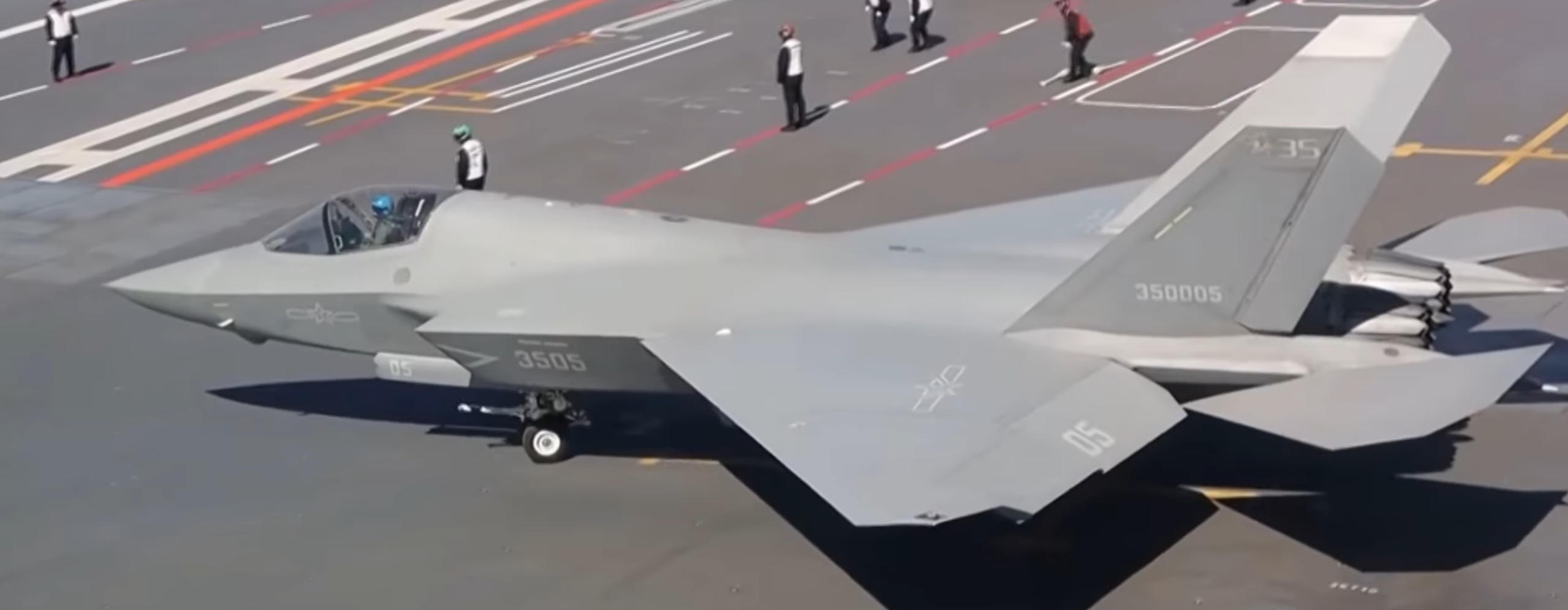
The Pakistan Air Force (PAF) has taken a significant step towards modernizing its military capabilities by signing an initial collaborative agreement to acquire the Chinese Shenyang J-35 stealth fighter. This development is poised to alter the regional air power dynamics and poses notable implications for the Indian Air Force (IAF) in its future planning and operational strategies.
PAF Deputy Chief of Air Staff Air Vice-Marshal Tariq Ghazi revealed that the air force is also aiming to enhance its arsenal with long-range precision weapons, additional Chengdu J-10C jets, and advanced versions of the JF-17 Thunder. While specific details regarding the timeline and numbers were not disclosed, sources like the South China Morning Post suggest that the first batch of J-35s could be delivered as soon as the end of this year.
The J-35, a twin-engine stealth fighter developed by the state-owned Shenyang Aircraft Corporation, is engineered for both domestic and export purposes. Its design features are reminiscent of the US F-35 Lightning II, showcasing low-observable characteristics such as an internal weapons bay and diverterless supersonic inlets. The aircraft incorporates radar-absorbent materials aimed at enhancing its survivability against advanced air defense systems. Although it has yet to formally enter operational service, recent reports have circulated regarding a potential export variant of the aircraft, particularly following instances of the J-35 being seen without the insignia of the Chinese military, indicating preparations for foreign clients.
In June of the previous year, the Pakistani government disclosed that China had proposed a substantial military package, which included 40 J-35 stealth fighters along with KJ-500 airborne early warning aircraft and HQ-19 air defense systems. The deployment of these assets could dramatically upgrade Pakistan’s operational capabilities. The KJ-500 in particular would bolster airborne surveillance, allowing for the early detection of enemy aircraft, including stealth models. Simultaneously, the HQ-19 is expected to serve as a significant enhancement over Pakistan’s existing air defense systems.
The introduction of the J-35 into the PAF arsenal is likely to complicate the IAF’s operational planning in future air engagements. The challenges posed by stealth aircraft are notable, as they are considerably harder to detect with conventional ground-based radar systems. The incorporation of the J-35 could compel the IAF to allocate a greater portion of its frontline assets towards air defense, ultimately affecting its combat flexibility and diminishing its numerical edge.
Retired IAF squadron leader Vijainder K. Thakur noted that the Indian Air Force will likely need to utilize a significant portion of its Sukhoi Su-30MKI fleet for J-35 detection, which could reformulate their strategic approach in a potential conflict scenario.
Looking ahead, this development may also disrupt New Delhi’s long-term fighter acquisition strategy. Currently centered on obtaining additional 4.5-generation aircraft from Western suppliers, particularly the Dassault Rafale, India is also investing in the indigenous Advanced Medium Combat Aircraft (AMCA) program to develop a fifth-generation fighter. However, given the prospect of Pakistan fielding the J-35 before the AMCA enters service, India may consider acquiring Russia’s Sukhoi Su-57 fighter as an interim solution. Previously, this aircraft had been dismissed by India due to concerns over its compliance with the IAF’s stringent low-observability criteria.
The Su-57 is designed to blend reduced radar visibility with enhanced maneuverability, featuring internal weapons bays and advanced composite materials. Reports suggest that Moscow is willing to offer joint production arrangements and technology transfer packages to facilitate the integration of Indian weaponry and systems.
Analysts warn that Pakistan’s move to procure fifth-generation fighters could compel India to accelerate its own fighter development plans, with some experts suggesting that it may lead to the creation of additional squadrons utilizing the Su-57 as a necessity to keep pace with evolving threats. As the regional military landscape continues to shift, both nations are likely to reevaluate their strategies to maintain air superiority in a landscape increasingly defined by advancements in stealth technology.


