




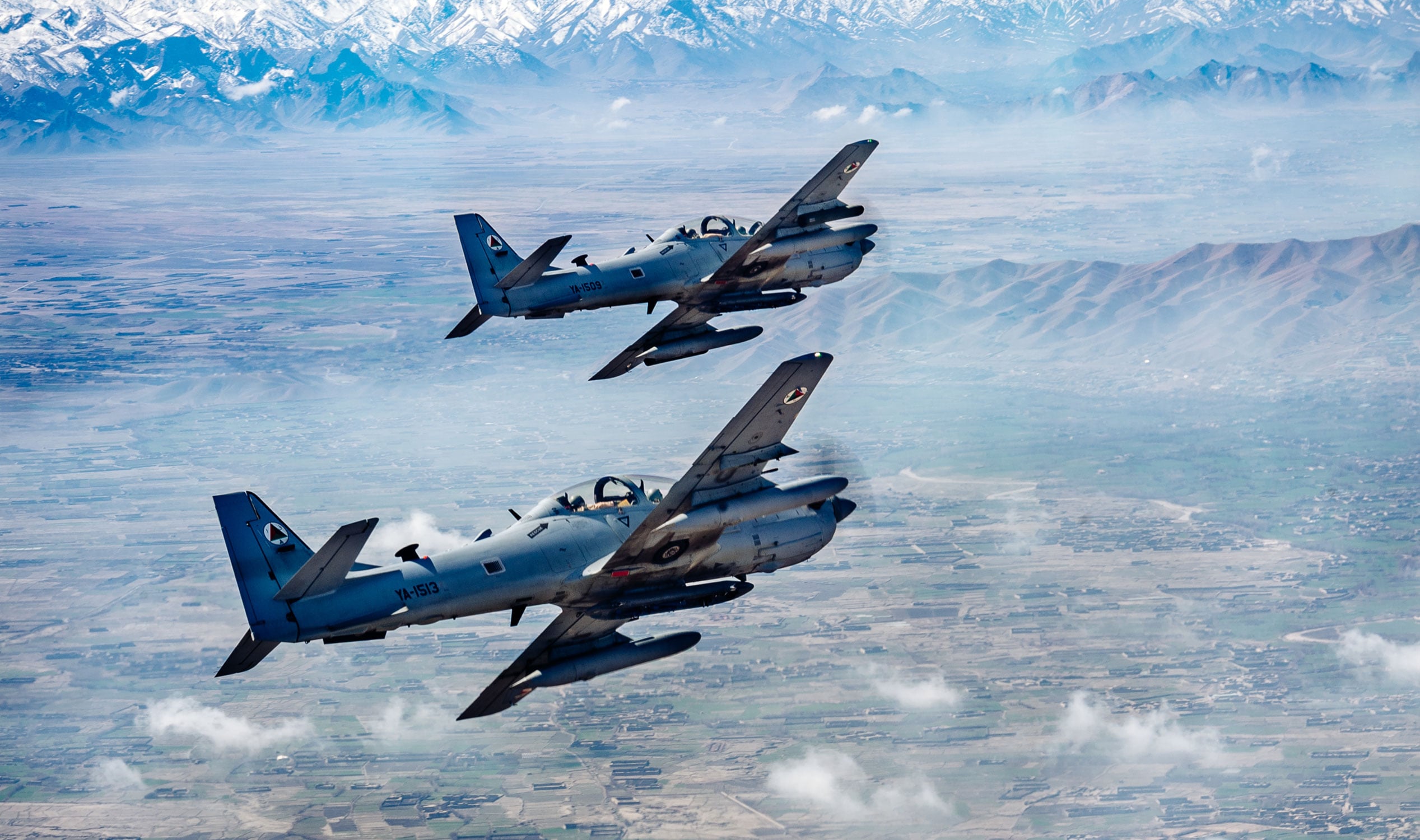
In today’s world dominated by high-tech stealth jets and advanced air combat technologies, one might overlook the significance of a propeller-driven aircraft. However, the A-29 Super Tucano continues to assert its relevance across various conflict zones, from dense jungles to arid deserts. This aircraft fulfills a vital niche between helicopters and high-performance fighter jets, designed for persistence rather than sheer speed.
The A-29 Super Tucano, produced by the Brazilian manufacturer Embraer, is classified as a light attack aircraft and turboprop trainer. It carries out diverse roles, including counterinsurgency, light attack missions, intelligence, surveillance, reconnaissance (ISR), and advanced pilot training. Capable of accommodating one or two crew members, it has a wingspan of 11.1 meters and can achieve a maximum takeoff weight of 5,400 kilograms. The Super Tucano is powered by a Pratt & Whitney Canada PT6A turboprop engine, enabling it to reach speeds of 590 kilometers per hour with an operational range of 1,300 kilometers.
The aircraft’s design champions low operating costs, long endurance, and rugged adaptability, making it particularly effective in asymmetric warfare scenarios. Unlike high-performance jets, the Super Tucano is built for operational flexibility, enduring performance, and the ability to conduct missions in austere environments.
The journey of the A-29 Super Tucano began with its predecessor, the EMB-312 Tucano, introduced in the 1980s as a basic trainer. By the 1990s, a growing need for a multifunctional platform capable of training and combat roles in low-intensity conflicts prompted Embraer to initiate the ALX (Light Attack Aircraft) program. The Super Tucano debuted in 2003 with the Brazilian Air Force, and by the 2010s, it had spread its wings internationally, with exports to over a dozen countries, further enhanced by upgrades aligned with NATO standards in the 2020s.
The Super Tucano has several variants, with the A-29A designed primarily for combat missions featuring a single-seat configuration, while the A-29B model incorporates a two-seat design that allows for both training and light attack operations, providing a seamless transition from training phases to combat roles.
Its engineering includes a robust Pratt & Whitney PT6A turboprop engine and a glass cockpit equipped with advanced avionics, including a head-up display and hands-on throttle and stick (HOTAS) controls. The aircraft is fitted with electro-optical and infrared sensor capabilities, five external hardpoints for versatile weaponry, and features such as armored cockpits and self-sealing fuel tanks designed to enhance operational resilience.
Despite its many strengths—including cost-effectiveness and a loiter time exceeding six hours—the Super Tucano does face limitations. Its lower speed and survivability in high-threat environments may hinder its effectiveness against advanced air defenses, and its payload capacity is also less than that of dedicated fighter aircraft.
Globally, the A-29 Super Tucano is utilized by more than 15 air forces, showcasing its versatility and operational value. It has been engaged in myriad missions, including close air support in Afghanistan, counterinsurgency operations in Colombia, and crucial roles during the Battle of Marawi in the Philippines. Additionally, it serves in various capacities across Africa, Uruguay, and Nigeria, focusing on ground support, surveillance, and anti-insurgent operations.
As the landscape of air power evolves, the demand for high-end jets and drones may not fulfill every operational need. The A-29 Super Tucano presents a compelling solution for air forces seeking affordable, flexible, and sustainable air support in conflict zones where advanced capabilities may be unnecessary. Its combination of proven performance and operational cost-effectiveness positions it as an indispensable asset in contemporary military aviation.


