




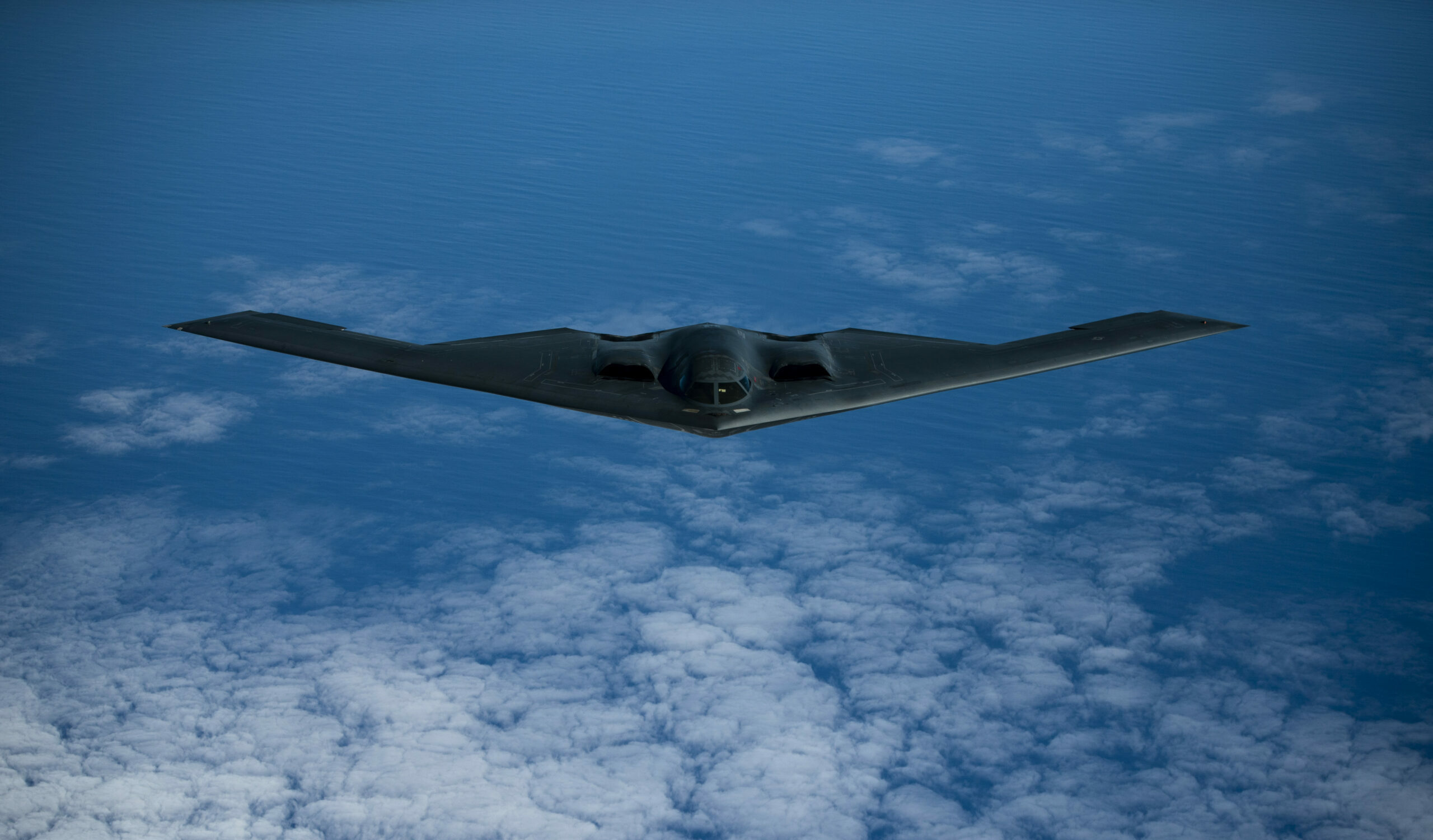
The B-2 Spirit, a long-range stealth strategic bomber operated by the United States Air Force, marks a significant innovation in military aviation. Rising from the Advanced Technology Bomber initiative during the late Cold War, it was developed by Northrop Grumman, drawing on historical designs of flying-wing aircraft. The B-2’s stealth capabilities revolutionized strategic bombing, allowing missions that once required sizable strike packages to be executed by this single, highly advanced platform.
Designed specifically to penetrate sophisticated air defenses, the B-2’s features include a flying-wing design and radar-absorbing materials, granting it minimal radar signature. This enables it to effectively deliver conventional and nuclear payloads at intercontinental distances, making it a critical component of the US strategic nuclear triad.
Notable specifications include a wingspan of 172 feet and a maximum takeoff weight of 336,500 pounds, powered by four General Electric F118-GE-100 turbofan engines that enable a high subsonic speed with an unrefueled range of approximately 6,000 nautical miles. The aircraft can carry up to 40,000 pounds of ordnance, including Joint Direct Attack Munitions (JDAMs) and precision-guided munitions.
The B-2 Spirit was publicly unveiled on November 22, 1988, and subsequently made its first flight in July of the following year. Its operational capabilities were officially realized with its first combat deployment during Operation Allied Force in 1999. The aircraft has since participated in various missions, including robust operations over Afghanistan and Iraq, where it demonstrated its capacity to deliver substantial amounts of munitions.
To maintain its relevance in the face of evolving air defenses, the B-2 has not undergone multiple configurations but rather continuous modernization, focusing on enhancing systems such as radar and communications. This approach ensures that the limited number of B-2s—the fleet comprises only 20 operational units—retains its effectiveness as threats evolve.
With notable strengths like exceptional stealth and long-range capabilities, the B-2 has established a reputation as a first-day-of-war strike platform, capable of hitting heavily defended targets. However, its low availability due to a small fleet size and high cost per aircraft are recognized limitations. Additionally, maintaining its stealth coatings requires intensive upkeep, which constitutes a substantial part of its operational readiness.
The B-2 has demonstrated its versatility in various conflicts, from precision strikes in the Kosovo War to deep penetration missions against fortified positions in Libya. Its operational role has underscored global power projection and deterrence, reinforcing its stature in military strategy.
Looking ahead, the B-2 Spirit is projected to remain in service into the 2030s, even as it transitions to the next generation of stealth bombers, notably the Northrop Grumman B-21 Raider. Improvement trends will include enhanced avionics, communications, and integration with advanced warfare architectures, ensuring the B-2 continues to serve as a benchmark in stealth bomber design long into the future.


