




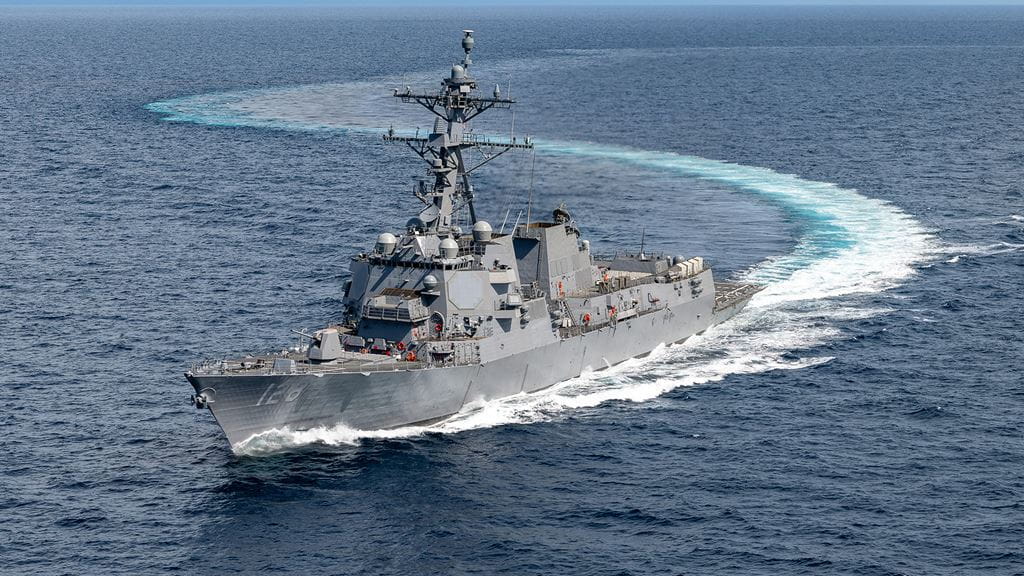
The U.S. Navy has made a significant move by awarding Raytheon a $515 million contract aimed at further supporting the integration and production of the SPY-6 family of radars. This contract comes as a follow-on to a previous $536 million agreement issued in June 2025. It specifically focuses on upgrading the U.S. Navy’s Flight IIA destroyers with the advanced SPY-6(V)4 radar variant.
In addition to enhancing U.S. naval capabilities, the new contract also addresses the future integration and support of SPY-6 radars on Germany’s upcoming F127 air-defense frigates. Importantly, there is an option included that allows for the addition of other countries that may choose to adopt this radar system.
Barbara Borgonovi, president of Naval Power at Raytheon, emphasized the radar’s capabilities, stating that “with over a decade of demonstrated success at sea, SPY-6 remains the U.S. Navy’s most advanced maritime radar.” She highlighted that the radar provides unparalleled sensing power and multi-mission readiness to counter evolving threats. To support this ambitious production plan, Raytheon is backing an $800 million investment aimed at modernizing its radar manufacturing facilities, with expectations to double SPY-6 output by 2028.
The SPY-6 radar family encompasses four distinct variants designed to provide comprehensive 360-degree coverage against a range of threats, including cruise missiles, ballistic missiles, aircraft, surface threats, and electronic warfare attacks. The SPY-6(V)1 variant, intended for Flight III destroyers, features four arrays equipped with 37 radar module assemblies (RMAs) each, while the SPY-6(V)4 variant for Flight IIA destroyers utilizes four arrays with 24 RMAs each. Both variants are adept at supporting air and missile defense as well as electronic warfare missions.
For vessels requiring different specifications, the SPY-6(V)2, designed for amphibious assault ships and Nimitz-class aircraft carriers, features a single rotating array, whereas the SPY-6(V)3, tailored for Ford-class carriers, incorporates three fixed arrays.
Currently, the SPY-6 radar system is installed on two commissioned U.S. Navy ships and is being tested on an additional eleven. Over the next decade, this advanced radar system is expected to be deployed on more than 50 U.S. Navy vessels, significantly enhancing their capabilities to defend against diverse threats spanning air, surface, ballistic missile, and electronic warfare domains.


