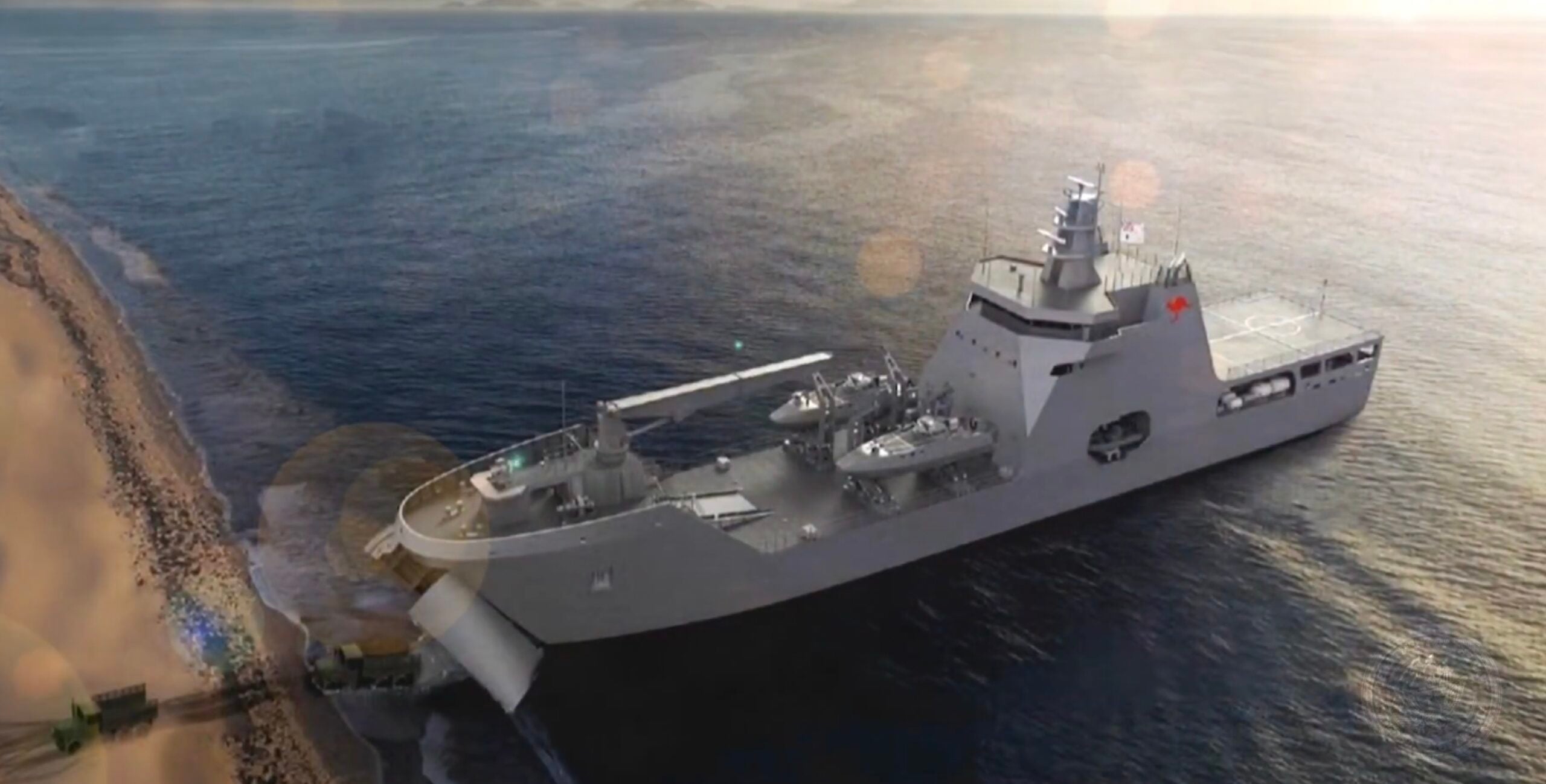
The United States Navy has confirmed the selection of Damen Shipyards’ LST-100 design as its future medium landing ship, marking a significant advancement after a year-long reassessment of the program. This decision was unveiled in a video statement from Navy and Marine Corps leaders and is part of a broader effort to reform how the armed services acquire maritime vessels, prioritizing speed, cost-effectiveness, and real-world operational readiness.
Secretary of the Navy John Phelan approved the LST-100 design late last year, emphasizing its potential for rapid deployment and reduced risk as compared to earlier, more customized concepts. Phelan articulated that this choice represents a transformative shift in naval shipbuilding practices, aiming to ensure that new ships are not only operationally effective but also financially responsible.
Phelan noted, “We are fundamentally reshaping how the Navy builds and fields its Fleet. Today, I’m taking the second major step in that effort: selecting the design for our Medium Landing Ship, an operationally driven, fiscally disciplined choice that puts capability in the Fleet.”
In this initiative, the Navy will implement a full 3D design alongside a standardized equipment layout, aimed at ensuring both long-term maintainability and reliability. The service aims to mitigate technical risks and accelerate construction timelines through a build-to-print methodology that is influenced by commercial practices. A vessel construction manager will be competitively awarded to oversee the project’s execution, while multiple U.S. shipyards will vie for the production aspects of the new ships.
According to reports, the Navy has invested $3.3 million in Damen for the technical data package associated with the LST-100 design. This selection follows the previous cancellation of initial Medium Landing Ship proposals deemed financially unsustainable. Admiral Daryl Caudle, Chief of Naval Operations, remarked that the Navy reassessed existing hull designs meeting Marine Corps requirements to gauge their producibility and cost effectiveness.
The LST-100 has been designed as a compact, ocean-going landing ship optimized for amphibious lift, logistics, and operations in coastal areas. With a length of approximately 100 meters (328 feet) and a displacement of around 4,000 tons, the ship is capable of transporting troops, vehicles, ammunition, and supplies directly onto unpaved beaches via its bow ramp.
Furthermore, the LST-100 boasts an impressive operational range of over 3,400 nautical miles (3,912 miles/6,296 kilometers), positioning it strategically between larger amphibious assault vessels and smaller transports. This makes it particularly suitable for distributed operations in contested maritime environments.
Naval Sea Systems Command has identified the non-developmental design of the LST-100 as crucial in rapidly delivering this needed capability. Marine Corps Commandant General Eric Smith underscored the operational significance of the medium landing ship, describing it as vital for maintaining mobility in the Indo-Pacific and other areas facing strategic challenges.
In terms of partnership, Damen Shipyards has played an integral role in the U.S. military’s maritime initiatives in recent years. The firm has supplied designs and technical expertise for various U.S. and allied vessel programs. The U.S. Navy has previously utilized Damen’s platforms, including the Stan Patrol, for maritime security tasks in regions such as the Caribbean and West Africa. Additionally, this collaboration has extended to the U.S. Coast Guard’s fast response cutters.
Since the mid-1990s, Damen’s technical cooperation and licensing arrangements have supported the construction of over 200 vessels in the United States, further solidifying the partnership between the shipyard and U.S. naval operations.