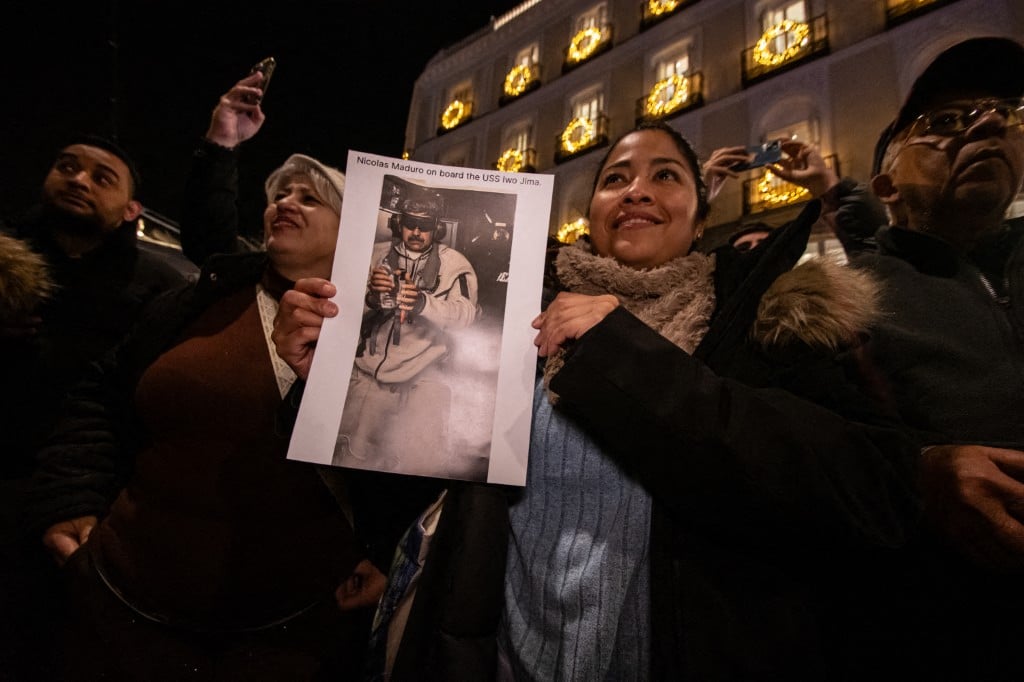
Venezuelan President Nicolas Maduro found himself in a New York jail on Saturday, following a dramatic military operation in which American special forces apprehended him and his wife in Caracas. The U.S. President announced that Venezuela would soon come under effective U.S. control, marking a significant escalation in the U.S. approach to the South American nation.
The pre-dawn operation involved commandos seizing Maduro while air strikes targeted various strategic locations around the capital. The ensuing chaos witnessed explosions and military activity that lasted almost an hour, leaving the city in an eerie silence shortly thereafter. A U.S. government plane flew Maduro to a military base, where he was subsequently transported by helicopter to New York City for arraignment on charges related to drug trafficking and weapon possession.
Footage released by the White House showcased Maduro in handcuffs, wearing sandals and flanked by federal agents. Reportedly, he greeted his captors with a sarcastic, “Good night, happy new year,” in English.
While the operation was deemed successful, uncertainties loomed over the future governance of Venezuela. Trump announced plans to appoint officials from his cabinet to oversee the transition, indicating a readiness for ground troop deployment if necessary. Trump expressed skepticism about the possibility of U.S.-backed opposition leader Maria Corina Machado leading the nation, suggesting instead that he would consider working with Maduro’s vice president, Delcy Rodriguez. Rodriguez, however, quickly countered by demanding the release of Maduro, asserting her commitment to defending the country’s sovereignty.
Late on Saturday, Venezuela’s Supreme Court ordered Rodriguez to assume presidential powers on an acting basis. Confusion reigned, with Trump suggesting U.S. involvement would continue until a suitable government transition occurred. This decision has drawn criticism from international quarters; China condemned the U.S. operation, and France highlighted the importance of an internally-achieved solution.
United Nations Secretary-General Antonio Guterres expressed deep concern over the situation, emphasizing that international law had not been adhered to. In response to Venezuela’s request, the UN Security Council is set to convene to discuss the crisis on Monday.
Residents in Caracas had anticipated military actions after U.S. forces had positioned themselves off the coast in previous weeks. Maduro and his wife surrendered without resistance, according to U.S. military officials, who reported that there were no U.S. casualties during the operation. However, Trump claimed that many members of Maduro’s security, including Cuban nationals, may have been killed during the strikes.
The U.S. has long refused to recognize Maduro’s presidency, citing allegations of electoral fraud in both the 2018 and 2024 elections. Past statements from the Trump administration have indicated that controlling Venezuela’s vast oil reserves has been a central element of U.S. interests, with plans for U.S. oil companies to invest heavily in revamping the country’s failing infrastructure.
As the fallout continues, political ramifications and public reactions are expected to unfold both domestically and internationally, while the Venezuelan populace remains in a state of uncertainty and tension following the unprecedented military intervention.