




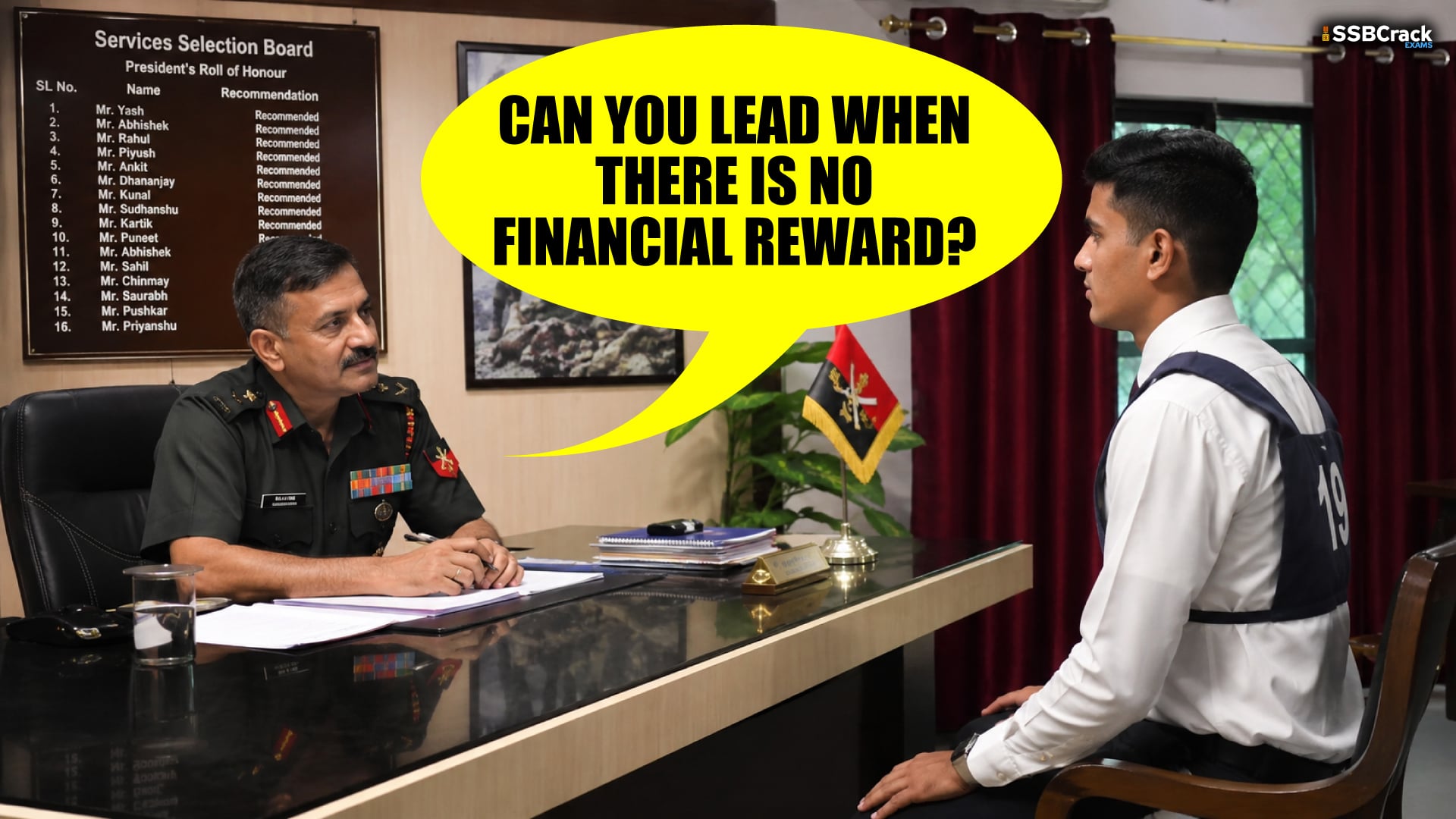
If you are a B.Com graduate preparing for the SSB Interview, remember that the assessors are not evaluating your knowledge of accounting alone. They want to understand how your academic background has shaped your thinking, decision-making ability, leadership potential, and understanding of responsibility. Commerce graduates often possess strong analytical, organizational, and management skills, all of which are valuable qualities for a future officer in the Armed Forces.
Here are 20 important SSB Interview questions specifically designed for B.Com graduates, along with the purpose behind each question, guidance on answering it, and sample responses.
1. Why did you choose B.Com as your graduation course?
Why It Is Asked
To understand your academic interests and decision-making process.
How to Answer
Explain your genuine interest in commerce, business, economics, or management.
Sample Answer
“Sir, I chose B.Com because I was interested in understanding how businesses function, how financial decisions are made, and how economic systems influence organizations and society.”
2. After studying commerce, why do you want to join the Armed Forces?
Why It Is Asked
To assess your motivation and career clarity.
How to Answer
Connect your commerce background with leadership and service.
Sample Answer
“Sir, commerce helped me develop analytical and management skills, but I have always been attracted to leadership, discipline, adventure, and service to the nation. The Armed Forces provide an opportunity to lead people while contributing meaningfully to national security.”
3. How can a B.Com graduate contribute to the Armed Forces?
Why It Is Asked
To assess your awareness of your strengths.
How to Answer
Highlight management, planning, and organizational skills.
Sample Answer
“A commerce graduate develops planning, analytical thinking, resource management, and organizational abilities. These skills can contribute to administration, logistics, and leadership roles within the Armed Forces.”
4. What is the most important lesson you learned from studying commerce?
Why It Is Asked
To understand how you apply academic learning.
How to Answer
Choose a lesson relevant to leadership or management.
Sample Answer
“One important lesson is that resources are always limited, and success depends on how effectively they are planned and utilized.”
5. If you were managing a military unit’s budget, what would be your first priority?
Why It Is Asked
To evaluate judgment and responsibility.
How to Answer
Balance operational efficiency and personnel welfare.
Sample Answer
“My first priority would be ensuring operational readiness while taking care of the welfare and essential requirements of personnel.”
6. Which subject in B.Com did you enjoy the most and why?
Why It Is Asked
To understand your interests and communication ability.
How to Answer
Choose honestly and explain your reasons.
Sample Answer
“I enjoyed Financial Management because it involves strategic planning, decision-making, and evaluating alternatives to achieve organizational goals.”
7. Tell me about a situation where you had to manage limited resources.
Why It Is Asked
To assess practical management skills.
How to Answer
Share a real-life example.
Sample Answer
“While organizing a college event, our budget was limited. We prioritized essential expenses, sought sponsorships, and completed the event successfully without exceeding the budget.”
8. What is more important: Profit or Purpose?
Why It Is Asked
To assess your values and reasoning.
How to Answer
Provide a balanced perspective.
Sample Answer
“Both are important. Profit ensures sustainability, while purpose provides direction and meaning. Long-term success requires a balance between the two.”
9. If you were the Finance Minister for a day, what is one change you would introduce?
Why It Is Asked
To assess awareness and initiative.
How to Answer
Suggest a practical and impactful reform.
Sample Answer
“I would focus on strengthening financial literacy programs so that citizens can make informed financial decisions from an early age.”
10. What does leadership have in common with business management?
Why It Is Asked
To assess conceptual understanding.
How to Answer
Focus on people and objectives.
Sample Answer
“Both involve planning, communication, decision-making, resource allocation, and motivating people to achieve common goals.”
11. If your team achieves excellent results but uses unethical methods, would you accept it?
Why It Is Asked
To assess integrity and values.
How to Answer
Prioritize ethics over outcomes.
Sample Answer
“No, sir. Success achieved through unethical means is unsustainable and damages trust. Integrity should never be compromised.”
12. What is the biggest economic challenge facing India today?
Why It Is Asked
To assess awareness and analytical thinking.
How to Answer
Support your opinion logically.
Sample Answer
“I believe employment generation remains one of India’s biggest challenges because economic growth should create meaningful opportunities for the country’s large population.”
13. If you had to choose between a highly talented employee and a highly trustworthy employee, whom would you choose?
Why It Is Asked
To understand your priorities as a leader.
How to Answer
Explain your reasoning clearly.
Sample Answer
“I would choose the trustworthy employee because skills can be improved through training, but trust is essential for teamwork and leadership.”
14. What would your classmates say is your strongest management skill?
Why It Is Asked
To assess self-awareness.
How to Answer
Use genuine feedback from others.
Sample Answer
“My classmates would probably describe me as organized and dependable, especially when managing group assignments and college activities.”
15. During a group project, two members refuse to cooperate. What would you do?
Why It Is Asked
To assess conflict resolution ability.
How to Answer
Emphasize communication and teamwork.
Sample Answer
“I would understand both viewpoints, encourage open discussion, identify common objectives, and help the group reach a practical solution.”
16. If given ₹1 crore to invest for the welfare of your community, how would you use it?
Why It Is Asked
To assess social awareness and planning ability.
How to Answer
Focus on sustainable development.
Sample Answer
“I would invest in education, skill development, and entrepreneurship programs to create long-term opportunities within the community.”
17. Which is more dangerous for an organization: Poor Planning or Poor Leadership?
Why It Is Asked
To assess judgment.
How to Answer
Provide logical reasoning.
Sample Answer
“Poor leadership is more dangerous because even a good plan can fail without proper execution, guidance, and motivation.”
18. If your entire academic record disappeared tomorrow, how would you prove your worth?
Why It Is Asked
To assess confidence beyond academics.
How to Answer
Highlight personal qualities and experiences.
Sample Answer
“I would rely on my communication skills, leadership experiences, work ethic, adaptability, and willingness to learn.”
19. What is one business principle that can be applied to military leadership?
Why It Is Asked
To assess interdisciplinary thinking.
How to Answer
Choose a principle relevant to leadership.
Sample Answer
“Efficient resource management is equally important in business and military leadership because success depends on making the best use of available resources.”
20. Why should we recommend you as an officer candidate?
Why It Is Asked
To assess confidence and self-belief.
How to Answer
Summarize your strengths honestly.
Sample Answer
“Sir, I believe I possess discipline, responsibility, organizational ability, and a strong desire to serve the nation. I am willing to learn, adapt, and continuously improve myself to become an effective officer.”
Bonus Out-of-the-Box Questions for B.Com Graduates
If your life were a company, what would be its mission statement?
What It Reveals: Vision, ambition, and self-awareness.
If Officer Like Qualities were listed as assets and liabilities on a balance sheet, which asset would have the highest value in your account?
What It Reveals: Self-analysis and creativity.
Which is harder to earn: Money, Trust, or Respect?
What It Reveals: Values and maturity.
If you could audit one aspect of your personality, what would you improve?
What It Reveals: Self-awareness and a growth mindset.
If leadership were traded on a stock market, would people invest in you? Why?
What It Reveals: Confidence, credibility, and self-perception.
Special Tips for B.Com Graduates
Revise basic concepts of accounting, economics, taxation, and management.
Stay updated with current economic developments and government policies.
Highlight experiences involving planning, organization, and teamwork.
Connect commerce concepts with leadership, decision-making, and responsibility.
Demonstrate integrity, accountability, and resource management skills.
Remember that the Armed Forces assess your ability to lead people, not merely manage numbers.
Closing Statement
Your B.Com degree has equipped you with valuable skills in planning, analysis, organization, and decision-making. However, success in the SSB Interview depends not on your academic stream but on the officer-like qualities you demonstrate. Be confident, stay authentic, draw examples from your own experiences, and show the assessors that you possess the character, leadership potential, and sense of responsibility required of an officer in the Armed Forces. Jai Hind!


