




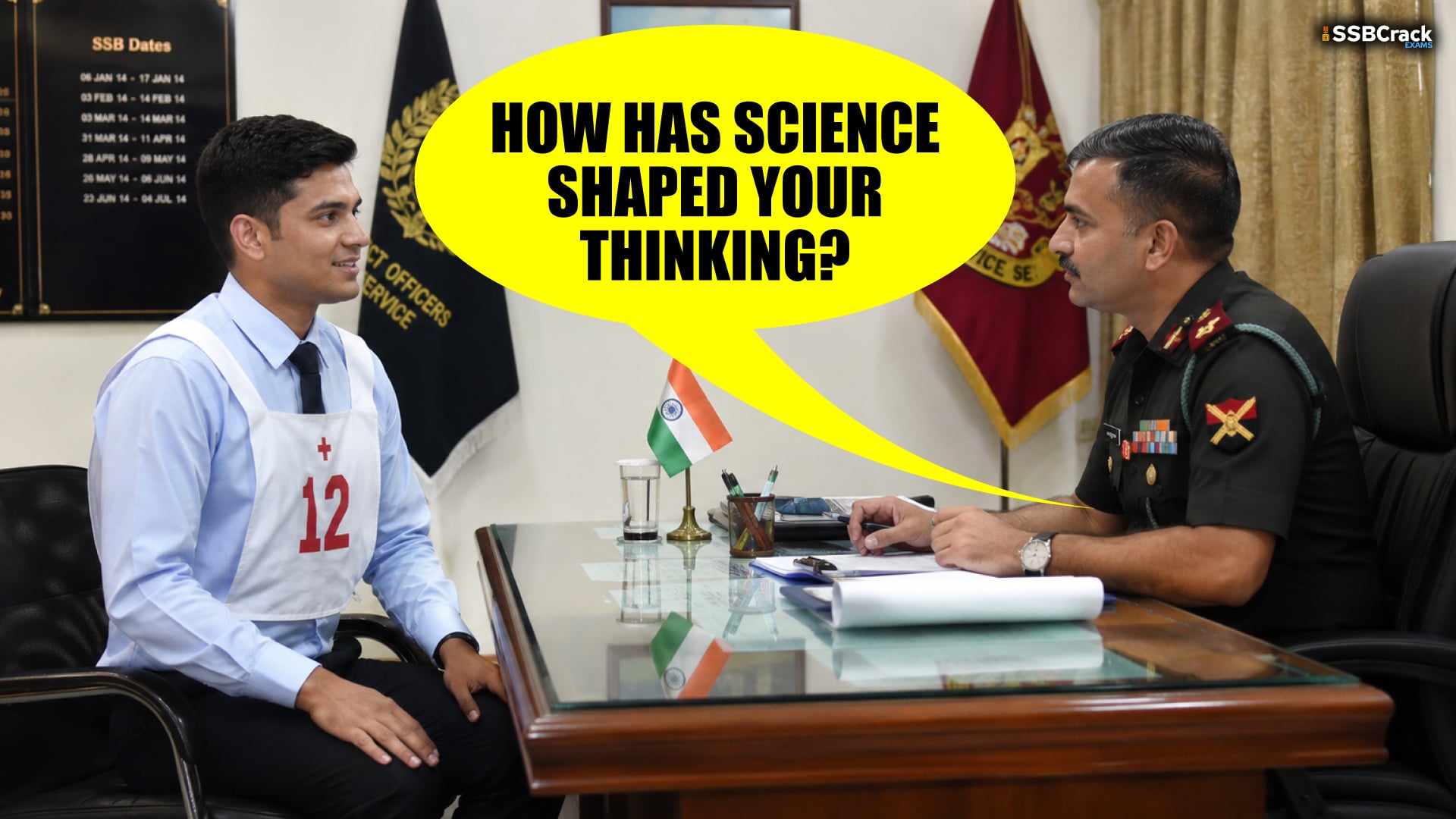
Are you a B.Sc graduate preparing for the SSB Interview? Remember that the interview is not just about your academic knowledge of science. The assessors are interested in understanding how your scientific mindset helps you think logically, solve problems, make decisions, and lead others. Your ability to connect classroom learning with real-life situations can make a strong impression during the interview.
1. Why did you choose B.Sc instead of professional courses like Engineering or Medicine?
Why It Is Asked
To understand your academic choices and decision-making process.
How to Answer
Explain your interests and career goals honestly.
Sample Answer
“Sir, I chose B.Sc because I have always been interested in understanding scientific concepts and natural phenomena. The course allowed me to develop analytical thinking and a strong academic foundation while exploring subjects I genuinely enjoy.”
2. How has studying science helped you become a better leader?
Why It Is Asked
To assess your ability to connect academics with leadership.
How to Answer
Focus on observation, analysis, and logical decision-making.
Sample Answer
“Science has taught me to approach problems systematically, analyze facts objectively, and make evidence-based decisions. These qualities are equally important for effective leadership.”
3. Which scientific discovery has inspired you the most and why?
Why It Is Asked
To evaluate curiosity and intellectual awareness.
How to Answer
Choose a discovery that genuinely interests you.
Sample Answer
“The discovery of vaccines inspires me because it demonstrates how scientific research can save millions of lives and transform societies.”
4. If you had to explain your graduation subject to a Class 5 student, how would you do it?
Why It Is Asked
To assess communication skills.
How to Answer
Simplify concepts without losing meaning.
Sample Answer
“As a Physics graduate, I would explain Physics as the study of how things move, why objects fall, and how energy helps us perform everyday tasks.”
5. Which practical experiment taught you the most important life lesson?
Why It Is Asked
To evaluate learning from experiences.
How to Answer
Relate the experiment to personal growth.
Sample Answer
“Repeated errors during laboratory experiments taught me that failure is often part of the learning process and that patience and accuracy are essential for success.”
6. Why do you want to join the Armed Forces after studying science?
Why It Is Asked
To assess motivation and commitment.
How to Answer
Link scientific skills with military leadership.
Sample Answer
“Sir, science has developed my analytical mindset, but I am equally passionate about leadership, adventure, and service to the nation. The Armed Forces provide the perfect platform to combine both.”
7. If your scientific hypothesis fails repeatedly, what would you do?
Why It Is Asked
To assess resilience and problem-solving ability.
How to Answer
Focus on persistence and adaptation.
Sample Answer
“I would review my assumptions, examine possible errors, seek feedback, and continue experimenting until I identify the root cause of failure.”
8. Which is more important in science and military leadership: Curiosity or Discipline?
Why It Is Asked
To evaluate judgment and reasoning.
How to Answer
Balance both qualities.
Sample Answer
“Both are important. Curiosity drives learning and innovation, while discipline ensures consistent execution. Success requires a combination of both.”
9. Tell me about a scientific concept that changed your way of thinking.
Why It Is Asked
To assess intellectual growth.
How to Answer
Choose a meaningful concept.
Sample Answer
“The concept of evolution taught me that adaptation is essential for survival and growth, a principle that applies to both individuals and organizations.”
10. If you were given unlimited funding for one scientific project, what would you work on?
Why It Is Asked
To assess vision and creativity.
How to Answer
Think practically and socially.
Sample Answer
“I would focus on affordable renewable energy technologies that can provide sustainable power to rural and remote areas.”
11. What is the biggest misconception people have about science students?
Why It Is Asked
To assess self-awareness and communication.
How to Answer
Give a balanced response.
Sample Answer
“Many people think science students focus only on academics, but scientific training also develops critical thinking, teamwork, and problem-solving abilities.”
12. If science and ethics come into conflict, which should take priority?
Why It Is Asked
To assess moral reasoning.
How to Answer
Emphasize responsible science.
Sample Answer
“Scientific progress should always be guided by ethical principles because technology without ethics can create serious societal problems.”
13. How would your laboratory partner describe you?
Why It Is Asked
To assess teamwork and self-perception.
How to Answer
Mention genuine qualities.
Sample Answer
“My laboratory partner would probably describe me as reliable, organized, and willing to help when problems arise during experiments.”
14. Which scientific field do you believe will have the greatest impact on future warfare?
Why It Is Asked
To assess awareness and strategic thinking.
How to Answer
Stay informed and practical.
Sample Answer
“I believe Artificial Intelligence and autonomous systems will significantly influence future warfare by enhancing decision-making, surveillance, and operational efficiency.”
15. What was the most difficult scientific problem you solved during graduation?
Why It Is Asked
To assess analytical ability.
How to Answer
Explain your approach.
Sample Answer
“While working on a research assignment, I faced inconsistent results. Through repeated testing and data analysis, I identified procedural errors and improved accuracy.”
16. If you discovered something that could benefit humanity but also be used for harm, what would you do?
Why It Is Asked
To assess ethics and responsibility.
How to Answer
Demonstrate balanced judgment.
Sample Answer
“I would ensure the discovery is regulated and used responsibly while working with relevant authorities to minimize misuse.”
17. What is one scientific principle that best describes your personality?
Why It Is Asked
To assess creativity and self-awareness.
How to Answer
Choose an appropriate analogy.
Sample Answer
“I would compare myself to the principle of adaptation because I can adjust to changing situations and learn from new experiences.”
18. If your scientific knowledge was erased tomorrow, what qualities would still make you successful?
Why It Is Asked
To assess confidence beyond academics.
How to Answer
Focus on personal strengths.
Sample Answer
“My discipline, communication skills, teamwork, determination, and willingness to learn would still help me succeed.”
19. What scientific question would you most like answered during your lifetime?
Why It Is Asked
To assess curiosity and imagination.
How to Answer
Choose a thought-provoking topic.
Sample Answer
“I would love to understand whether intelligent life exists elsewhere in the universe and how such a discovery would affect humanity.”
20. If you were a scientist on a remote military mission and a critical experiment failed, what would be your first action?
Why It Is Asked
To assess composure under pressure.
How to Answer
Show calm and systematic thinking.
Sample Answer
“I would remain calm, assess the situation, identify the cause of failure, evaluate available resources, and develop an alternative plan to achieve the objective.”
Bonus Out-of-the-Box Questions for B.Sc Graduates
If your life were a scientific experiment, what would be the objective?
What It Reveals: Purpose, self-awareness, and ambition.
Which law of science best describes human behavior?
What It Reveals: Observation and creativity.
If you could ask one question to any scientist in history, whom would you choose and what would you ask?
What It Reveals: Curiosity and intellectual interests.
If people came with instruction manuals like scientific instruments, what would yours say?
What It Reveals: Self-understanding and humor.
Which is more dangerous: Ignorance or Misuse of Knowledge?
What It Reveals: Ethical reasoning and maturity.
Special Tips for B.Sc Graduates
✅ Expect questions connecting science with leadership.
✅ Revise basic concepts from your graduation subjects.
✅ Be prepared to explain scientific ideas in simple language.
✅ Demonstrate curiosity, observation, and logical thinking.
✅ Relate laboratory experiences to teamwork and problem-solving.
✅ Show that you can apply scientific thinking to practical situations and leadership challenges.
Closing Statement
A B.Sc degree equips you with knowledge, analytical ability, and a scientific approach to solving problems. However, the SSB Interview goes beyond academics and evaluates your personality, leadership potential, and officer-like qualities. Use your scientific mindset to demonstrate clarity of thought, adaptability, teamwork, and sound judgment. When knowledge is combined with character and confidence, it creates the qualities of an effective military leader. Keep learning, stay curious, and move forward with determination toward your goal of becoming an officer. Jai Hind!


