




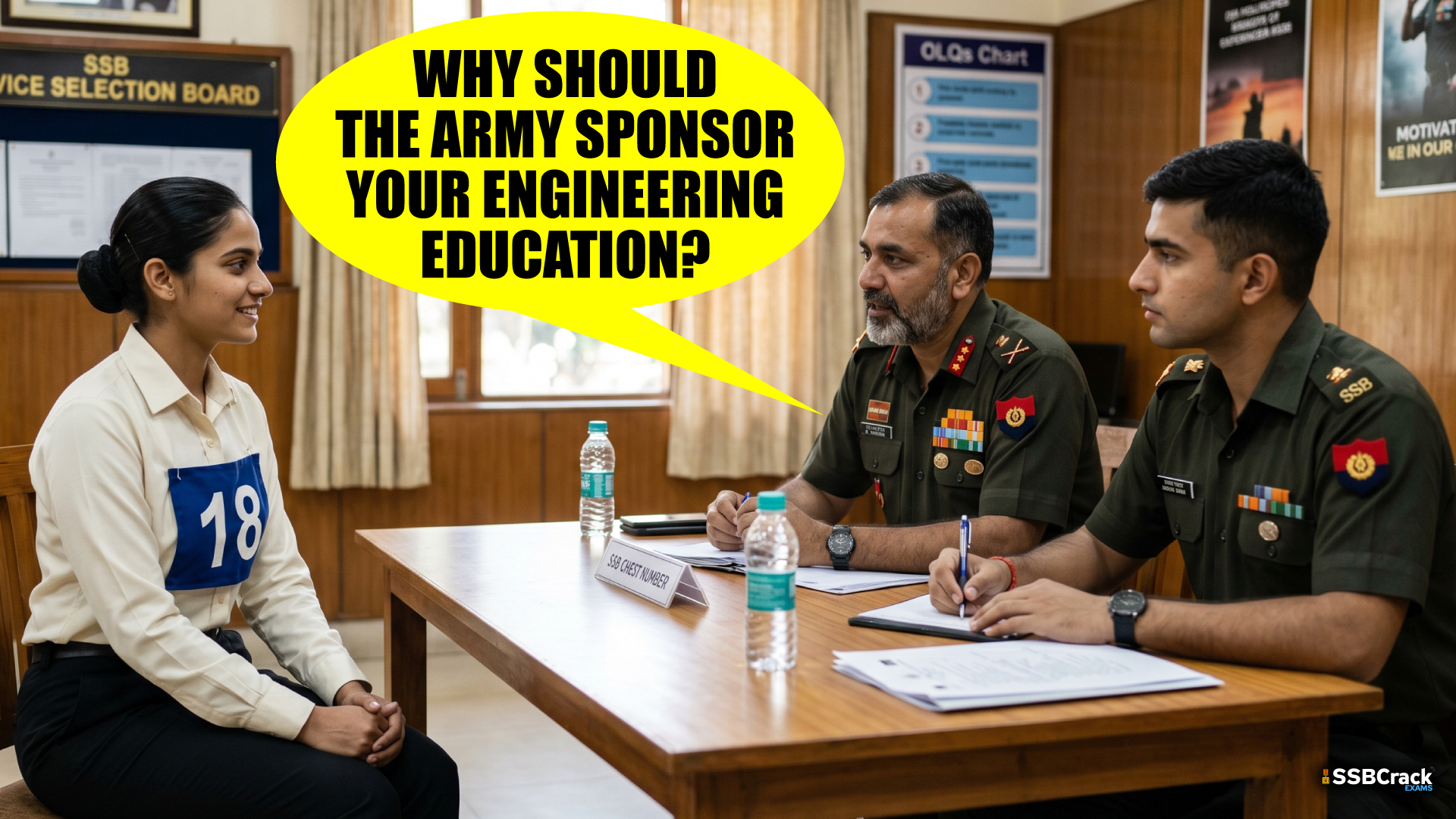
The Technical Entry Scheme, popularly known as TES, is one of the most prestigious entries into the Indian Army for science students after Class 12. Unlike many other entries, TES offers a unique opportunity to pursue technical education while simultaneously training to become an Army officer.
Many TES aspirants focus heavily on Physics, Chemistry, Mathematics, and technical knowledge. However, it is important to remember that the SSB Interview is not selecting engineers—it is selecting future Army officers. Your technical aptitude is important, but your personality, leadership potential, responsibility, communication skills, and Officer Like Qualities are equally important.
In this article, we will discuss 20 important interview questions frequently asked to TES candidates, understand why these questions are asked, learn how to answer them effectively, and examine sample responses that reflect the qualities expected in future technical officers of the Indian Army.
1. Tell me about yourself.
Why it is asked
To assess communication skills, confidence, self-awareness, and personality.
How to answer
Cover:
- Family background
- Education
- Hobbies
- Achievements
- Responsibilities
Sample Answer
“I am a Class 12 Science student with Physics, Chemistry, and Mathematics. I enjoy solving analytical problems, playing football, and participating in science exhibitions. Along with academics, I actively participate in team activities that have helped me develop leadership and teamwork skills.”
2. Why do you want to join TES?
Why it is asked
To assess motivation and understanding of the entry.
How to answer
Show interest in both technical and military aspects.
Sample Answer
“TES offers a unique opportunity to combine technical education with military leadership. I am interested in engineering and also aspire to serve the nation as an Army officer. TES perfectly aligns with both these goals.”
3. What do you know about TES?
Why it is asked
To assess preparation and seriousness.
How to answer
Know the basic training structure.
Sample Answer
“TES is an officer entry scheme for PCM students after Class 12. Selected candidates undergo military and technical training before being commissioned as officers in the Indian Army.”
4. Why Army and not a regular engineering college?
Why it is asked
To assess career motivation.
How to answer
Respect engineering careers while explaining your preference.
Sample Answer
“A regular engineering college provides technical education, but the Army offers technical expertise along with leadership opportunities, responsibility, adventure, and service to the nation.”
5. Why should we select you?
Why it is asked
To assess confidence and suitability.
How to answer
Link personal qualities with officer requirements.
Sample Answer
“I possess discipline, responsibility, adaptability, and a strong learning attitude. I enjoy challenges, work effectively in teams, and continuously strive to improve myself.”
6. What are your strengths?
Why it is asked
To assess self-awareness.
How to answer
Support strengths with examples.
Sample Answer
“My strengths are perseverance, teamwork, and analytical thinking. These qualities help me solve problems systematically and work effectively with others.”
7. What are your weaknesses?
Why it is asked
To assess honesty and improvement orientation.
How to answer
Mention a manageable weakness.
Sample Answer
“I sometimes spend extra time verifying details before finalizing a task. I am working on balancing accuracy with efficiency.”
8. Why did you choose Science with PCM?
Why it is asked
To assess academic interests.
How to answer
Explain genuine reasons.
Sample Answer
“I have always enjoyed mathematics and problem-solving. Physics helped me understand practical applications of scientific concepts, which increased my interest in technical fields.”
9. Which subject do you like most and why?
Why it is asked
To assess academic inclination.
How to answer
Explain with practical examples.
Sample Answer
“I enjoy Physics because it explains how things work in the real world and encourages logical thinking and problem-solving.”
10. Which subject do you find difficult?
Why it is asked
To assess honesty and self-awareness.
How to answer
Accept difficulty while showing effort.
Sample Answer
“Initially, I found Organic Chemistry challenging. However, through regular practice and concept-based learning, I improved significantly.”
11. Tell me about a leadership experience.
Why it is asked
To assess leadership potential.
How to answer
Use a real example.
Sample Answer
“I led a team during a science exhibition project where I coordinated research, task allocation, and presentations. Our project was completed successfully and appreciated by teachers.”
12. What responsibilities do you have at home?
Why it is asked
To assess maturity and responsibility.
How to answer
Mention actual responsibilities.
Sample Answer
“I help manage household errands, assist younger family members with studies, and contribute whenever family responsibilities arise.”
13. What are your hobbies?
Why it is asked
To assess personality beyond academics.
How to answer
Mention genuine hobbies.
Sample Answer
“I enjoy football, reading technology-related articles, exercising, and participating in outdoor activities.”
14. What is your biggest achievement?
Why it is asked
To assess goal orientation and effort.
How to answer
Choose an achievement involving commitment.
Sample Answer
“My biggest achievement was securing a top position in a district-level science competition after extensive preparation and teamwork.”
15. Tell me about a failure and what you learned.
Why it is asked
To assess resilience and learning ability.
How to answer
Focus on lessons learned.
Sample Answer
“I once performed poorly in a mathematics test due to inadequate preparation. The experience taught me the importance of consistent effort and effective time management.”
16. What qualities should an Army officer possess?
Why it is asked
To assess understanding of military leadership.
How to answer
Mention practical OLQs.
Sample Answer
“An Army officer should possess integrity, courage, responsibility, teamwork, leadership, emotional stability, initiative, and determination.”
17. What would you do if your team disagreed with your idea?
Why it is asked
To assess teamwork and flexibility.
How to answer
Show openness to discussion.
Sample Answer
“I would listen to their viewpoints, evaluate all alternatives objectively, and support the best solution for the team’s objective.”
18. How do you handle pressure before examinations?
Why it is asked
To assess emotional stability.
How to answer
Mention practical strategies.
Sample Answer
“I follow a study schedule, prioritize important topics, take short breaks, and maintain physical activity to remain focused and calm.”
19. If not selected for TES, what will you do?
Why it is asked
To assess resilience and planning.
How to answer
Remain positive and practical.
Sample Answer
“I will continue pursuing engineering education, improve my shortcomings, and prepare for future defence entry opportunities because my goal of serving the nation remains unchanged.”
20. What does becoming an Army officer mean to you?
Why it is asked
To assess understanding of military responsibility.
How to answer
Focus on leadership and service.
Sample Answer
“Becoming an Army officer means accepting responsibility for people, leading by example, making decisions under pressure, and serving the nation with dedication and integrity.”
Technical Questions Frequently Asked to TES Aspirants
Apart from personality-based questions, TES candidates may face simple technical questions from Class 11 and 12 PCM subjects.
Physics
- What is Newton’s Second Law?
- Explain Ohm’s Law.
- What is electromagnetic induction?
Mathematics
- What is differentiation?
- What is probability?
- Explain the concept of limits.
Chemistry
- What is pH?
- Difference between ionic and covalent bonds?
- What is oxidation and reduction?
Tip
The interviewer is usually more interested in your understanding than in memorized definitions.
What Assessors Look for in TES Candidates
✔ Officer Like Qualities (OLQs)
- Effective Intelligence
- Reasoning Ability
- Initiative
- Self-Confidence
- Organizing Ability
- Responsibility
- Cooperation
- Social Adaptability
- Determination
- Courage
✔ Technical Aptitude
Basic scientific curiosity and logical thinking.
✔ Leadership Potential
Ability to influence and guide others.
✔ Learning Ability
Willingness to acquire new knowledge and skills.
✔ Discipline
Ability to follow routines and responsibilities consistently.
Common Mistakes TES Aspirants Make
❌ Focusing only on technical knowledge.
❌ Ignoring personality development.
❌ Giving memorized answers.
❌ Exaggerating achievements.
❌ Claiming leadership without examples.
❌ Becoming nervous when technical questions are asked.
❌ Pretending to know answers instead of honestly admitting limitations.
Interview Answer Formula
For experience-based questions:
Situation → Action → Result → Learning
Example:
“Our science project team faced time constraints. I coordinated schedules, redistributed tasks, and monitored progress. The project was completed successfully, and I learned the importance of planning and teamwork.”
Final Advice for TES Aspirants
Remember that TES is a technical entry, but the Indian Army is primarily selecting future officers. Technical knowledge can be taught and improved during training, but qualities such as responsibility, leadership, courage, teamwork, and integrity must already be visible in your personality.
Focus on becoming a responsible student, a supportive teammate, an effective communicator, and a disciplined individual.
Conclusion
Success in the TES SSB Interview is not determined by how many Physics formulas or Mathematics concepts you remember. It is determined by the personality you have built through your education, responsibilities, teamwork, and daily actions.
The Indian Army seeks young individuals who possess both technical potential and officer-like qualities. If you combine scientific curiosity with leadership, discipline, responsibility, and a genuine desire to serve the nation, you will significantly strengthen your chances of success.


