




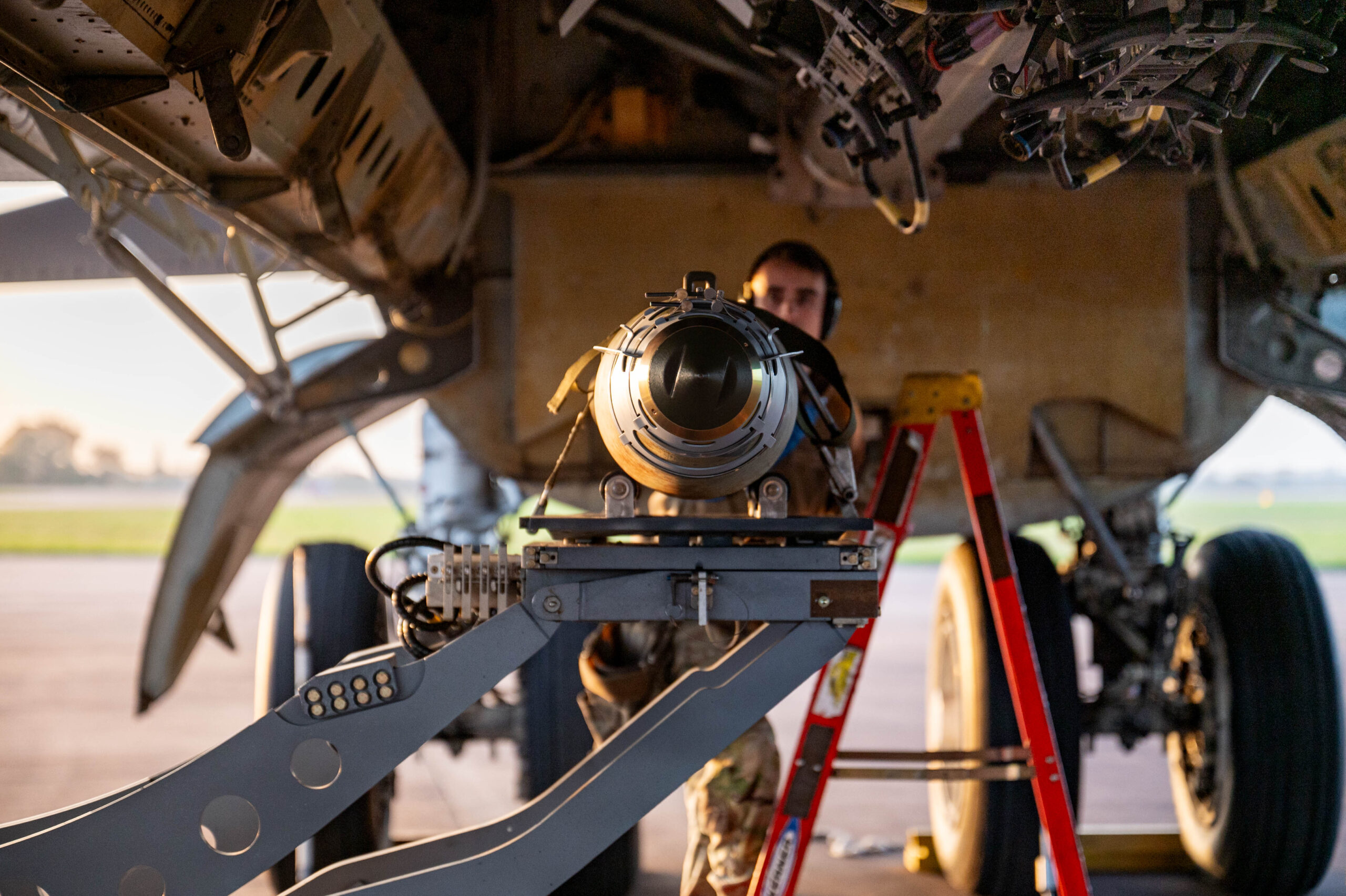
In the late 1990s, the United States faced a significant challenge with large stockpiles of unguided bombs, prompting engineers to devise an economical solution that would enhance precision without the need for entirely new bomb designs. The result was the GBU-38 Joint Direct Attack Munition (JDAM), a bolt-on tail kit that transformed traditional gravity bombs into GPS-guided munitions.
Originally intended as a cost-cutting measure, the JDAM has evolved into one of the most dependable precision weapons utilized in contemporary air warfare. The GBU-38, specifically a 500-pound variant from the JDAM family, converts existing general-purpose bomb designs into precise, GPS-guided weapons capable of hitting targets accurately across various weather conditions.
This innovation stemmed from insights gained during the 1991 Gulf War, where adverse weather limited the use of laser-guided munitions, and unguided bombs proved ineffective from medium and high altitudes. Initiated in 1992, the research culminated in the first JDAM guidance kits being introduced in 1997, leading to broad integration across U.S. Air Force and Navy platforms, and even exports to allied nations.
The GBU-38 leverages a tail-control unit combined with GPS and inertial navigation systems (INS) to navigate to its target. Prior to deployment, aircraft initialize the weapon’s navigation based on their starting position, while target coordinates can be pre-loaded, adjusted mid-flight, or received dynamically from onboard sensors. This integration allows for remarkable accuracy; under optimal conditions, JDAMs are capable of hitting targets within approximately 16 feet, and maintain an error margin of roughly 98 feet when GPS is unavailable.
The JDAM can be deployed in various flight profiles, including low-altitude releases, dives, and straight-and-level drops. Multiple GBU-38s can be directed at various targets within a single pass, enhancing operational flexibility. The predominant reliance on GPS for midcourse adjustments allows the JDAM to achieve a circular error probability of tens of meters, significantly improving striking accuracy compared to unguided munitions, particularly in adverse weather or nighttime operations.
Some variants of the JDAM also feature a laser seeker, enabling engagements of moving or precisely designated targets by homing in on laser-designated points, thereby combining satellite navigation with terminal laser guidance.
Strategically, the introduction of JDAMs, particularly the GBU-38, has significantly altered the approach of air forces towards precision strikes. By repurposing existing general-purpose bombs into GPS-guided munitions, military forces have gained a low-cost, adaptable strike option that remains effective regardless of weather conditions and enhances standoff capabilities beyond traditional free-fall bombs. This adaptation has resulted in a reduction in the number of sorties required to achieve strategic objectives, decreasing risks for aircrew and simplifying logistics relative to acquiring large quantities of specialized guided missiles.
The JDAM’s modular, software-oriented design positions it well for future upgrades, including enhancements to GPS anti-jamming technologies, tighter INS integration, and advanced terminal seekers. As military operations adapt to increasingly contested environments, the GBU-38 continues to be a reliable, cost-efficient asset for precision strikes, showcasing versatility and a clear path for future advancements in guided munitions.


